DIY Parents: Getting Ready for the Big Move…Before You Move

By Smith Banfield

Moving into a new apartment can be overwhelmingly stressful—especially when you’ve add kids to the already chaotic mix. To figure out how to mitigate some of the horror, we asked styling consultant Smith Banfield of Clear Space in New York City for her top survival tips.

1. When you move, you’re stepping into the future—but not everything you own needs to go there with you, because most of that stuff is from your past. Before you just empty drawers into packing boxes, take some time to go through everything and really assess if you have to bring it along into your new, and doubtless limited, space. That having been said, don’t make those decisions for anyone but yourself. My mother was really harsh with me about things she’d bought me that were expensive and she thought we should keep, but ultimately, she decided what was important to me as a child rather than letting me decide. So, don’t force your children to keep anything they don’t want. If you think it’s worth saving, donate it to another family that can’t afford it. And if your child really feels she needs to hang on to something, let her make that decision.

2.  Categorize things before you move! There are boxes that you know will live in certain rooms, so you can transfer things from the old kitchen to the new kitchen; if you have comparable space in the new place, you can even transfer things from the top kitchen drawer, the middle kitchen drawer, and so on—mark all your boxes clearly with the room and its place in the room. You may need to modify this if you’re moving into a smaller space. And you should definitely throw away anything item you wouldn’t purchase tomorrow if you found it in its current condition at a garage sale—like a disintegrating spatula. Curate! So many people who say, “I’ll deal with it later,” then they wind up with a pile of boxes in a room that soon becomes invisible, and you put a lamp on it. It’s self-sabotaging, when what you really want when you move is to step into a new life, with a clean slate.

3.  Take the time to measure every inch of your new space before you move in, and then take a hard look at the furniture you have, so you don’t move a bulky couch that’s not going to fit through the door—because remember, everything you put on the moving truck increases the cost. What I do is take blue painters tape and tape it down on the floor where I think any object is going to go. If it looks like a tight fit, like the king bed is not going to fit in the bedroom, you can decide to buy a smaller bed. It’s also important to slow down and analyze your space once you’ve actually moved all your stuff into it. Before you do a huge redesign, live in the space for six months, so you and your family will learn your habits in terms of how you use it. I know you want everything to be perfect, but it is a process. That goes for painting the walls, too. You can have your landlord put up a fresh coat of white paint, and then wait and see what the lighting is like at night, or in winter; this avoids the mistake of deciding on a pretty blue for the dining room, only to discover that there’s not a lot of light coming in in December and the blue just looks depressing. It might take an entire year for you to feel like you’re completely settled in. But that’s okay!

Crafty Kids: How to Make Beaded Key Fobs

The title of this craft begs the questions: what exactly is a fob, and why on earth would any kid want to make one (aside from the fact, of course, that they’re really pretty)?

Traditionally—meaning, in the late 19th century—a fob was a decorative chain that attached your pocket watch to your person. Since not many folks wear pocket watches anymore, the craft is reimagined here by our friends at Crafting Community as a decoration for a key. And as every kid knows, getting your own key to the house is an enormous rite of passage, one that symbolizes a surge in responsibility as well as a parent’s recognition of it.

Why make a key fob? To celebrate that oh-so-important key and make it look as important as it really is. Not to mention, help your kid find it in her cluttered backpack!

What you’ll need:

Plastic lacing
Scissors
Metal clips
Pony beads in assorted colors

1. Start with about 6 feet of plastic lacing, fold it in half, and put it on a metal clip.

2. Thread your first bead onto one end of the cord, then thread the other end of the cord through the opposite side of the bead.

3. Begin your design by adding the next row of beads. To do this, slip on 2 beads to the right half of the lacing and then thread the left side of lacing through both beads.

4. Continue to increase or decrease by 1 bead each row until your design takes shape. Once your design is finished, make a knot and hide the little ends under the last row of beads. Now it’s time to hook on that key!

How to Help Kids Deal With Rejection

Girl being left out

By Denise Daniels

If your child has ever been left out on the playground, left un-picked for a sports team, or overlooked for the school play, you understand the heartbreak and humiliation of rejection. Being snubbed is painful, especially for younger children, who lack experience with and perspective on peer relationships and haven’t yet developed the socialization skills necessary to navigate the complex world of emotions.

When kids feel rejected or are left out, they don’t feel important or valued, accepted or wanted.  They may try to avoid certain situations that could cause them pain, missing out on enriching opportunities that would make them happy and fulfilled. Studies show that kids who experience consistent rejection can have lower self-esteem and anxiety, which can lead to depression and other emotional problems. Which means, early intervention is key! Learning new social and emotional skills can help children feel more competent and confident trying to fit in with peers.

So how can we teach kids to cope with rejection?  First of all, by teaching them to understand and manage their emotions.  Emotional awareness gives us important information about what we are experiencing and helps us know how to react.  It also helps us build stronger relationships.  When I work with kids, I tell them that there are no right or wrong feelings, that all feelings are okay!  Some feelings are big and some are small.  Your child can even rate on a scale of I to 10 how she is feeling.  It’s always good to think about how we feel about ourselves and our situation.

Here are some tips for accomplishing all this:

1. If your child has been rejected, try not to minimize or be dismissive of her feelings. Listen with empathy and validate her feelings, so she knows that you understand.  You can even share a time when you felt left out, and reassure her that even grow-ups feel rejection from time to time.

2. If your child is feeling left out, acknowledge it! Instead of denying that anything is wrong, encourage her to think about how normal it is to feel that way given what she has experienced.

3. Help her voice what she is feeling.  Sometimes younger kids need help finding words to express themselves because they lack a vocabulary for feelings.  It’s okay for your child to say, “I felt really bad when I wasn’t picked for the team because all my friends got picked and I didn’t.” You can also encourage her to talk to a friend or someone who cares about her and who is a good listener.

4. Don’t let her dwell on her rejection. Instead, help her think positively and use “self-talk” to help get her over it and move on. Helping her thing about what she does well and what’s good about her can help ease the pain and start to rebuild her confidence. Then she can keep it in perspective by seeing that there will be other opportunities for her.  Yes, being rejected can hurt but it isn’t the end of the world!

Eat, Play, Sleep

By Susan Maushart

In a recent Australian study, four in ten mothers describe dinner as an “unpleasant experience,” with the meal usually ending in an argument. At the same time, 76 percent agree that sit-down meals strengthen the family’s communication (and possibly its vocal chords), according to a recent survey of more than 16,000 mothers nationwide. Contradiction? Not necessarily.

Maybe the experience of being together as a family is a bit like eating your spinach. As Popeye might have observed, that which doesn’t kill us makes us stronger. Like it or not—and clearly four out of ten of us don’t—family meals are consistently correlated with positive outcomes for children. And not just slightly positive outcomes. Ridiculously positive ones. Kids who eat family meals five to seven times a week get better grades, have a sunnier outlook on life, have significantly fewer problems with drugs, alcohol, or nicotine, and seem almost magically protected from developing eating disorders. They also—surprise!—have healthier diets. Recent research from the Department for Children, Schools and Family found a direct link between frequency of family meals and high school leaving scores, while a study published in the Journal of Adolescent Health in 2008 uncovered a clear, inverse relationship between “eating together as a family” and risky sexual behavior. Weirdly enough, simply having supper together was as protective against unsafe sex as “doing something religious together.” Then again, maybe it’s not that weird.

It’s not the “postcode effect” either (where socioeconomic class is the underlying determiner of advantage). Researchers in study after study have controlled for demographics and the findings remain. Rich or poor, middle class or underclass, highly educated or barely educated, families that eat meals together are dishing up a smorgasbord of advantages for their kids.

These facts are hardly news—although the media love nothing better than to give parents a serve on the topic. Or mothers, more accurately. In most accounts, the demise of the family meal is attributed to the usual suspect: feminism—or, as it is more decorously described, “Women’s participation in the workforce” or the “dual-earner family.” The implication is that when mothers work, families, like chickens, go free-range and slightly feral. Yet in Australia, where the full-time workforce participation of women with children is much lower than it is in the United States and the UK—a mere 11.42 percent of mothers report that their children usually eat at the family table. Remember, too, that we are talking about where and how the family members eat, not about who (or what) is doing the cooking. The effect is exactly the same, whether it’s a roast with all the trimmings, a stir-fry with fourteen intricately diced and unpronounceable vegetables, or burgers and fries eaten straight from the wrapper…

Among the things the family-meals literature doesn’t tell us is whether the benefits increase arithmetically with time—if twenty minutes around the dinner table is beneficial, are forty minutes verging on miraculous?—but heading into The Experiment, it seemed safe to assume that more of a goof thing was probably going to be…well, a good thing. Because we had always been a family that ate meals together…I was looking to The Experiment as a way of extending the experience in both quantity (time spent) and quality.

Admittedly, we were coming off a pretty low base. I would definitely have put up my hand along with the 40 percent of Australian mothers who find mealtimes unpleasant AND the 67 percent who believe they are good for us anyhow. Most nights, I’d put a fair amount of effort into preparing a meal. Nothing lavish—like most teenagers, mine are allergic to lavish—but in the main nutritious, balanced, and quasi-palatable…My kids were demon speed-eaters…With no more attractive prospect to lure them from the dinner table, [they’ did not exactly learn to linger over cigars and brandy. But at least they stopped inhaling their food and bolting for the nearest digital foxhole. We did slow down, all of us, and, over time, we did engage in more meaningful dinnertime dialog….

There were unexpected gains elsewhere on the bill of fare. Deprived of his early- morning downloads, Bill started spending more time at the breakfast table. He didn’t initiate a lot of conversation. But he did eat a lot more eggs, and spent an impressive amount of time reading the sports pages. I’m not sure it improved family communication, but it made me smile to see him tented behind the pages of The Australian…Sussy, too eventually started to make unscheduled appearances at the breakfast table…I’d serve her whatever it was I was making for Bill, anyway, and she’d eat every bite. It was sort of the opposite of demand feeding—more supply feeding, really—and I wished I’d started it fourteen years earlier.

Excerpted from The Winter of Our Disconnect by Susan Marchaut. (c) 2011 Susan Marchaut. Jeremy P. Tarcher, Penguin Group USA, Penguin Random House.

Photograph by Anna Demianenko via Unsplash.

Why Creativity Matters for Kids

By Clark Burbidge

The importance of creativity in our lives has been supported by study after study, but in our current public school system, the curriculum rarely supports creative thinking in our children. Too often, we find standards that are driven by tests, or by the desire to deliver curriculum in the most economical way. Such efforts do not train our children to think; rather, they teach memorization without meaning and regurgitation on demand, without understanding.

Measuring students’ skills by using a grading scale, while critical in schools, does not take into account the full spectrum of learning development necessary for our children to achieve success in many aspects of their lives. By taking our children away from art, music, performance, and other creative offerings that historically round out primary education, we are sliding ever more toward teaching what the answer is, rather than why the answer is important and how to get there. And as a result, our children are losing touch with the actual beauty of life on this planet.

Fostering creativity in children builds confidence, self-esteem, understanding, empathy, and emotional health. And if they aren’t getting it in the classroom, we parents must provide it ourselves. Below are a few great ways to help foster your child’s creativity outside the classroom environment—beyond art and craft projects.

Start a family book club. Reading with our kids is a great way to develop imagination. Take it a step further by spending time talking about the book afterwards. To avoid this feeling like just another homework assignment, start with an informal dinner conversation, asking questions like, what was the motive of the main character? Did he make a morally right decision? What would you have done in that situation? Help your kids look at the story from different angles and think of new possible outcomes.

Start a family blog. Creative writing can help improve a child’s vocabulary, as well as his creative muscles. A blog can be a great medium for a fiction series (like, what if we lived in space?) or to explore a topic your child is interested in, like cooking or science.

Take advantage of YouTube. There are a great many educational shows on YouTube and some of them are terrific—like TED’s Education channel. So many subjects are left out of traditional education these days. Discussing them will expand your child’s view of the world, and may even lead to a new passion! Ask your child what her favorite building is and why (maybe you have a budding architect on your hands), or her favorite scene in a TV show (maybe she’d like screenwriting), or favorite magazine (journalism). If you have middle- or high schoolers, discussions about social interactions and problem solving will develop creative and critical thinking skills and help them work out social interaction strategies.

You don’t need to be an expert in any of these things. Just get started—from wherever you and your child happen to be. Don’t overlook simple opportunities like museum exhibits, city festivals, and other cultural events. Then, make these creative interactions a regular part of your family life. That’s when the miracles will begin!

Photograph by Lotus Carroll via Creative Commons.

News You Can Use: Are Music Lessons Good for Kids’ Brains?

By Lela Nargi

Likely you remember a scenario like this: a young you, looking forward to dinner and TV after a long day at school, scrambling to finish your homework by dim winter’s light, only to hear your mother’s admonition, “Time to practice!”

Unless you were a true music aficionado, you probably wanted nothing more than to be let off the hook for that half-hour of tootling on your piano, or your flute, or your sousaphone. You counted off the days until the end of the year when, your parents had promised, you could quit the lessons. But years later, here you are with kids of your own and to your own shock, for reasons you can’t quite put your finger on, you find yourself determined that they, too, should be subjected music lessons.

Now, you’ve got science to explain that nagging sensation that all this must be good for you. According to a study published last year in the Journal of the Academy of Child & Adolescent Psychiatry,  researchers at the University of Vermont College of Medicine determined that music training helps kids develop their brains, their attention spans, and their emotional control.

Dr. James Hudziak and colleagues used MRIs to scan the brains of 232 children aged 6 to 18, three times at 2-year intervals. Analyzing the data, they discovered that playing music alters the motor areas of the brain, “because the activity requires control and coordination of movement,” according to an article in Science Daily.

Additionally, playing an instrument thickens various parts of the brain that are responsible for executive functioning, including “working memory, attention control and organizational skills,” according to Mic.com. “In short, music actually helped kids become more well-rounded.”

Is it too late for us parents to go back and revive their own music educations? The science is still out!

What Kids Really Gain from Arts Education: One Mom’s Personal Reflection

orchestra
By Lela Nargi

It’s a late evening in early December and I’m sitting with my tween daughter in a stiflingly heated, baldly lit, packed-to-the gills auditorium near Coney Island, waiting for Mark Twain middle school’s winter concert to begin.  We’ve come out to see a friend of my daughter’s sing with her 7th grade choral class. It promises to be a long night, with three grades’ worth of choral performances, three of band, three of orchestra, and a few extras thrown in for good measure. But I’m used to these sorts of engagements. As the parent of a kid who’s been lucky enough to attend public schools that vigorously buck the current trend of defunding arts programs, I’ve been sitting in on biannual music, dance, drama, photography, and broader “talent” shows since my daughter was in Pre-K. I hardly give the enterprise any thought.

Arts education has been a big educational talking point for years, but possibly never more than since the advent of the test-driven Common Core curriculum. As across the country the arts have been cast aside in favor of reading comprehension and STEM subjects—as well as the high-stakes exams that supposedly determine a child’s competency in them—the findings of multiple studies have been invoked to champion the ability of painting, drumming, ballroom dancing, playwriting, to enhance creativity, fine motor skills, and language development in our kids—with even more significant and lasting boons for low-income children.  Many parents with kids who are painting, drumming, dancing, and playwriting through school, both where I live in Brooklyn and elsewhere, accept these benefits as a given. But they’re not what are on my mind as the lights in the auditorium dim and the first orchestral group streams onto the Mark Twain stage.

The students are wearing the customary on-stage uniform of white shirts and black bottoms. They march purposefully out from the wings in a steady and orderly manner, delicately carrying their instruments. They quietly find their seats, set their music on their stands, and follow along with their section leaders in tuning their instruments. When Jamie Baumgardt, Mark Twain’s strings teacher, appears on stage they stand, then await her cue to sit again. As anyone who’s ever watched an orchestra knows, this is business as usual. But if you’ve ever spent any time with a large group of rabid tweens and teens, you know how exceptional this sort of behavior is.

And if you’re an educator, you know it even more acutely. I’ve listened to my sister-in-law, a 20-year veteran of elementary school classrooms, bemoan the mounting inability of her students to sit still and focus. She chalks it up to the use of smartphones and tablets, devices that encourage them to eschew human interaction and reward them for making fast, unconsidered decisions. For years, my husband taught literature to community college students and every night came home with frustrated stories of kids who didn’t know how to behave in his classroom: truly didn’t know they shouldn’t text and take phone calls, didn’t know they shouldn’t gobble sandwiches and bags of candy, didn’t know they shouldn’t listen to music through one headphone as he led them (or attempted to lead them) in discussions of Kafka and Chinua Achebe. Children are losing their understanding of basic courtesy and in the process, are becoming ever more removed from their peers and larger society. With this loss, life becomes less pleasant and more challenging for all of us. Because the loss is palpable everywhere we go. Think of the people texting through movies. Refusing to let you pass as you haul heavy grocery bags down the sidewalk. Shoving you aside to get onto the subway car first.

And this is what I’m thinking about as the strings students finish their performance, again await Ms. Baumgardt’s cue to rise, and quickly, silently take their bows and leave the stage. An orchestra has many governing rules. To survive and thrive in this setting, an orchestra member not only has to know them, she has to tacitly agree to follow them. As these rules govern how members of an orchestra treat their leaders, their equals, and the audience that has come out to see them—in addition to expectations for their own personal responsibility to practice—an orchestra, quite simply, offers a blueprint for how to behave in a society.

“My music students learn professionalism and that, regardless of the context of the setting, there are times and places to be professional,” Ms. Baumgardt tells me. “Running around in the park you can be kids and throw Frisbees. But in a professional setting there are expectations. What values should musicians have that translate to the rest of their lives?” Plenty. Do we want our children to be able to make eye contact with friends and strangers as they politely converse with them? Do we want them to be able to show empathy for others, both locally and globally? Do we want them to understand the positive influence of their hard work, not only on their own development, but on the achievements of an affiliated group? Thanks to the efforts of Ms. Baumgardt and other teachers of music, dance, drama, and plastic arts such as sculpture and drawing, they’re getting an excellent footing. “I show them that being committed leads to success, and that can make you feel great about yourself,” says Ms. Baumgardt. “But it’s also about the bigger picture. The efforts they contribute, in the long run, are going to make everyone successful.”

In some cases, that even includes their own parents. As my daughter’s friend takes the stage with her fellow singers, a dad sitting in front of me becomes animated. After snapping photos with his stage-obscuring iPad, he begins to wave his arms over his head, trying to get his kid’s attention. She ignores him. He tries again. And again. She finally acknowledges him with the meager-est of nods. By behaving professionally, as she’s been taught, she’s given her own father a subtle clue about how to behave with professionalism and courtesy. Hopefully, that tiny trend will radiate.

The very fact that my daughter and I are here tonight is proof that the lesson transcends beyond the classroom and the stage for kids, too. My daughter has come out to show support for a friend, just as this friend came out to support her a week earlier, when my daughter danced in a performance of The Nutcracker. The older they get, and the more serious about their various artistic pursuits, the more supportive they become for each other. Empathy (in the plastic arts, critiques would be miserable without empathy) is built right into the framework.

And empathy—along with discipline, listening skills, manners, the ability to articulate and to work as a team—will serve these kids whether or not they eventually choose careers in any arts-driven field. Sarah, a violinist in Ms. Baumgardt’s 8th grade ensemble, wants to be a doctor—and feels the emotional connection she’s developed to music will help her have an emotional connection to her future patients. Tricia, an 8th grade violist, thinks teamwork and intuition are the two lessons she’s learned from music that will be most valuable to her possible future career as a children’s dentist. Ultimately, the goal of arts education is not to churn out professional artists. As Mark Twain’s principal, Karen Ditolla, puts it so succinctly, “By helping children learn these crafts, we’re helping them grow as people.” There isn’t any goal finer.

Photograph from the George Grantham Bain Collection, Library of Congress Prints and Photographs Division Washington, D.C. 20540 USA, #LC-B2-3849-6

5 Ways to Teach Kids the Value of Volunteering

Cooking in kitchen

By Mark Palm

Parents today face an uphill battle when it comes to getting their kids interested in doing anything besides burying their faces in the screen of a phone or tablet. They might put their devices down to eat, play sports, and sleep, but otherwise engaging them in the physical world around them can be a serious challenge. Especially when it comes to generating interest in volunteering and humanitarian work.

Most parents don’t have the opportunity to do what I did; 10 years ago, my wife and I moved with our three young children to Papua, New Guinea, so I could establish a local service organization, Samaritan Aviation, through which I fly emergency rescue missions into remote jungle villages, picking up injured and sick people who would otherwise never receive professional medical care, and transporting them to the only hospital in the region. My wife and children have worked by my side over the years, helping to care for strangers in desperate times of need.

But to inspire yourself and your kids to help others, you don’t have to look any further than your own neighborhood. Here are some tips for getting the whole family involved in volunteering—a great way to start off the New Year!

1. Set an example. It’s hard to expect your children to want to give up their free time to help others if you are not doing the same. Talk about previous experiences you’ve had in helping others, even if it was a long time ago, then take steps to get yourself involved, even if it’s just volunteering to collect cans for a food drive at your office.

2. Incorporate their interests. An easy way to spark a child’s interest in volunteering is to find a charity that involves a sport or hobby they already enjoy. For example, if your child is artistic you could suggest ways for them to earn money to purchase art supplies for less fortunate children. Or, if your child loves animals, get her involved with a local rescue organization that needs volunteers to feed the cats, for example. The possibilities are endless.

3. Get friends involved. Talk to the parents of your children’s friends and find out if they would be okay with you bringing their children along on a volunteer experience as well. Kids can bond with their friends while helping others and having a friend along can help them to be bolder when trying new things—and to have a lot more fun while they are at it.

4. Provide a variety of experiences. Volunteer as a family at a local food bank, help out building a house with Habitat for Humanity, walk dogs at a local animal shelter, or help clean up at the local zoo. By introducing your kids to a variety of volunteer experiences, they can learn which appeals to them the most and find one they will be willing to contribute to long-term.

5. Let your kids take the lead. Help your kids organize a lemonade stand, bake sale, or car wash in your neighborhood to raise money for a charity of their choice. Around the holidays, give them supplies to decorate a wagon and have them go door-to-door, while you supervise, to collect coats and toys that can be donated to clothing and gift drives. Take them with you to drop of the donations, so they can experience the gratitude of the organization first hand.

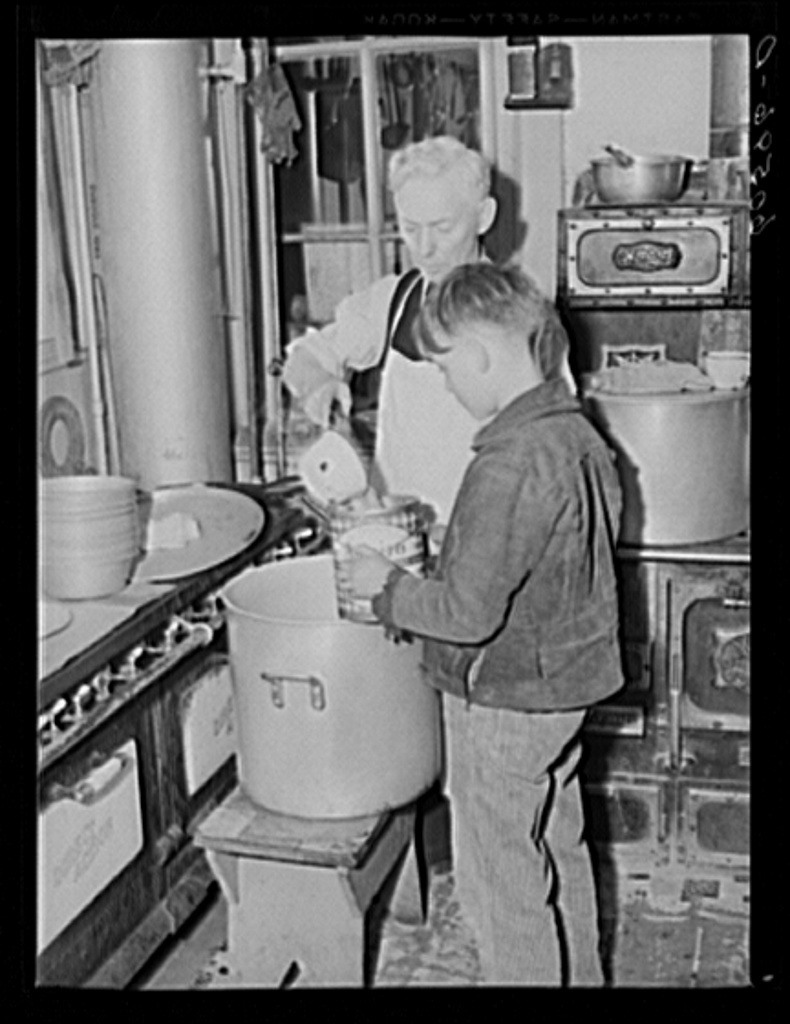
Photograph by John Vachon, via Library of Congress Prints & Photographs Division FSA/OWI Collection, LC-USF34- 060596-D

7 Picture Books for Kids Who Want to Learn Something New

By Lela Nargi

Every now and then, a kid stumbles upon some new information that delights him almost beyond reason. And so begins the pursuit to discover everything he possibly can about his latest passion—whether it’s machines, or artwork, or the stars, or an unfamiliar language. And although nothing can take the place of firsthand experience on a building site, or in a museum, or lying out beneath the night sky, or visiting another country, books come in a very close second.

Here we’ve rounded up seven volumes that explore themes that are sure to inspire kids who are fascinated by so much of what they see and feel and hear. Reading them along with your children, we challenge you not to learn something, too!

How Machines Work by David Macaulay.  Kids who are enthralled with machinery know they’re in for something compelling just by looking at the cover of Macaulay’s latest opus, with its moving toothed-gear mechanism that’s operated by a determined-looking sloth. The premise of the whole book hinges on an escape from a zoo that’s orchestrated by two of its unhappy residents, which sets up the introduction of all sorts of simple machines (and shown to delightful effect with pop-ups and foldouts) they hope will get the job done…eventually. Pulleys, levers, screws, wheels—it’s all in here, and then some (ages 7-10, $20).


Round is a Tortilla and Green is a Chile Pepper by Roseanne Greenfield Thong & John Parra. A welcome twist on the same-old shape and color books, these two rhyming texts offer a primer on rectangles and stars, purple and yellow—as well as introducing things that come in those shapes and hues that are common in Spanish speaking cultures, and in many cases, offering the words in Spanish, too. Thoughtful and full of heart, and centered around family and friendship, these books are certain to make children curious about cultures previously unknown to them, opening up whole new worlds of possibility (ages 3-5, $17 each).

Yaks Yak: Animal Word Pairs by Linda Sue Park & Jennifer Black Reinhardt. Nouns can also be verbs—an infinitely tricky concept to explain aloud, but one that is thoroughly sensical when illustrated on the page—especially when those illustrations are laugh-out-loud hilarious. Word-loving kids will be inspired to bad puns and possibly naughty doings by badgers badgering, parrots parroting, and hogs hogging (ages 4-7, $17available for preorder).


I, Humanity by Jeffrey Bennet. What we know about space and the universe increases, it seems, with each passing day. This photo book backtracks to explain the history of our understanding of such concepts as a round Earth and the pattern of the planets—and how it evolved through science. This is the second in the “Story Time from Space” series—log on to watch videos of astronauts reading to children from the International Space Station (ages 7-9, $15available for preorder).


Bowls of Happiness: Treasures from China and the Forbidden City by Brian Tse & Alice Mak. Every aspect of ancient Chinese art is laden with symbolism—even when that art is something as simple and seemingly utilitarian as a porcelain bowl. But colors and images all have meaning behind their beauty and this small and decidedly odd tome from the China Institute breaks it all down in a way that will appeal to visual-minded children, who after exploring its pages, will surely go on to look for greater meaning among the objects in your own drawers and cupboards (ages 5-8, $13).

Do Unto Animals by Tracey Stewart & Lisel Shlock. The more likely title for this book is “Do Unto Dogs and Cats,” since these are the house pets on which it mainly focuses (although some attention is paid to backyard and farm animals as well). But any child who’s a lover of creatures great and small will delight in the highly expressive illustrations, and thrill to knowledge that lets her become an expert in how to make animals supremely happy. Since this book is written for adults, it’s offered here as read-aloud material—all the better, since you and your tots can enjoy learning together (all ages, $20).

Let Kids Get Down and Dirty—for Their Health

By Lela Nargi

As you get ready to pack the family off for a daytrip to the country, to visit goats and sheep, maybe plant something in dirt or pick whatever’s grown if the season is right, consider this: a visit to the farm might seem like a diverting novelty. But it might also be good for your children’s health.

Beyond the benefits of frolicking in the Great Outdoors, dirt—that’s right, dirt—has been shown in a recent study published in the magazine Science to help kids avoid developing asthma and allergies. According to Bart Lambrecht and Hamida Hammad, the study’s co-leads from Ghent University, 25 percent of kids who grow up on a farm—compared to 45 percent of children who grow up elsewhere—react to such common allergens as dust mites, mold, pollen, and animals.

A protein called A20 is likely responsible. In mice, it was found protecting the lungs during exposure to allergens; when it was removed from their systems, they experienced allergic reactions. As Dr. Lambrecht explained to the Washington Post, “The first cells that recognize the allergen are not so much the cells o the immune system, but structural cells that make up the inside of the lungs…A20 was not a coincidence, it was really necessary.”

So go ahead and let your kids get good and farm-grimy. Although, you may want to draw the line at bringing home a pony.

Photograph by Angelina Litvin