News You Can Use: No Need to Eat for Two When Pregnant

Pregnant woman

By Dawn Van Osdell

Researchers at Imperial College London have proven that there’s no need for pregnant women to “eat for two,” because their bodies adapt to absorb more energy from the same amount of food they would normally consume. Thanks to a hormone secreted during pregnancy—even as early as fertilization—a mother-to-be’s digestive system dramatically grows, stimulating her body to store more fat to support the demands of a growing fetus.

“We normally think of our internal organs as being a fixed size, but the fact is that they are not. They can grow and change, and we show that this is important for making babies,” says Irene Miguel-Aliaga, the lead researcher in the study conducted at the Medical Research Council’s Clinical Sciences Centre in London.

Until now, scientists had thought that a pregnant woman’s appetite increased as her baby’s demand for energy increased. This new research—performed in fruit flies, which have genes that are also present in humans—is the first to show that a “juvenile hormone” triggers the changes to the intestine and fat metabolism, similar to the way human thyroid hormones regulate energy demands. “Studies in fruit flies have been very valuable in providing insights into human physiology,” say Joe McNamara, M.D. and author of the study. “This research points to a new scientific explanation why eating for two during pregnancy is not necessary, and may even be harmful, as a growing body of evidence indicates that a mother’s diet can impact a child’s propensity to be obese in later life. “

The research also sheds some light on why some women may have trouble losing weight after pregnancy. If hormone levels fail return to normal after birth, a mother’s intestine may remain abnormally large, so she will continue to extract extra energy from her food.

Eating for two may be an old wives’ tale some pregnant women will be sad to see go. But in the long run, we and our growing families will be healthier and happier having forgone that third trimester cupcake binge!

Photograph courtesy of UrbanSitter

Good News About Fighting Sibs

Kids on beach

By Dr. Laura Markham

I wasn’t prepared for my son’s reaction when his little sister was born. At four, he’s had only a few tantrums in his entire life. But when the baby appeared, he seemed to panic. He was clingy, he was angry, he was scared. I was trained as a psychologist, but I was out of my league.

Like me, most parents look forward to the awe on our older child’s face as he or she gazes for the first time at our newborn. We imagine the baby laughing as her big brother entertains her with funny faces. When one child gets hurt, the other will repay the care he’s received from us, offering his sibling a hug and a blankie. Over time, romping through the sprinkler will give way to bike rides and camping out, which will give way to arguing over who gets the car on Saturday night and consoling each other over lost games and broken hearts They might head their separate ways after high school, but that bond will continue through all the ups and downs of adulthood. We want to believe we’re giving our children a priceless gift: a friend for life.

But sometime in the first year—maybe even before the baby arrives—most parents begin to realize things may be quite so simple, as I hear from the families I coach:

“She loves her brother…In fact, she hugs him so hard that it scares us…Her hands always seem to end up around his neck.”

“I can’t even drive the car safely because they can’t keep their hands off each other.”

“He really pushed me to my limit when I came out of the shower and he had peed on his nine-month-old brother!”

There’s no way around it. Sibling rivalry is universal. After all, every human is genetically programmed to protect resources that will help him survive, and your children depend on and compete for what are, in fact, precious resources—your time and attention. Even when there’s plenty of love to go around, young humans haven’t developed much impulse control, so they’re bound to get into conflicts. Finally, temperament colors every relationship. Children who tend to be challenging will be even more challenging when you introduce a brother or a sister, and some siblings simply clash.

Unfortunately, many parents don’t know how to help their children with these strong emotions, so hurt feelings can lead to aggressive acts, which can spiral into negative patterns of interacting with each other. Those feelings can set the tone in a sibling relationship right through the teen years, and even have a way of popping up at family stress points across a lifetime.

But there’s good news, too. The sibling relationship is where the rough edges of our early self-centeredness are smoothed off, and where we learn to manage our most difficult emotions. Siblings often become good friends, and because they know each other so well, they can provide each other a deep sense of comfort. Even siblings who fight a lot usually do gain respect for each other and eventually get along. When they’re grown, may siblings feel a deep connection to the only other people who understand what it was like to grow up in their home.

And here’s the best news of all. Parents can make a tremendous difference in shaping the sibling relationship. Sibling jealousy is unavoidable, but it’s almost always possible to help children develop a strong, positive bond that trumps the natural jealousy. It’s not always easy to raise siblings who appreciate each other, who become friends for life—but a committed parent can make all the difference.

Excerpted from Peaceful Parent, Happy Siblings by Dr. Laura Markham. (c) 2015 Dr. Laura Markham. Perigee, Penguin Group USA, Penguin Random House.

Photograph by Daria Nepreikhin via Unsplash.com

Crafty Kids: How to Make a Woven Yarn God’s Eye

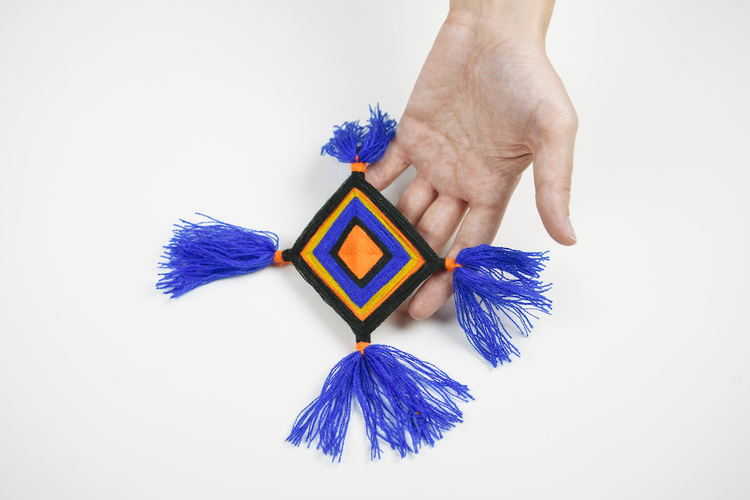
Woven Yarn God's Eye

The ojo de Dios (Spanish for “eye of God”) is a folk toy with origins among the Huichol Indians of the Sierra Madre. The four points of the crossed sticks are said to represent the elements of earth, air, water, and fire; the finished eye, replete with alternating stripes of yarn, is meant to offer health, fortune, and long life.

Extremely simple to put together, this bright, festive craft from our friends at Crafting Community forms the base for a great crib mobile—something for an older sibling to make for the new baby in the house. It’s also a super entry point for talking to kids about American history—and for parents to learn a little something, too.

What you’ll need:

  • Two sticks of equal length
  • Brightly colored yarn in 3 or 4 color
  • Scissors

1. Grab two sticks and tie them together in the middle with the end of your ball of yarn. Twist the sticks to form a ‘+’.


2. Wrapping in a clockwise direction, wind your yarn over and around 1, then 2, then 3, then 4. (See image at right for technique).

3. To switch up your colors, simply snip the yarn you’re working with and tie on a new color. Trim the excess and continue wrapping.

4. To finish your god’s eye, top knot your yarn around your final stick twice. Trim the excess yarn and you’re done!

To add tassels:

1. Loop yarn around your fingers 15x

2. Thread another piece of yarn through your loop and make a knot with long tails. Cut the end of your yarn loop to create fringe.

3. Tie your tassel on, knotting it to your gods eye on the back side.

4. Wrap one side of the tails around the arm of your gods eye several times, then knot it to the other tail to finish.

19 Books for Giving to Kids of All Ages

By Lela Nargi

Put off by the idea of giving the kids in your life a pack of toys they’ll only grow tired of by the time the new year hits? Then give them books—lots and lots of books. Here we get your list started with our picks for the brightest, most beautiful offerings of the season, for children of all ages. Happy reading!

Color Dog by Matthew Van Fleet & Brian Stanton. Finally, someone’s put adorable, freeloading puppies to work—helping tots learn their colors. This thick, colorful photo book has big, toddler-friendly tabs for puling to make tails wag and heads bobble, and foldouts galore, behind which a host of irritated cats would prefer to remain inconspicuous (ages 2+, $20).

Tough Guys Have Feelings Too by Keith Negley. Possibly the best gift of all for the sensitive kid on your list is the gift of self-confidence. The slim volume, enriched with vivid color block  illustrations, shows the toughest of men feeling sad, uncertain, and lonely and is certain reassurance that our feelings only make us more lovable (ages 3-5, $18).

The Mellops Go Spelunking by Tomi Ungerer. What could be more festive that a family of cave-hunting pigs?  This reissue of the classic learning/adventure tale follows father pig and his brood into Earth’s underworld, where they discover cave-pig paintings, stalactites and stalagmites, and the lair of perfume smugglers. Oink on! (ages 3-6, $15)

Classic Children’s Tales: 150 Years of Frederick Warne. The British children’s publisher Frederick Warne brought you, and your parents, and your parents’ parents, some of their favorite stories of all time, Beatrix Potter’s The Sly Old Cat not least among them. This compendium of six of their most famous offerings presents, too, their original, charming illustrations, along with introductions by contemporary children’s book authors and illustrators. A perfect read-aloud for the end of a holiday—or any—evening (ages 3-7, $25).

Robo-Sauce by Adam Rubin & Daniel Salmieri. This seriously ingenious little book within a book will have your kids manipulating its pages over and over to work its transformative trick. All the while, they’ll be reading a hilarious take on what happens when robots take over the world, and wishing upon any star that it will come true (ages 4-8, $19).

Oskar and the Eight Blessings by Richard Simon, Tanya Sin & Mark Siegel. In December of 1938, Christmas and the seventh night of Hanukkah converged, creating a super-charged atmosphere of love and giving for a boy who had already lost so much in his young life. New York City-dwelling kids especially will relish the opportunity to compare their city, then and now and to reflect on all the ways that we are the same (ages 4-8, $18).

Written and Drawn by Henrietta by Liniers. 

In this charming graphic novel for the kindergarten set, a young girl gets a box of her very own colored pencils for a present and is inspired to use them to write and illustrate her own book. There is plenty of fodder here for all sorts of creative kids to
get making, and with a vengeance—
especially if they received their own box of colored pencils, too, this holiday season…
hint, hint… (ages 5+, $13).

Whatever Happened to My Sister by Simon Ciraolo. The holidays mean lots of extra family time and no one understands the bittersweet twinge of this like a younger sibling. But just when all hope is lost for a return to happier, simpler times, the teen of the household swoops lovingly in on her little sister to show her that times may change, but family is forever (ages 5+, $18)

garfield_shakespeare_stories_cover_2048x2048.jpg

Shakespeare Stories by Leon Garfield & Michael Foreman. There’s a classicist in almost every family, and this terrific rendering of the Bard’s plays in story form brings 21 tales to light for a young, traditionalist audience that might otherwise be frustrated with language that can be a challenge at times, even for grownups. A far cry from a child’s version of Cliff’s Notes, the author weaves Shakespeare’s own words and tone into the fabric of his renderings, with familiar, and yet fresh, results. In fact, you might want to add it to your own bedside stack of must-reads (ages 5+, $25).

The Day the Crayons Came Home by Drew Daywalt & Oliver Jeffers. While kids are unwrapping new toys and games galore, this book is a not-so-gentle but still sweet reminder for them to think fondly on all the possessions they once loved and cherished—before they carelessly discard a whole new season’s worth (ages 5-8, $19).

Lost in NYC by Nadja Spiegelman & Sergio García Sánchez. New York kids love a book about their own hometown at least as much as aspiring kid visitors to the city do. It gives them a chance to test their own street savvy, and to see themselves in the landscape. This graphic novel, though, will also appeal to children who love buildings, children who
love maps, and children who love trains—which probably means pretty much every
kid you know (ages 8+, $17).

Historium by Jo Nelson & Richard Wilkinson. The internet may have rendered encyclopedias obsolete, but this amazing large-format illustrated series—the first was Animalium—is single-handedly showing kids of all ages the joys of knowing a little about a lot of strange and interconnected things. Got a kid who dreams of becoming an archaeologist? Then this book is the ultimate brain- and eye-candy for her (ages 8-12, $35).

The Wolf Wilder by Katherine Rundell. A middle grade fairy tale that unfolds over a wild, snowy expanse of Russian wilderness as a young wolf rehabilitator named Feo struggles to save everything that she loves. This is the perfect story for curling up to on a cold winter’s night, and for dreaming of all that is possible in this world—and others (ages 8-12, $17).

The Doldrums by Nicholas Gannon. For the tween reader who loves a rousing adventure—and is still pleased to have accompanying illustrations to bolster the scenes he’s imagined in his mind. This book will add just a bit more magic to the holidays (ages 8-12, $18).

Roller Girl by Victoria Jamieson. Graphic novels have become a popular means for conveying tales of tween drama, and this illustrated story about best friends drifting apart to find their own new and true selves is an apt example of how powerful the genre can be. Even if your own kid shakes her head at the notion of roller derby, Roller Girl will get her thinking about her own unique abilities (ages 8-12, $13).

The Toymaker’s Apprentice by Sherri L. Smith. For the ballet-obsessed on your list, this story is a retelling of E.T.A. Hoffman’s fairytale “The Nutcracker and the Mouse King,” itself the inspiration for perennial season favorite performance, The Nutcracker. Only here, readers will be forced to contemplate the possibility of a strange, alternate fate: mice and squirrels taking over the world (ages 10+, $17).

Alice’s Adventures in Wonderland by Lewis Carroll with new illustrations by Anna Bond. Truth be told, text and illustrations go in and out of style. And 150 years after Lewis Carroll released his Alice, the classic story gets a fresh, modern, and most welcome update from illustrator Anna Bond, who also manages to give the protagonist and all her cohorts a sweetly innocent mien (ages 10+, $30).

Saint Anything by Sarah Dessen. If the holidays are about anything, they’re about family—the one we’re born to and sometimes, the more nurturing one we find in its stead. A wrenching, honest tale for teens who are prescient enough to understand that life’s miracles can be subtle and often, must be worked for rather than waited for (ages 12-17, $20).

61AEqbDVlSL._SY344_BO1,204,203,200_.jpg

The Absolutely Essential 60th Anniversary Edition of Eloise by Kay Thompson & Hilary Knight. Is this re-released book—enhanced with a historical scrapbook of the author
and friends—actually for kids? Or is it really for their grownups, who grew up admiring and aspiring to the reckless hi-jinx of Manhattan’s unruliest citizen? Likely it will fit the gift-giving bill for quite a number of folks on your list. Because Eloise, it seems, simply never goes out of style—and that’s just the way we like it (all ages, $20).

To Push or Not to Push: Finding the Balance in Kids Sports

Kids playing baseball

By Dawn Van Osdell

Fourth-grader Michael Shaw* tried out and earned a spot on a local U10 boys soccer team, giving him a chance to improve his game and compete in a sport he’s enjoyed since age 4. He attended the team’s pre-season training camp; now joins team practice twice a week from early August through late May; competes in as many as two or three games each weekend during the season; and travels to a handful of tournaments around the state. He sounds like a kid committed to his sport, right?

Not compared to several of his teammates, many of whom spent their summers at (expensive!) sleep-away soccer training camps, frequently turn up for myriad optional practice sessions, and attend training workshops and drills in the off-season.

Who’s got it right? Is it the kid who’s playing—albeit at a high level—for the camaraderie and the fun of the game? Or is it the kid who is in it to win it above all, and will sacrifice many other aspects of his home- and school life to do so?

For many parents it’s tough to say. How do we know when to push our kid to excel—at a level not unlike that expected of a professional athlete—so that one day, he or she may be able to reach for, say, a college scholarship to play ball? Or when to let him try his hand at other activities he might find enriching, or simply enjoy a sport without pressure to advance and excel, perhaps ensuring that he will be forever mediocre as a soccer player? How can we possibly know how to strike just the right balance?

“It’s critical that parents see the big picture and realize that sports are just one window in a child’s life,” advises Aubrey Fine, a professor at California State Polytechnic University, a licensed psychologist, and the author of The Parent Child Dance. We often open that window when our children are preschoolers, signing them up for tumbling, or Little League, or AYSO soccer. We let them dabble in hockey and basketball and karate. We have reason on our side: As many studies have made clear over the years, there are great benefits to our children’s cognitive, physical, and emotional development when they participate in activities such as these. Through them, our kids get to explore and discover their passions, inclinations, and abilities.

Come elementary school, many kids start to shed multiple activities in order to focus on just one. Parents who encourage their kids to dedicate their efforts often to do it for practical reasons—it’s easier than juggling multiple sport schedules, and makes more time for increasing homework loads—or because they want their children to experience being really good at something. Some parents see it as preparation for a spot on the middle- or high school team. Others are hoping to recoup the cash they’ve shelled out on camps and private lessons with a college scholarship somewhere down the line.

In his parenting book, Positive Pushing, Jim Taylor, Ph.D., an expert in performance psychology, says that parents often struggle with these decisions, knowing that if they push kids too hard, they may rebel and achieve neither success nor happiness. If they don’t push hard enough, their kids may be self-satisfied and unmotivated.  “Popular sports- development culture tells us that if our kids aren’t specializing early, they will be left behind,” he says. “(But) if they are under 12, they are still figuring out whether they really like a sport and want to commit to it. They need to own the sport and find their own reasons to want to work hard,” he says. Sounds simple enough. But putting it into practice can be anything but for parents uncertain what the ultimate result of pushing—or not—will be on our children.

John O’Sullivan, founder of the Changing the Game Project, says we need to take the pressure off our kids and ourselves. This is because kids need three essential ingredients to excel at, and stick with, any given sport or activity: enjoyment, ownership, and intrinsic motivation. All of these come from within each one of us, not from parental pushing or prodding. Yet the stereotypical Tiger Mom—a term for parents known for their hyper-vigilant, tough-love style and laser focus on achievement and performance—has evolved in response to a mounting societal pressure to propel kids toward success (or even just help them keep up with the pack).

Most of us would probably hope that our parenting style would fall somewhere in between the Tiger Mom and her polar opposite, the Elephant Mom, as she was dubbed in a recent article in The Atlantic about parents who encourage their children without focusing on winning or success. But few of us feel confident we know how to define that middle ground, let alone commit to it.

While there are plenty of examples of superstar athletes who zoned in on their sport and have hammered away at it since childhood—Tiger Woods or the Williams sisters, for example—most experts agree that even if you hope your kid will one day achieve starting lineup status, it’s better for him to play multiple sports, because it makes him a better all-around athlete. A University of California, Los Angeles study surveying nearly 300 college athletes found that 88 percent of NCAA Division 1 athletes played two or three sports as children, and 70 percent did not specialize in one sport until after age 12. Studies also show that early specialization often leads to injuries, such as concussions, sprains, and torn ligaments. And, it can also lead to a hasty burnout for kids just getting their footing in life.

A practical argument against pushing your kid toward one pursuit is the sacrifice it entails. Because of the time demands—for lessons or practice, private training, and travel—plenty falls to the wayside, like homework, friendships, family dinners, a weekend in the mountains, even a night to just chill out on the couch. Not to mention the sacrifice required by parents and siblings of the rising star, who give up time, and often financial support, for their own interests. “Forget about letting my youngest join a team, trying to squeeze in a Saturday workout for myself, or planning a family getaway—soccer for Michael nearly consumes our schedule, nearly year-round,” says Shaw. So much for simplifying the family schedule by reducing your child to one sport; specialization blows that dream right out of the water!

Regardless of the science that supports a parent dissuading a kid from fully committing to a sport in his early years, there are still so many examples of kids who dedicate themselves to a sport while still in elementary school, and who see the benefit that comes from the time and hard work they put into it. Patricia Moore, mom of 9- and 11-year tennis devotees who have been playing since they were 5, was recently asked by the mom of a tween girl if she thought her fifth-grader could take up the game and advance quickly enough to make the middle school team come seventh grade.  “Of course it’s not too late to learn to play tennis at age 11, but you simply have to play a lot of tennis to get good at it, and because it’s such a mental game, it helps if you have played competitively and are used to having all eyes on you,” says Moore. Her kids attend tennis lessons and clinics several days a week and routinely compete in tournaments, year-round. It will be tough for a tween tennis newbie to earn a spot on the team, competing against kids like Moore’s who have been on the courts since they were in kindergarten.

The experts see no reason to quell true passion for a sport, like that of the Moore kids. But they say it’s important to strike some sort of balance for the good of your child and your family life. “Parents worry that their kids will lose out if they don’t give them appropriate training, but their focus should be on making positive experiences and raising well-balanced individuals,” says Fine. “There’s so much beyond being a super athlete.”

Moore knows this, and encourages her kids to participate in other activities—a running club and basketball, for instance—to develop overall athleticism and prevent injuries. This kind of diversity is mirrored even at top training clubs around the world, where young players in any given sport take tumbling, gymnastics, yoga, and martial arts to build other strengths and avoid injury.

For kids who like their chosen sport but seem to waiver when going gets tough, Taylor says it’s worth giving a little push. “If parents don’t encourage kids to stick with it when it gets tough, the child may never find out what he is capable of and will miss out on the satisfaction of moving out of his comfort zone and pushing his limits,” he says. “If you push him to try harder and persist longer, he is more likely to face his discomfort and attain a higher level of achievement and satisfaction.”

Of course, you still have to figure out when to say when, because nothing kills a kid’s enjoyment faster, or more permanently, than an overly-pushy parent. Studies show that 70% of kids drop out of organized athletics by age 13—some due to financial or time constraints, but most because playing just isn’t fun anymore.  “As we become actively involved in our children’s activities, we must realize that our role is that as spectators and supporters,” says Fine. The events themselves belong to our kids.

“At the end of the day, the real purpose of sports is to let kids feel like champs, enjoy themselves, and benefit from a healthy body and mind,” says Fine. How far they go, ultimately, should be up to them.

Photographs via Compfight/Boys by SeeBee; Soccer Girl by Clappstar.

Donations 101: Give Your Unwanted Stuff a Second Life

Shoes

By Lela Nargi

Late autumn is the time many of us find ourselves cleaning out the drawers and closets. There’s never a bad time to do this—whenever you feel overwhelmed by stuff, then that’s the time for stuff to go—but just before we shutter the doors and windows in anticipation of the cold months ahead, and well in advance of the deluge of all the new stuff that comes along with the holidays, may be a better time than most.

Yes, it can be cathartic to load up industrial strength garbage bags with shredded socks, used up art supplies, the cute little tutus the ballerina in your family utterly dismissed when she switched to hip hop classes. But what about the perfectly good shoes that got no wear? And the stack of pants with nary a stain on them, that your son merely outgrew? And your own hidden closet “gems” that you finally have to admit you will never again don in this lifetime? Rather than relegating all these still-useful things to the landfill, take a moment to consider who else might gain from your happy loss.

“If you are a sample sale junkie and have unworn or gently worn designer clothes or you are a vintage junkie and need to make room for new finds,” professional organizer Smith Banfield recommends checking out what resale retailers might exist near you—like Brooklyn’s Buffalo Exchange. They give you cash or credit for your gently used clothes (adults only) and, says Banfield, ”If they don’t want it, they have a bin nearby to donate your clothing so you don’t have to bring it back home. It doesn’t matter what you paid for any of these items. Make a commitment to leave everything at the store.”

If you think your and your family’s clothes are worth a bundle—if you’ve bought rare and beautiful pieces for everyone in the house and they’re all still in terrific shape—then try a consignment shop. They’ll stick any stuff they think they can sell on their racks, and give you a portion of the proceeds when and if it’s purchased. But, cautions Banfield, this method is “not always worth the effort.” Unless you’ve got some seriously hot ticket items—or your kids’ clothes are exactly right for the season—you might have a long wait before you see any big dollars.

If you’re not interested in getting any cash for your items, and you live in an area that doesn’t fine you for putting big bags of stuff out on the street, Banfield recommends posting a curb alert onto Craig’s List with a good-quality photo of what you’re about to toss. Chances are good someone will show up for it, pronto.

If you’ve got school-age kids, get ready for the onslaught of holiday requests for donations. Coats are always top of list, as are very gently used and new toys, games, and books. All of these items can really go a long way toward making December a lot brighter for kids and families in need.

Still flummoxed about where to unload? Check out donatestuff.com for a national registry of places that accept donations. Then, sit back and enjoy the new, clutter-free you…for a few weeks, at least!

News You Can Use: Singing to Soothe a Crying Baby

Crying baby

By Dawn Van Osdell

Every parent has tip-toed away from a nearly sleeping baby after using all the tricks in our arsenal to sooth him. Turns out, these shenanigans might not be necessary.  A new study from the University of Montreal found that the best way to console a crying baby is to sing him a nursery rhyme. Babies in the study, which was recently published in Infancy, remained calm twice as long when they listened to a song—even one they didn’t know—as they did when they listened to parental speech.

We’ve known for years—generations, even—that music has a calming effect on humans, but until now it wasn’t known whether infants had the mental ability to be enraptured by it as well. “Many studies have looked at how singing and speech affect infants’ attention, but we wanted to know how they affect a baby’s emotional self-control,” says Isabelle Peretz, professor at the University of Montreal’s Center for Research on Brain, Music and Language. “Emotional self-control is obviously not developed in infants, and we believe singing helps babies and children develop this capacity.”

Her research studied 30 infants aged 6 to 9 months. In order to eliminate the possibility of influence by other factors—sensitivity to a mother’s voice, facial expressions, and connection between performer and baby, for instance—all speech and music were uttered in Turkish, a language that was unfamiliar to the babies; and parents were present, but out of sight. The music used was recorded rather than live, so no points were awarded for an especially talented singer or for social interaction between the singer and child.

When listening to the nursery rhymes, which tend to have a specific range of tones and rhythms, babies remained calm an average of nine minutes. They were calm for roughly half as long when speech—using baby-talk or not—was attempted as a means to sooth them.

“Our findings leave little doubt about the efficacy of singing nursery rhymes for maintaining infants’ composure for extended periods,” Peretz said. “Even in the relatively sterile environment of the testing room—blank walls, dim illumination, no toys, and no human visual or tactile stimulation—the sound of a woman singing prolonged infants’ positive or neutral states and inhibited distress.”

The findings are important because mothers, and Western mothers especially, speak much more often than they sing to their children. Switching to song as a comforting response could mean the difference between a crying baby and a content one.  No worries if you don’t know the words or can’t carry a tune—infants haven’t yet developed the capacity to judge you!

Photograph by Angelica Lasala via Compfight

3 Misconceptions About Post-Partum Fitness, Busted!

Yoga moms

By Dawn Van Osdell

There’s a lot of contradictory and downright erroneous parenting info floating around out there. We’re not afraid to tackle it head-on! 

You’re never the same after becoming a parent. And while it’s all for the better, most moms wish for a speedy return to the body and the energy level they had before bringing home a baby.  Starting or resuming a regular fitness routine is the surest way to look and feel as good—if not better—than your old self. Finding the time, motivation, and energy to squeeze it in is another story.

We talked to super fit (and super prego!) mom, Linda Okwor, the founder of one of Los Angeles’s most popular Baby Boot Camps, to set us straight on post-partum exercise. This fitness trainer and former NBA cheerleader and fitness competitor knows a thing or two about getting in shape. As the mom of a toddler with a second baby on the way, she also knows what it takes to care for yourself when you’re being pulled in so many directions. Read on!

Myth: Now is the time to focus on my newborn, not myself.

Truth: Congratulations on your new little one! While it may be emotionally tough to take yourself from away from your new addition, it’s important to take care of yourself by getting back into a regular fitness routine. “You will be healthier, happier, and more balanced if you exercise,” says Okwor. Regular exercise helps to shed excess weight, restore muscle strength and tone, boost energy, and relieve stress. And what new mom doesn’t need all that? Consider, too, that research shows that moms who make the time to work out have a more enjoyable experience with their newborns and are less likely to struggle with postpartum depression, which means regular sweat sessions are good for you and your baby. “Taking care of yourself takes a little time and effort, but the reward is well worth it,” says Okwor.

Myth: I want to bounce back quick! A strenuous, challenging workout is the way to go for results.

“Taking care of yourself takes a little time and effort, but the reward is well worth it.”

— Linda Okwor

Truth: Barring any unusual circumstances or complications, doctors give most new moms the green light to exercise six weeks after their baby’s birth (slightly longer for moms who deliver via C-section). But, says Okwor, “Some moms need more time to heal and it is perfectly okay to postpone activities until you feel well enough to return.” She advises moms to cut themselves some slack by easing back into an exercise routine. “Even though you are cleared to work out, you are still healing and your body is going through a lot of physical and hormonal changes,” she says.

Okwor recommends that new moms start with a post-partum exercise program or hire a professional trainer who specializes in working with women who have recently given birth. “They know the challenges and restrictions for new moms, and can guide you and help you build your stamina and strength,” she says. Start slowly and gradually increase pace and intensity to avoid injury or petering out before you’ve found your groove. To get a workout that gives you some pep, hold off on taking an intense spin class or tackling an uphill run, and instead choose moderate intensity exercise: a walk, yoga class or strength training. Also be sure drink plenty of fluids—this is especially important for nursing moms. And of course, stop what you’re doing if you feel any pain.

Myth: I’m already exhausted. Working out would zap my energy and put me over the edge.

Truth: “I am a mom, too, and I am expecting my second so I completely feel you when you talk about exhaustion!” says Okwor. But contrary to popular belief, exercising doesn’t make you tired. It gives you energy, kick starts your metabolism, and helps fight fatigue. The key to working out when you’re sleep-deprived is to find the motivation you need to get moving and choose the right exercise. For some, the social interaction of exercising with other moms—babies along in a stroller or a carrier—can be motivating. “Remember the nutrition part of the equation, too— a well-balanced diet rich in nutrients will fuel and support healing and a new level of activity,“ says Okwor. “The right diet is really important and really motivating.“

Photograph by Kyle Monk

Brian Boches is Putting Canned Tuna Back on the Menu for Pregnant Women

By Lela Nargi

It seems that everything we eat these days is tinged with peril. Processed food is making us fat and sick. GMOs and growth hormones with the potential to make us antibiotic-resistant have taken over the produce aisle and our milk supply.  Meat—well, what isn’t wrong with meat? And what wild fish you can find has become contaminated with heavy metals, thanks to ongoing destruction, from various industrial quarters, of our oceans. If you’re pregnant or a child yourself, your options for healthful dining are even more limited.

But in Sausalito, CA, one surfer-turned-accidental-entrepreneur is working hard to put at least one beloved foodstuff back on our tables. Safe Catch tuna, distributed through a growing number of eco-conscious food outlets, is the only canned tuna on the market that guarantees that every fish it processes has been tested—three time—for mercury content, and is wholly sustainable to boot. After launching their product just this past year, the company has already received a coveted NEXTY award, which fetes products with strong social and environmental values, and become the official tuna of the American Pregnancy Association.

Really, though, it started out with less hands-on goals. “My wife and I have a big connection to the ocean,” says Bryan Boches, the company’s co-founder along with Sean Wittenberg. “We felt helpless watching the impact of the coal industry on coral reefs. We felt we had to do something.” Originally, he and Wittenberg developed a simple, inexpensive technology for testing seafood for mercury and shopped it around to Big Tuna. They thought they’d be heroes. Instead, they were told, “No one cares about mercury.”

Boches practically screams into the phone in exasperation as he recalls this response. “No one cares?” he huffs. Since 2004, “the per capita consumption of tuna has declined by 30 percent. Not just because pregnant women are being told by their doctors not to eat it. But they’re not going to buy that product for their kids, either.” Clearly, someone—a lot of someones—care about mercury. In the end, the only way Boches and Wittenberg could think to get their technology out into the world was to bring it there themselves.

“Like any entrepreneur in San Francisco, we did this with zero experience,” Boches says as he talks about going into canned tuna production—overseeing boat fleets and factories and all. And yet, despite their perceived ineptitude, Safe Catch tuna, priced at about $3.50 a can, has already taken off; it’s on its way to about 1500 chain stores near you. “We’ve done it all on our own with no brokers, no help,” says Boches. “Now we’re getting some attention and we’re thinking: yeah, people want this. The industry doesn’t want to change. The government doesn’t want to change. But when you provide an alternative to the consumer, everybody changes.” Along the way, “We get to educate people about the quality of our oceans. It’s equally important to us that people become aware that EPA policies about water actually matter.”

The Safe Catch technology itself, a proprietary product that Boches cannot thoroughly disclose, is a hand tool that allows sample results to be read in seconds rather than days. These samples are taken from every fish in Safe Catch’s production facility. They’re taken again as cans come off the line. Then they’re taken yet again by a third-party lab. These rigors are necessary, according to Boches, to ensure that absolutely no mercury has breached a can. He also points out that samples from two fish in the same school can come back with highly varied levels of mercury. Bucking conventional wisdom about large fish carrying the highest levels of mercury, Boches says, “You can get large tuna that test low, and small tuna that test high. You cannot ensure pregnant women the fish are safe unless you test every single one.”

You also can’t have testing procedures so expensive that a can of tuna will cost $40. Or that an untrained factory worker can’t figure out how to manipulate it, in unfavorable conditions. “It’s got to be mobile, it has to stand up to environmental changes, vibrations, extremes of weather, getting sprayed with fishy water. In short, it has to work in an industrial environment,” says Boches. With 700,000 fish already tested to date—more than the FDA tests in a year—it’s pretty clear the thing works.

Pregnancy-safe seafood, according to Safe Catch

PREGNANCY-SAFE SEAFOOD, ACCORDING TO SAFE CATCH

Boches wife, Joanna, by day a hotel executive, is as emotionally invested in the company as her husband and his business partner—especially now that she’s a mom (she and Bryan have a 18-month-old son, Dylan, whose photo turns up in Safe Catch publicity materials). “Joanna spent a lot of time in Maui on dive boats in the coral reefs, and even now, up here, we’re seeing all these weird things happening in the ocean: big schools of sharks up and down San Luis Obispo which are migrating here as the feedstock migrates; and all the plastic that’s killing the reefs. For our family,” says Boches, “there’s nothing bigger for us than the health of the ocean. I figure, we’ve got a decade to fix it.”

But how much can one brand, of one product, actually influence the future of edible fish, let alone the health of our oceans? “We can solve a lot more than tuna,” says Boches, starting to talk fast with excitement. “Our technology applies to PCBs and antibiotics in farmed salmon, to shrimp and fresh tuna. We think purity is going to be the biggest trend in this generation. And us? We’re the distruptor.”

Photographs courtesy of Bryan Boches

News You Can Use: Quality Sleep is More Important Than Quantity

cool-kid-in-grass
By Dawn Van Osdell

It’s no surprise to parents of newborns or kids with sleep challenges that waking several times throughout the night can really put you in a foul mood. A study just released from Johns Hopkins Medicine proves that your bad mood is more likely due to lack of quality sleep, than the reduced quantity of sleep you get. To feel better, you’re better off getting the same shortened amount of sleep without interruption.

“When your sleep is disrupted throughout the night, you don’t have the opportunity to progress through the sleep stages to get the amount of slow-wave sleep that is key to the feeling of restoration,” says the lead author of the study, Patrick Finan, Ph.D., an assistant professor of psychiatry and behavioral sciences at the Johns Hopkins University School of Medicine.

The study, reported in the journal Sleep, evaluated 62 healthy men and women who in a research setting were assigned to three consecutive nights of either forced awakenings, delayed bedtimes, or uninterrupted sleep.  Researchers monitored the subjects’ sleep stages using polysomnography, a test that records brain waves, blood oxygen levels, breathing, heart rate and movements during sleep. At the end of each night, participants were asked to report how strongly they felt positive or negative emotions, such as anger or cheerfulness.

The study found that after the second night, those who were awakened several times during the night reported a 31 percent reduction in positive mood. The delayed bedtime group showed a 12 percent decline. It also found that the interrupted sleep group experienced shorter periods of deep sleep—the sleep stage that is important for the body to repair itself and maintain health— and that disturbed sleep impacted certain aspects of their mood, including energy level, friendliness, and feelings of sympathy.

The effects of interrupted sleep on positive mood can be cumulative, the study also showed, which helps to explain why depression is often a symptom reported by those suffering from insomnia or chronic sleeplessness. “You can imagine the hard time people with chronic sleep disorders have after repeatedly not reaching deep sleep,” Finan says. It can be a real downer. And the same holds true for parents who wake repeatedly throughout the night to feed or soothe an infant or child.

Further studies are needed to learn how long it takes us to recover or make up for lost sleep. For now, we know it’s more important to get our kids to sleep through the night—so we can, too—than it is for us to turn in early.

Photo by Sander Smeekes via Unsplash