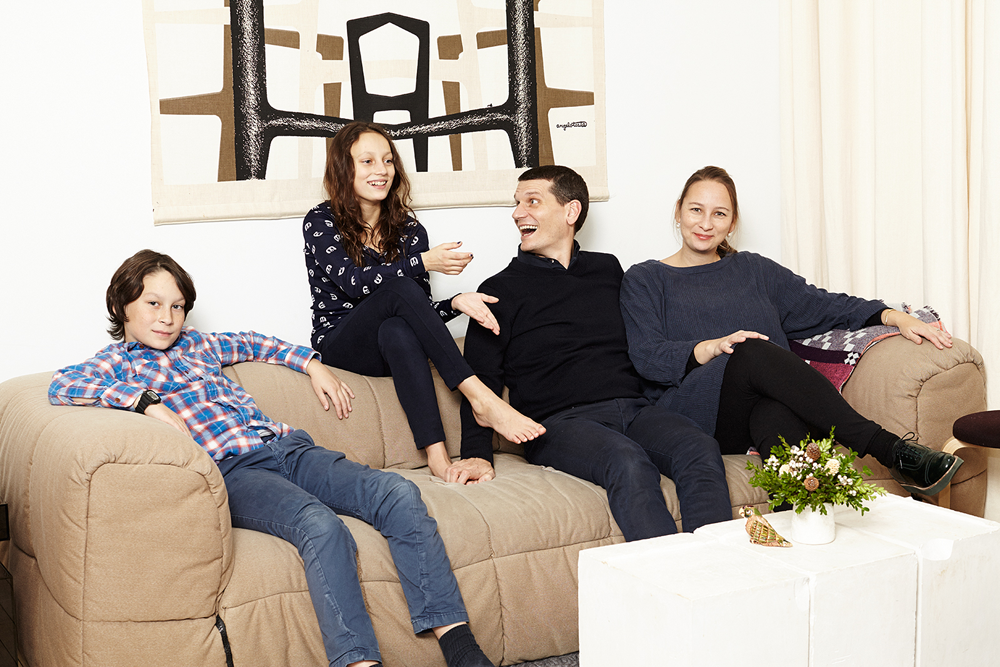
Meet Belinda Garza, Matt Hartwig & Graciela, Petworth, Washington, DC

By Christina Bruce

The last “first” time that Belinda Garza and Matt Hartwig met, they were at an engagement party, seated at opposite ends of a large table. Noticing a tall and handsome stranger, Belinda elbowed her friend and whispered, “Who’s that?” She also noticed how much fun the guests on his side of the table seemed to be having. “I loved the people on my end but wanted in on that party!”

First impressions can count for a lot, but not in this case. Garza and Hartwig already met more than once over the years, but those meetings never quite registered until that fateful party. As Garza says more than five years later, “Timing is everything.”

Timing also turned out to be key in finding the airy, slate-grey row house in Northwest Washington D.C.’s Petworth neighborhood that they now share with 7-month-old daughter, Graciela and Spot, a three-year-old Bluetick/Coonhound mix (they think).

While living in Columbia Heights, a busy neighborhood about a mile south, they knew they wanted to find a place “that was big enough to allow us to grow,” says Harwig, an Iowa native who’s director of communications and external affairs at BP America (Garza, who hails from Texas, is vice president of government relations at the Spanish language cable network, Univision). The pair wasn’t initially familiar with Petworth, but after much searching, they finally settled on this four-bedroom house because it had a yard and was close to the Metro, which made for easier commuting. “It turned out to be a really good move,” Hartwig says, “because in the year and a half we’ve been here, it has really changed.”

“Each D.C. neighborhood is developing its own vibe. This one has a nice mix of new people with longtime residents.”


He means for the better. Petworth is one of several neighborhoods in D.C. that’s seen a transformation as a result of the city’s landmark growth in recent years. New restaurants and businesses (including “an actual bookstore that sells books,” Hartwig wrily notes) have popped up within walking distance—and for the couple, so has a community.

“The neighborhood is changing so much, and so quickly, that all the residents are really active in what’s going on,” Garza says. D.C.’s growth has led to the development of New York-style enclaves with their own identities. Says Hartwig, “Each neighborhood is developing its own vibe. This one feels very family-oriented. You still have a nice mix of new people with longtime residents, who have seen the neighborhood go through all kinds of transitions.”

The couple have come to rely on the neighborhood’s active listserv, which advertises everything from schools to goods for sale. But it was Hartwig’s love of basketball that led them to part ownership in a nearby diner. Coaching the son of entrepreneur Paul Ruppert, who owns the aforementioned bookstore as well as local haunts like the upscale pub Petworth Citizen, Hartwig got to know about his latest project, a diner called Slim’s, which is slated to open this August. Ruppert told Hartwig he’d be opening up 45 percent of the diner’s ownership to the community, and Hartwig and Garza decided to take a stake in it—they felt the neighborhood could use a place that was open late, something not common in early-to-close D.C.

Ruppert also owns one of the couple’s favorite new places for a date night, the cozy, popular Japanese-French restaurant, Crane & Turtle, four blocks away from their house. “Small seating, open kitchen, great menu, small plates, good wine,” enthuses Garza.

Homegrown ‘hood-within-‘hood events such as Grant Circle Social, a monthly outdoor gathering, help keep them connected with neighbors.  “People take their dogs, or take their kids,” Garza says. “We take them both,” says Hartwig, adding that the get-together is a nice way to meet neighbors, “because there are a lot of new, particularly young, families moving in.” Hartwig is also on the board of Petworth’s weekend market, featuring farm vendors, live music, and crafts,

Baby Graciela can also be seen about town at “many a happy hour, many a brunch,” Garza says. Hartwig jokes that he’s posted Graciela’s picture at Petworth Citizen on Instagram with the hashtag #babyinabar, a nod to the early after-work drinking scene where strollers are not uncommon.

It’s possible that Graciela’s active social calendar has contributed to what Hartwig calls her “baby FOMO”: Fear of Missing Out. Both Graciela and Spot—a rescue from local nonprofit Lucky Dog who also frequents the nearby dog run and has play dates with other local canines—like to socialize. Spot plunks himself in the middle of the group when visitors are around, while Graciela defies bedtime and makes baby-chat with new acquaintances.

Rock Creek Park, the four-square-mile urban oasis a short drive away, is a favorite for weekend mornings. “When it’s warm, we come back through the farmer’s market on Saturdays, get some coffee and some fruit and pastries, and then we get started with our day,” Garza says.

It wasn’t so long ago that she and Hartwig would have been just getting to the gym at that hour, she recalls. But Graciela and Spot aren’t on the same timetable: “They don’t know what a weekend is yet.”

Photographs by Jeffrey Morris

Ice Cream Jubilee’s Victoria Lai on Retooling the Five-Year Plan and the Importance of Pink Desserts

By Christina Bruce

Five years ago, Victoria Lai accepted what she thought was her dream job. She left a law career in New York City to work at the Department of Homeland Security (DHS) as a presidential appointee working on immigration issues.

Even as a teenager in Houston, Lai, the daughter of first-generation Chinese parents, knew she wanted to make her mark in Washington. She picked Wellesley, the seedbed for women in leadership, for college. She worked on the John Kerry presidential campaign as director of outreach to Asian-American voters. She was, as she puts it, “Doing all the right things.”

Although it wasn’t on her resume, she also happened to have a talent for making ice cream.

But that side interest turned into a future she couldn’t have imagined for herself when she walked into the U.S. Citizenship and Immigration Services headquarters in downtown D.C. (USIS is a branch of the DHS). “I’m the type of person who always had a five-year and a ten-year plan,” Lai says, but “it was really deflating to find my dream job and then realize it wasn’t everything that I wanted it to be.”

Sitting for a chat a few weeks ago at a table in the airy D.C. riverfront store, Ice Cream Jubilee, that she opened just over a year ago, she reflects on how a home hobby morphed into a thriving business and a huge detour from the national policy career she’d always imagined.

Lai’s love of ice cream is attached to a warm childhood memory. Her father, a neurologist who often worked through dinnertime, would share ice cream with Victoria and her sister when he got home at night.  “It’s what brought our family together when my dad was really busy,” Lai says. “

Lai started making her own ice cream in her un-air-conditioned apartment in New York as a way of indulging her creative side, and continued the habit when she moved to D.C., featuring her creations on a blog that would eventually provide the name for her brand. Even though she had gone so far as to rent a commercial kitchen in D.C.’s NoMa district and was selling her ice cream to two local grocery stores, the pursuit remained firmly “on the side” in her mind.

Things changed when she entered the D.C. Scoop competition in 2013. Making more ice cream than she ever had before—13 gallons, double her usual weekly output—she toted it to D.C.’s Union Market and gave out samples to some 8,000 attendees in blazing July heat. In a field of more than 15 vendors, she won the people’s choice award. “I just didn’t think that I was in that league,” Lai says.

Weeks later, the developers of a waterfront site at Navy Yard, an area booming with new housing and restaurants just a short walk from the Nationals ballpark, asked her if she would be interested in opening an ice cream shop.

When she visited, she found the site fluorescent-lit, with papered-over windows. Even so, she could appreciate how much sunlight the towering floor-to-ceiling windows would bring in, and the beauty of the river view beyond. “If I’m going to dedicate myself to long hours every week, I might as well do it somewhere as beautiful as this,” she thought. “This is where I want to be. It was that conclusion that made me take the leap.” Today, she still feels that same sense of uncertainty about a five-year plan, but in a different way: “I’m sort of at a loss for what’s going to come, but only because there are many more directions to go,” she says.

The Navy Yard waterfront still has a bit of the empty, almost-too-clean feeling of a neighborhood that’s still being redeveloped. Modern glass-front apartments, a movie theater, and a winery/event space are all underway. On a sunny weekday afternoon, a group of construction workers from a site nearby comes into the store, and Lai pauses her conversation to make sure one of her employees hands out water.

In running her business, Lai has lots of emotional and practical support from her husband, Howard Yoon, and 10-year-old stepson, Ian. Yoon, a literary agent who has also blogged about food, helps develop Ice Cream Jubilee’s signature unusual flavors, such as maple rye pecan and salty apple pie. Ian puts stickers on pint lids, cleans the windows (at least, as far as he can reach), and recently opened a pop-up root beer float stand outside the shop.

“My relationship with Ian has grown as the store has grown,” says Lai, who married Yoon this past January after meeting him at a supper club event in 2011. And he’s learning plenty about hard work. “When a kid sees the line and hears the crowd and waits up till 11 p.m. for me to come home,” she says, “that’s a whole lot more tangible than me doing a really hard negotiation or being on an airplane all the time.”

Every week at Ice Cream Jubilee brings new challenges: Whole Foods has already upped its order from early July, and the store broke sales records when its first birthday celebration, National Ice Cream Day, and the arrival of Taylor Swift for two shows at Nationals Park all coincided during the week of July 12.

Meeting the demand is a challenge, given that production happens out of the store and storage is limited. Lai says she has already doubled staff from last year and rearranged the store to fit customers in a double-length line at the counter. Still, Lai is launching a mail order delivery option soon (“I joke that once we do that, then my mom can be a quarter of our sales”) and eyeing locations for a second store.

She’s also constantly coming up with new, sophisticated, and offbeat flavors—Dark and Stormy, based on the cocktail, was one of her recent favorites—and she’s dedicated to using high-quality, local cream. But Lai is also committed to keeping prices as low as possible, and being family-friendly.

“If a family comes here and there is no pink ice cream, somebody’s world is going to get destroyed,” she says. “We hear that all the time: ‘What do you have that’s pink?’”

That’s why a freezer full of cool, new flavors must always have room for good old vanilla and, of course, strawberry.

“Pink ice cream with rainbow sprinkles cures a lot of problems,” Lai says. “If life can be that easy, let’s smooth that over for people.”

Photographs by Jeffrey Morris

A Night Off With Kim & Jeff Bosse of Birch Road Cellar, Lincoln Park, Chicago

Completely violating Birch Road’s no-kid policy, the Bosses with Reese and Sophie

By Lela Nargi

Just over a year ago, Kim Bosse, a social media consultant, and her friend Sharon Provins, hit on a brilliant idea: a top-secret, members-only club that would appeal to grownups—if not exclusively parents, like them—who were looking for a low-key, no-kid night out that didn’t have to end right after dinner was over, or devolve into a bar crawl.

Says Bosse, whose husband, Jeff, is now full-time managing the product of this brainstorm, Birch Road Cellar, “A lot of parents appreciate a night away from the kids and night out, but they don’t necessarily want that to be a big scene. They just want to break out of the house!” And that counts for Kim and Jeff as much as anyone. Read on to learn more!

Tell us a little about your “clubhouse.”
Kim Bosse: It’s pretty simple. What we offer is a comfortable, casual environment where our members can hang out. They can keep their own spirits and wine in our wine cellar, which makes getting out of the house easy. Parents have so much on their plate it can be hard to plan stuff. But here, you can get takeout, open up a bottle of wine, and actually talk to your partner, because the music’s not too loud. There are also plenty of other couples you can connect with, if you want to.

Sometimes, Jeff and I will get a last-minute night out. There are all these new restaurants in Chicago I’m always dying to try, but you have to reserve three weeks in advance. It completely turns date night into Chipotle night. But even Chipotle night can be fun if you’re eating it in a nice space with a bottle of wine!

What is it that you guys most like about hanging out in the space you created?
Kim: I grew up in the suburbs, where we had secret neighborhood spots that we kids would ride to on our bikes. It’s something I valued as kid, and also now as a grown-up. The idea of everyone serving themselves here [there are no waiters or bartenders at Birch Road] came from our own lives. I like craft spirits and buying local beer, but when I go out and look at restaurant lists, I can’t remember what I’ve had and liked before. Also, it’s impossible for a bar or restaurant to stock what everyone likes but here, whatever you’ve tried that you like, you can buy it and put it in your locker at Birch Road and it will be waiting for you the next time come in. Or maybe you have special bottle of wine someone gives you as gift but don’t want to open just for yourself; you can’t wait to come in and share it with another member you’ve met here.

Was having a clubhouse-y feel important to you?
Jeff Bosse: We’ve got very much of the living room set-up. People seem to really like those kinds of comfortable spaces.

Kim: We tried with the décor to make it as comfy as home, but to still functional like a bar. A lot of seating at bars and restaurants is intentionally designed to be not comfortable long-term, because they don’t want you to stay. Here, we want you to sit back and enjoy!  We have “studio spaces” that are like mini living rooms. If you want to be more interactive with other members, you can sit in the bar area. There are sofas and easy chairs, but they’re not pushed together, no one is listening in on your conversation or intruding.

Are all your members parents?
Jeff: Only about 30% of them are parents, but among them, we have parents with kids of varying ages: babies, school-age, some who are even older than that.

Kim: One of the things I love about coming here versus other social opportunities we have as parents is that people branch out and the center of the conversation is not always our kids. I love talking about my kids [son, Reese, is 8 years old and daughter, Sophie, is 6] and I could easily talk about them all day. But it’s nice to feel like a grownup and have a conversation about other things. We’ve got a diverse group of members in here, so the conversation naturally steers away from childhood stuff, to food and drink and movies and shows.

Parents in Chicago embrace diversity for families and kids—we’re always looking for diverse experiences—but social clubs here tend to be industry-specific. We have a number of private clubs that are dedicated to finance, to lawyers; these are places people join to further their careers. But Birch Road is unique because we offer the private club experience without it being a resume-building environment; it’s just a place where you and your peers can meet. And most important of all: we’ve got a no-kid policy!

Do you have a favorite kind of night at the club?
Jeff: One of the things I’ve really enjoyed since opening Birch Road is being the best host for Dad’s Night Out. Before, I would host literal “garage parties” where we would drink beer and play darts in my garage. Now we’re sipping Scotch and playing darts in my private club!

Photographs by Thomas Kubik of TK Photography

For ConstructionKids’ Deb Winsor, Confidence Comes with the Bang of a Hammer

By Lela Nargi

The 214-year-old Brooklyn Navy Yard is a three-acre industrial park that occupies a small cove just across the East River from Manhattan’s Lower East Side. As a major builder of battleships during World War II, it earned the nickname the “Can-Do Yard,” a title that moldered along with its buildings when the yard was decommissioned in 1966. But lately, it’s been reclaiming its former glory, after the 2004 arrival of Steiner Studios to the park (Boardwalk Empire and the film Teenage Mutant Ninja Turtles were both shot here)—and on its heels, hundreds of “can-do” businesses of all varieties: artist and textile studios, furniture restorers, ship repairers, woodworkers, a rooftop farm, and one seemingly incongruous company with a large “workforce” comprised of people who are all under 48 inches tall.

That company is ConstructionKids and its fearless leader, Deb Winsor, has in her six years in business taught some 12,000 New York City schoolchildren the rudiments and beyond of building things with wood and nails and hammers. Her home base is in the Navy Yard’s Building 92, the former Marine Commandant’s House that serves as exhibit space and education center; the second floor is devoted to ConstructionKids. “People are always amazed when they walk in and with 40 kids, it’s humming like a factory in here and nobody’s fooling around,” says Winsor—loudly over the din—as a group pint-size builders cobble together tool boxes at low tables in the center of the large, project-lined space. “It’s fully engaging for children when we give them the tools and the process to be self-reliant.”

“It’s fully engaging for children when we give them the tools and the process to be self-reliant.”

Construction Kids is a highly likely culmination of a lifetime’s experience for Winsor. “Coming from a family of engineers, I spent a lot of time down in the basement watching what my dad did,” she says. “Carpentry and woodworking really spoke to me.” After majoring in industrial design at Syracuse University, she realized that she wasn’t cut out for office work and wound up in Nantucket, painting houses. That led to historic preservation work, then a move to Long Island to learn about boat building and restoration. Says Winsor, “That was a real game changer, because you can make a chair that looks great, but a chair doesn’t have to float and keep you alive in a storm.” She got a Master’s in historic preservation at Columbia University, “wound up in New York with a family,” and all was plodding steadily on. When she got a call from her son, Jack’s, preschool teacher.

“They were studying igloos,” Winsor recalls. “His teacher said, Can you build an igloo with a bunch of 4-year-olds, in Brooklyn, in May?” The final product—made from a bent wood with fabric stretched over it—was not quite the “igloo” Winsor had in mind. “But we were all down there on our knees on the floor, and it struck a vein with every kid, every teacher, every parent,” she says. That summer, she ran her first two-week camp through the school. “It took off like a shot,” she says.

Now running more than 100 programs city-wide—including afterschool programs at the Navy Yard space and in some 20 schools; vacation and summer camps; birthday parties; and special events—Winsor admits, “We’ve never been quite able to meet the demand. It’s a crazy business model to have!” She credits her success to her commitment to expanding slowly—“If I need to buy three hammers, first I need to make the money to buy three hammers”—as well as meeting a primal need of an increasingly sedentary, screen-focused population of elementary schoolers to do something physical and hands-on. “It’s whole-child learning, which they don’t get much of in school these days,” she says. She offers an analogy to Jack’s first foray into Little League baseball: “He walked across Prospect Park with this bat-weapon in his hand, hitting the ground, the dog, the tree. When I picked him up from practice two hours later, that bat was no longer a weapon; it was a tool and he had been taught to use it. That’s what we do, too. It gives kids confidence.”

Every day, one of Winsor’s teachers arranges the hammers in a different pattern on the floor.

During camp season, Windor takes on some 60 employees but during the regular school year, her staff of 14 teachers, administrators, and fabricators work to ensure that every child who comes to build has a fun, creative, and safe experience. “Someone calls up and says, We need to build the Lincoln Memorial for a program we’re doing in our school,” says Winsor. “Our creative and fabrication teams get together with the educators to talk about what kind of curriculum themes they’re trying to develop, then we build prototypes.” Always, they start kids building with wood because while kids have plenty of opportunities to use clay and paper and fabric in school, wood is not often offered as a material.

Winsor’s program also begins with hammer and nails—the “iconic tools,” as Winsor calls them. “When it’s paper, it can only be wrong or right, but if you bend a nail, you can take it out and put in another one; it doesn’t feel like a failure,” she explains. From there, kids progress to saws and vices, then wrenches and bolts, then nippers and pliers. At each step, they’re taught how to hold the tools correctly and most of all, safely.

The age of the kids is of paramount in importance in determining programming. Not only are the materials scaled down to meet their physical needs and abilities—like four-ounce hammers for the littlest builders—so are the expectations. “We work with little, tiny 3- and 4-year olds who are still learning what a triangle, square and rectangle are,” says Winsor. “So, we spend a disproportionate amount of money on program development,” to make sure Construction Kids get things just right.

On the other, older-kid, end of the spectrum, “It was transformational day for me when the three boys arrived and told me they wanted to build Yankee Stadium,” Winsor laughs as she remembers. “Which also was the day we established one of our few cardinal limits, which is, any project you build in this workshop has to fit through a New York City subway turnstile”—the measurements for which, along with those for those of an American Girl doll, Winsor and her team have committed to memory.

Teaching kids how to use tools responsibly gives them confidence—part of the core culture of ConstructionKids.

And indeed, in an era when so much is made about creating STEM opportunities for girls, Winsor admits to a certain amount of frustration around persisting gender stereotypes. “Making is a gender-neutral skill,” she says. “So, we embrace the American Girl doll as an opportunity for girls to do architecture around this omnipresent character. We don’t have a marker for girls that we can recognize as ‘building’ except for their creative play—making environments for dolls—but that to me is science and STEM and architecture and planning. I don’t know if everyone sees it that way.”

 The final component to making ConstructionKids such a unique space is what Winsor calls an “intergenerational connection.” Staff is often high school and college students—grownups who are not quite peers but more along the lines of older cousins, or family friends. Says Winsor, “We teach them that their role is to be a safe buddy, so kids can step out of that teacher-child, parent-child world they spend their whole day with. That’s a big part of our culture.” She talks about the joy of watching kids of all ages learning from each other in her big, bright, tidy, and tool-filled space. “They’re marching over to get their end-nipper, or marching over to the vice to chuck up their piece of wood,” she says. “Confidence—that’s what we’re about. It’s pretty fantastic stuff.”


Photographs by Roy Beeson

What Kids Really Gain from Arts Education: One Mom’s Personal Reflection

orchestra
By Lela Nargi

It’s a late evening in early December and I’m sitting with my tween daughter in a stiflingly heated, baldly lit, packed-to-the gills auditorium near Coney Island, waiting for Mark Twain middle school’s winter concert to begin.  We’ve come out to see a friend of my daughter’s sing with her 7th grade choral class. It promises to be a long night, with three grades’ worth of choral performances, three of band, three of orchestra, and a few extras thrown in for good measure. But I’m used to these sorts of engagements. As the parent of a kid who’s been lucky enough to attend public schools that vigorously buck the current trend of defunding arts programs, I’ve been sitting in on biannual music, dance, drama, photography, and broader “talent” shows since my daughter was in Pre-K. I hardly give the enterprise any thought.

Arts education has been a big educational talking point for years, but possibly never more than since the advent of the test-driven Common Core curriculum. As across the country the arts have been cast aside in favor of reading comprehension and STEM subjects—as well as the high-stakes exams that supposedly determine a child’s competency in them—the findings of multiple studies have been invoked to champion the ability of painting, drumming, ballroom dancing, playwriting, to enhance creativity, fine motor skills, and language development in our kids—with even more significant and lasting boons for low-income children.  Many parents with kids who are painting, drumming, dancing, and playwriting through school, both where I live in Brooklyn and elsewhere, accept these benefits as a given. But they’re not what are on my mind as the lights in the auditorium dim and the first orchestral group streams onto the Mark Twain stage.

The students are wearing the customary on-stage uniform of white shirts and black bottoms. They march purposefully out from the wings in a steady and orderly manner, delicately carrying their instruments. They quietly find their seats, set their music on their stands, and follow along with their section leaders in tuning their instruments. When Jamie Baumgardt, Mark Twain’s strings teacher, appears on stage they stand, then await her cue to sit again. As anyone who’s ever watched an orchestra knows, this is business as usual. But if you’ve ever spent any time with a large group of rabid tweens and teens, you know how exceptional this sort of behavior is.

And if you’re an educator, you know it even more acutely. I’ve listened to my sister-in-law, a 20-year veteran of elementary school classrooms, bemoan the mounting inability of her students to sit still and focus. She chalks it up to the use of smartphones and tablets, devices that encourage them to eschew human interaction and reward them for making fast, unconsidered decisions. For years, my husband taught literature to community college students and every night came home with frustrated stories of kids who didn’t know how to behave in his classroom: truly didn’t know they shouldn’t text and take phone calls, didn’t know they shouldn’t gobble sandwiches and bags of candy, didn’t know they shouldn’t listen to music through one headphone as he led them (or attempted to lead them) in discussions of Kafka and Chinua Achebe. Children are losing their understanding of basic courtesy and in the process, are becoming ever more removed from their peers and larger society. With this loss, life becomes less pleasant and more challenging for all of us. Because the loss is palpable everywhere we go. Think of the people texting through movies. Refusing to let you pass as you haul heavy grocery bags down the sidewalk. Shoving you aside to get onto the subway car first.

And this is what I’m thinking about as the strings students finish their performance, again await Ms. Baumgardt’s cue to rise, and quickly, silently take their bows and leave the stage. An orchestra has many governing rules. To survive and thrive in this setting, an orchestra member not only has to know them, she has to tacitly agree to follow them. As these rules govern how members of an orchestra treat their leaders, their equals, and the audience that has come out to see them—in addition to expectations for their own personal responsibility to practice—an orchestra, quite simply, offers a blueprint for how to behave in a society.

“My music students learn professionalism and that, regardless of the context of the setting, there are times and places to be professional,” Ms. Baumgardt tells me. “Running around in the park you can be kids and throw Frisbees. But in a professional setting there are expectations. What values should musicians have that translate to the rest of their lives?” Plenty. Do we want our children to be able to make eye contact with friends and strangers as they politely converse with them? Do we want them to be able to show empathy for others, both locally and globally? Do we want them to understand the positive influence of their hard work, not only on their own development, but on the achievements of an affiliated group? Thanks to the efforts of Ms. Baumgardt and other teachers of music, dance, drama, and plastic arts such as sculpture and drawing, they’re getting an excellent footing. “I show them that being committed leads to success, and that can make you feel great about yourself,” says Ms. Baumgardt. “But it’s also about the bigger picture. The efforts they contribute, in the long run, are going to make everyone successful.”

In some cases, that even includes their own parents. As my daughter’s friend takes the stage with her fellow singers, a dad sitting in front of me becomes animated. After snapping photos with his stage-obscuring iPad, he begins to wave his arms over his head, trying to get his kid’s attention. She ignores him. He tries again. And again. She finally acknowledges him with the meager-est of nods. By behaving professionally, as she’s been taught, she’s given her own father a subtle clue about how to behave with professionalism and courtesy. Hopefully, that tiny trend will radiate.

The very fact that my daughter and I are here tonight is proof that the lesson transcends beyond the classroom and the stage for kids, too. My daughter has come out to show support for a friend, just as this friend came out to support her a week earlier, when my daughter danced in a performance of The Nutcracker. The older they get, and the more serious about their various artistic pursuits, the more supportive they become for each other. Empathy (in the plastic arts, critiques would be miserable without empathy) is built right into the framework.

And empathy—along with discipline, listening skills, manners, the ability to articulate and to work as a team—will serve these kids whether or not they eventually choose careers in any arts-driven field. Sarah, a violinist in Ms. Baumgardt’s 8th grade ensemble, wants to be a doctor—and feels the emotional connection she’s developed to music will help her have an emotional connection to her future patients. Tricia, an 8th grade violist, thinks teamwork and intuition are the two lessons she’s learned from music that will be most valuable to her possible future career as a children’s dentist. Ultimately, the goal of arts education is not to churn out professional artists. As Mark Twain’s principal, Karen Ditolla, puts it so succinctly, “By helping children learn these crafts, we’re helping them grow as people.” There isn’t any goal finer.

Photograph from the George Grantham Bain Collection, Library of Congress Prints and Photographs Division Washington, D.C. 20540 USA, #LC-B2-3849-6

Healthy Living with Dean, Anne, Lucas & Jasmine Ornish, Sausalito, California

By Dawn Van Osdell

Dean Ornish, M.D., his wife Anne, and their two children—Jasmine, age 6 and Lucas, age 15 (from Dean’s previous marriage)—live the holistic lifestyle they teach others by embodying a simple motto: “Eat well, stress less, move more, and love more.”

Dr. Ornish is passionate about helping people live healthier, happier lives by making better lifestyle choices. He’s the founder of the nonprofit Preventive Medicine Research Institute, a clinical professor of medicine at the University of California, San Francisco, and the author of six best-selling books that claim that lifestyle and diet can reverse aging and improve chronic diseases—such as heart disease, type 2 diabetes and prostate cancer—and can also change your genes by turning off disease-promoting elements. “We’re committed to creating healthcare, rather sick-care,” he explains about his pursuits. Anne, a former yoga instructor, is the digital director for Ornish Lifestyle Medicine at Healthways, Inc., focused on bringing their holistic principles to the masses by providing inspiring tips for creating a better balanced life.

The couple took time away from their work to talk with us about their daily life with Jasmine, a rising first-grader at Mark Day School in San Rafael, and Lucas, who is returning from summer camp and starting his freshman year at The Bay School of San Francisco in the Presidio, which is just over the Golden Gate Bridge from their home in the picturesque, water’s-edge town of Sausalito.

the ornish family in 2014

THE ORNISH FAMILY IN 2014

What makes Sausalito conducive to living the healthy lifestyle you teach?
Dean: I’ve lived in Sausalito since 1988. It allows us to embody the principles we teach others, and to implement them into our daily lives. We can walk to work, find healthy foods from local farmers’ markets, and incorporate exercise into every day. It feels good just being in Sausalito.

Anne: Sausalito has a network of stairs—our daughter calls it “the secret passageway”— that take us from home to our office, and comes out by Poggio, one of our favorite restaurants. We almost never have to get in our car. We have electrical packs on our bikes so when we leave Sausalito, we can bike all the way to Point Reyes, Fort Baker, Cronkhite, Cavallo Point, or to the (Bay Area) Discovery Museum. We have a special, covered doggy basket on our bikes for our Maltipoo, Cocoa, so she can come, too.

Aside from walking and biking as transportation, how else do you incorporate exercise into your busy lives?
Anne: We have two double kayaks with recumbent pedals that are like sea turtle paddles. We kayak bayside—around Sausalito and Mill Valley, or head out to Belvedere and Angel Island.

Dean: If exercise is fun and easy to incorporate into daily life, it works for me. In addition to walking to work, riding bikes with my family, and kayaking, I like to swim and play tennis. I have a treadmill desk at work so I can get some exercise while I’m checking my email. I also have a personal trainer who comes to my home gym and helps me incorporate strength training and cardio.

Building a stronger mind/body connection and reducing stress are a big part of your lifestyle philosophy. Is this something you practice daily?
Anne: For me, mind/body practice, like yoga, is essential. I was a private yoga instructor in my 20s. Now, like all working mothers, I practice whenever I can squeeze it in. On busy workdays, that usually means meditation time in the morning to get grounded and focused. On other days, I get in longer practices. I can’t always practice everyday, but if the majority of my seven days are well balanced, the whole week seems balanced.

Jasmine must have been a yoga teacher in a former life—she’s a natural, even in her mannerisms. She’s always teaching me something, especially with our dog around to show her some poses!

Where do you like to go when we venture away from home?
Anne: We like to take the ferry from Sausalito into San Francisco, especially when we have guests. Last weekend, the grandparents were visiting and we took them to the Ferry Building for the great restaurants and market, visited the Exploratorium, and the Academy of Sciences.

On the mainland, as we like to call it, we like to visit Big Sur, Napa and Sonoma, where we recently visited the beloved Train Town. Additionally, we spend a couple of weeks every year in Kauai. It’s like a healing sabbatical for us—our time to recharge and enjoy the fresh food, like the amazing local bananas and mangoes.

You have so many fantastically healthy, flavorful recipes on your site and in your books. What are some of your family favorites?
Anne: We have four or five salads that everyone loves that are in rotation right now. We tend to think in themes: Asian or kale/Brussels sprouts, for instance. But then we’ll go the farmer’s market and throw in whatever is fresh, like a perfect peach. Right now my favorites are shredded Brussels sprout salad, similar to the Kale and Brussels Sprouts recipe on our site, and a kale and mint salad we make with sugared pecans and sliced apples. Having so many great markets nearby makes it easy to get fresh, good food. We all enjoy going to the farmer’s market in San Rafael, where they have pony rides for the kids on Thursday nights. It’s like a street fair.

kale and brussels sprouts salad, an ornish family favorite.

KALE AND BRUSSELS SPROUTS SALAD, AN ORNISH FAMILY FAVORITE.

Where do you enjoy eating out around Sausalito?
Anne: In addition to Poggio, we like Sushi Ran; Fish, which offers sustainable fish and local, organic produce; and we’ve just tried and really enjoyed a new restaurant, Barrel House—we order all the vegetables and eat them family style, with a great view.  We also really like Greens in San Francisco.

Do your kids eat what you eat? If so, what’s the trick!?
Anne: If left to her own, Jasmine would eat the food all kids like. But we’ve been exposing her to what we eat since she was very young, and working at developing her palate. If kids see what everyone else is eating, they want to be a part of it and will usually want to eat the same thing. Sometimes it’s about picking the parts that work for them.

Photos: Grapes via Maja Petric at Unsplash; Kale and Brussels Sprouts Salad via Ornish Lifestyle Medicine; Ornish family photo via the Ornishes

Courtney Brockmeyer Pays it Forward with Backpacks and School Supplies

Courtney's family

By Dawn Van Osdell

Parental guilt can be a powerful motivator. In 2013, Courtney Brockmeyer, like many working moms, felt enslaved by the long, stressful hours that often come with working for a big company in a big city. When her youngest daughter—then 7 years old—asked her why she worked so much, she couldn’t find an answer to justify the time she spent away from her family.

“I knew something had to change,” she says from the home her family now shares in Moraga, CA, a quaint residential town east of San Francisco and the headquarters of Sydney Paige, a “social good company” Brockmeyer started in 2014 and named after her and husband Dale’s daughters, Sydney and Paige. “If I was going to work that hard, my work needed to have an impact. I needed to make a difference,” she says. Brockmeyer can now tell her kids that’s she’s working to help supply the more than 16 million kids who live below our country’s poverty level with the materials and tools they need to stay in school, and to make their own mark on the world.

She started Sydney Paige from her previous home in Los Angeles with little more than a sense of responsibility to her family and the families of others, a desire to do good, and a few other moms willing to lend a hand. It operates on a buy/give business model, similar to the way shoe company Toms and optical outlet Warby Parker work. Through the company’s website, Amazon.com, or local events, buyers purchase high-quality backpacks; accessories like lunch boxes, nap blankets, and bag tags emblazoned with inspiring messages, such as Give Back, Respect and Creativity; and children’s books that Brockmeyer has written to illustrate the importance of education. For every purchase, the company fills a matching product with school supplies, hygiene items, food, clothing, and monetary donations secured through partnerships. It then distributes it to a child in need through a non-profit organization of the buyer’s choice—everything from local schools to national and global organizations like Baby2Baby, Volunteers of America’s Operation Backpack, and the Salvation Army.

Why backpacks? Searching for a way to have a positive impact  on education, a cause that spoke to her, Brockmeyer found that kids most frequently drop out of school because of lack of confidence and lack of supplies. “If you don’t have a backpack to take to school, everybody knows it. It makes you stand out and shouts to the world that you’re poor, “ she says. No kid deserves that stigma, she says, and every kid deserves the chance to proudly go to school, graduate, and eventually break the vicious cycle of poverty that entraps so many disadvantaged kids.

Sydney Paige’s mission originated from more than just anonymous research. A decade-long employee of food giant, Nestle USA, she conducted market research in her role as business manager by meeting with lower income consumers in their homes. She also took them food shopping to observe their buying habits and budgets. She saw first-hand what need looks and feels like. “We all know poverty exists, but we have no idea how others live or how little they have,” she says.  During focus groups and home visits, she saw not only empty refrigerators, but also a lack of books, crayons, and art supplies. “You can’t buy these things when the choice is between that or food,” she says.  And, yet, how can a kid be a kid without them ?

All this helped Brockmeyer to channel a sense of personal responsibility she’d carried since college. She’d won a scholarship to attend Pepperdine University, a highly regarded private institution with a price-tag to match its reputation and Malibu, California zip code. When the scholarship wasn’t renewed her second year of college, a second award—the Raleigh Runnels Memorial Scholarship from the chancellor of her university—allowed her to continue her education. “Winning that scholarship gave me a huge responsibility to prove to myself and to others that I was worthy of such a gift,” she says. “I knew I had to someday make a huge impact.”

Sydney and Paige Brockmeyer

Paying it forward through Sydney Paige—like starting any new business—has been a bumpy, and at times serendipitous journey. Just after starting the company in 2014, Dale, also a Nestle employee, took a job as chief financial officer of Dreyer’s, a promotion that moved the family hundreds of miles north of their hometown LA to the San Francisco Bay Area. Amidst the move—getting kids settled in a new school and setting up a home while getting her business off the ground—half of her first product line, a shipment of backpacks designed by a talented designer friend in Austin, Texas and manufactured overseas, was destroyed at the port of entry into the U.S. A second shipment from another manufacturer came back with inferior stitching. They wouldn’t do. “I want shiny, awesome backpacks that kids can be proud of,” says Brockmeyer. “They need to last through school and even beyond.” Already saddled with hundreds of thousands of dollars in personal debt, she trekked on.

As luck, or fate, would have it, she found a “mompreneur,” a seamstress in a neighboring town, who agreed to reinforce thousands of bags for a fee that wouldn’t break an already tapped-out budget. “We took bags to her, load by load, until they were sturdy and ready to go,” says Brockmeyer. Coincidentally, the seamstress is married to a small business loan officer who agreed to coordinate an additional loan, one that ultimately kept the business afloat. “I just kept going, and I just keep going,” says Brockmeyer.

Today, she works at her home, surrounded by loads of inventory—some 10,000 backpacks in a nearby storage unit. Her new best friend is the PTA president at her kids’ school, who is now also the company’s director of sales.  She says her view is far better than it was in LA—rolling hills and pine trees. Her workforce is a collection of dedicated do-gooders, many working without compensation. Together, they have given nearly $1 million worth of backpacks and school supplies to children in need.

“Believe it or not, backpacks can really make it or break it for a kid who is struggling to stay in school because his family is too poor to provide the supplies he needs to attend,” says Brockmeyer. Dedicated to her business of keeping kids in school, Brockmeyer hopes to expand her product lines, partnerships, and retail outlets; and eventually offer scholarships like the one that ultimately inspired her to make all the difference to kids in need.

Photographs courtesy of Courtney Brockmeyer

Meet the Yanows of Los Feliz, California

The+Yanows+of+Los+Feliz,+CA
The Yanows of Los Feliz, CA

By Dawn Van Osdell

From their whirlwind business beginnings nearly five years ago, Tony and Amy Yanow took inspiration from an unlikely but apt quote from George Orwell: “The Puritanical nonsense of excluding children and therefore to some extent women from pubs has turned these places into mere boozing shops instead of the family gathering places that they ought to be.”

Parents to three-year-old twins Chloe and Hudson and Tony’s 12-year-old daughter, Marley, the Yanows own and operate a now-burgeoning craft brewing mini-empire. Quite possibly, they hold exclusive rights on being the only pub owners in the country who’ve found a way to integrate family, wholesome food, and craft beer so that it all functions as one great, organic whole. “Business and family, together, have become a way of life for us,” says Tony.

golden+road+brewing+with+yanows
The Yanows at Mohawk Bend in Echo Park

“Love brought me to the eastside of LA, which felt like a different country— and with the traffic, was nearly as far as one,” recalls Amy of her move six years ago from LA’s westside to be with Marley and Tony, who hails from Canada. She’s constantly surprised by the gems she’s still finding in the cluster of small neighborhoods that make up the family’s laid back, hilly community of Los Feliz and nearby areas—including a kid-friendly bowling alley, X-Lanes, right next door to one of their family’s favorite vegan lunch spots, Shojin, in Little Tokyo. “It’s a much more urban area, here, and so well-suited for family life,” she says of Los Feliz’s proximity to downtown LA and its many dining and entertainment options.

The Yanow’s home is an urban oasis, tucked away from the grit of city streets. It’s outfitted with a yurt, which houses the family’s home gym. And it’s just a short jog from the area’s greenway, Griffith Park—which, conveniently, links their house and all three of  their three businesses. “It’s a jewel of LA; everyone with kids knows it,” Amy says of the park. “There are trails to hike, a huge lawn for kids to play on, the observatory, haystacks and pumpkins in the fall. It even has a view of trains—Travel Town—for my train-obsessed son.” She says the park is a fantastic way to entertain her kids without spending a dime, right in her very own backyard.

Amy Yanow and her three-year-old twins, Chloe and Hudson

Another source of local, family entertainment: roller derby! The Yanows are die-hard fans, supporting Marley’s LA Junior Derby Dolls team, both bodily from the stands on game days, and more practically through their businesses, as the women’s team’s corporate sponsor.

When it’s time to go to work, Amy says, “The kids love to go to the restaurants with us.” Although their eateries are famous for their expertly compiled local beer lists and menus aimed at the late-night crowd, they’re also super kid-friendly and reflect the values the Yanows find meaningful in their personal lives. Tony’s Darts Away is beloved for its board games, and has also earned accolades for thoughtfully sourced menu items the Yanows have added since they took ownership in 2010. Namely, an impressive selection of sausages—at least a half dozen of them vegan.

Mohawk Bend, an old Echo Park movie theater the Yanows have transformed into a sleek, industrial-modern gastro pub, has generated buzz on sites like Yelp and UrbanSpoon for its vegan Buffalo Cauliflower as well as for nowhere-near-vegan options like chorizo-stuffed Medjool dates wrapped in bacon. “It’s packed with night owls who come in the late morning hours but before they wake up, it’s absolutely perfect for families, with no wait for a table,” says Amy.

The busy Yanow family heads to 12-year-old Marley's roller derby practice
The busy Yanow family heads to 12-year-old Marley’s roller derby practice

The Yanow’s most recent establishment, Golden Road Brewing in LA proper, which Tony co-owns with Meg Gill, is also designed to draw families, luring Mom and Dad in for a Point the Way IPA, and kids with lawn games, like corn-hole, set up in the side yard. All three eateries (at least possibly responsible for GQ Magazine naming LA one of the top five beer cities in American in 2012) have well-rounded kids’ menus that go beyond fried chicken fingers, including fresh fruit and simple pasta options.

In case you haven’t guessed it by now, the Yanows keep a vegan household (and at least a partially-vegan business), “for ecological reasons and because we like the way we feel eating plant-based foods,” Amy explains. She was raised vegetarian, and returned to the lifestyle after a brief burger rebellion. Their younger kids don’t know the word vegan, though, and aren’t strictly held to the diet. “We downplay it,” Amy says. “If they go to a birthday party and everyone is eating cheese pizza and cake, they can have at it, if they choose. I don’t want them to resent us.”

But Amy says the kids enjoy the meals she serves so much that she doesn’t share the pain some other parents feel about cooking healthy food their kids ultimately reject. One of the first things she does each morning is turn on the rice cooker. “It just tastes better when it’s fresh,” she says, explaining that she adds beans or lentils from big batches she keeps on hand for burritos, to pack in the kids’ bento lunchboxes. They are also big fans of raw cashews, whirled in their VitaMix to become cheese-like bases for rich, creamy sauces at dinnertime.

“Just like at our restaurants, no one feels like they are missing out,” says Amy of family life.  “We’re well rounded, something for everyone.”

yanow+family


Photographs by Kyle Monk

Chudney Ross is Bringing Literacy to a New Generation at LA’s Books and Cookies

Ross and daughter, Callaway
Ross and daughter Callaway enjoying the sunshine out on the Books and Cookies turf.

By Lela Nargi

On a low-slung strip of street halfway between the skate shops of Venice’s Muscle Beach and the boutiques of downtown Santa Monica, Chudney Ross has opened her kid-centric outpost, Books and Cookies. Twice.

Aiming to provide what she calls a “literacy-based experience” for the area’s burgeoning young family population, in 2011 Ross fell in love with a storefront that was wedged in among the area’s myriad coffee shops and palm trees, even though she knew the space was much too big for what she had in mind. “I had positive aspirations!” she laughs.


Books are arranged at toddler height, so kids can easily select their faves.


Those aspirations began even before Ross was a mom herself—to daughter Callaway, now age two. Back then, she lived in Venice (as she still does, with Callaway and fiancé Joshua Faulkner), rode her bike “everywhere,” and was writing her first children’s book at a nearby branch of the Coffee Bean. Wherever she looked, she says, “I noticed there was nothing at all for children. There’d be moms in the Coffee Bean but it was just a place for them to meet up with each other and chat before going for a walk somewhere else with the kids.”

That vision of a klatsch of moms-without-a-base stuck with Ross. And so it was that when this former teacher and youngest daughter to legendary Motown singer Diana Ross opened Books and Cookies in its first incarnation, she already knew that she wanted to create an environment that was welcoming and nurturing, not just for children, but for their parents as well. It’s an environment she likens to the ’80s TV show Cheers, “Where everybody knows your name,” Ross says.


Art time at Books and Cookies!


The old place, like the new, significantly more manageable place—which Ross opened across the street from the original locale just this past September—was conceived as part bookstore, part event space. Parents could shuffle in for Books and Cookies’ ever-popular storytime, order up cups of strong hot coffee for their own bleary selves and some home-baked cookies for their kids. Then casually spend the morning hanging out with like-minded moms and dads who were elated to have a safe, fun place to park their strollers and veg out for a while. If they were feeling slightly more ambitious, they could drop in for a Mommy & Me yoga class or a craft-making event. Above all, says Ross, it was a place where “parents could bond.”

It’s been a work in progress since its inception. Says Ross, “Originally I thought of it as three separate businesses: a bookstore, a café, and an enrichment center.” Re-conceiving it as an all-in-one destination not only streamlined her original concept; it helped her create a place that is not quite like any other. “There are a lot of baby classes in LA that teach parents how to do all kinds of things. I’m not trying to teach parents anything—I’m learning everyday myself. What I know how to do is make reading fun.”

The fun starts when you walk in the door of the new narrow but bright space. Right up front is Ross’s continuously revolving and highly curated selection of books for kids of all ages, within easy reach of even the smallest of mobile tots. “We may not always have exactly the book you’re looking for, but we’ve got unique bestsellers and classics from when I was young,” says Ross. Certain titles are always on tap, like James Dean and Eric Litwin’s Pete the Cat. “It’s got singing, and fun colors—basically, it’s a good read for all the age ranges we see in here,” says Ross. Infants and toddlers dominate the morning; toddlers on up to kids around age 6 show up after nap time and stay well into the afternoon.

Whether or not to keep such tender merchandise within grabbing and gnawing distance was a matter of some debate. “People cautioned me from letting families pull down books,” says Ross. “But for me it was more important for them to spend time reading. And our families are pretty good about buying a book that has a bite mark in it, or a cover that’s a little mangled.” Ross also set up a bargain bin near the cash register—one of many unique solutions Books and Cookies adopted right from the get-go.

Another is found in the small details that turn up all throughout the shop, which welcome children to stay. And stay. And stay. Says Ross, “I found a picture of an amazing bookstore in Hong Kong, where kids could climb into holes in the walls and sit in there with pillows and books to read. I didn’t have the resources to recreate that, but Mimi Shin, who helped me design the space, made shelving structures you could climb under, and a hammock up front the little ones can sit in.” Also inviting intimacy with reading material is the teepee in the shop’s turf-topped, 600-square-foot outdoor playspace.


Sneaking a peek
Sneaking a peek.

Since babies and toddlers often prove to be such fickle and short-attentioned visitors, that playspace, which was tiny and indoors in the old location, was an unexpected boon to the business. “People love it—they walk in and say, ‘This is awesome!’” says Ross. Kids can run amok and burn off energy in the almost-always-balmy So-Cal weather—including Callaway, who Ross says used to be content to sit in the shop, propped up by books, but who now “tears the store up.” And parents don’t have to worry about losing a toddler, since the area is enclosed. It doubles as a party space for the myriad birthdays the shop hosts.

Although literacy always remains a focus. Says Ross, “A lot of times when they come in to book a party, people will say, ‘Oh we don’t need to do storytime—our four-year-old won’t like that.’ And I say, ‘Please give it a shot.’ Their kids always wind up loving it. They see us read with enthusiasm.” More often than not, they’re excited to bring that positive energy home with them.

Ross says it was simple enough to reinstate all the old favorite classes from Books and Cookies’ old outpost to the new. Although storytime remains the shop’s most popular recurring event—it happens four mornings a week at 9:30AM, led by one of Ross’s personally-trained staff members—there is also toddler yoga, and sensory playtime, and various music classes, run by a cadre of local kid specialists. But even these activities contain a subtle literacy bias. After all, says Ross, “We can also story-tell thorough our bodies, and through music.”

One thing that didn’t quite make the full transition: the cookies that comprise half the shop’s name. In the old space they were hand-baked daily on site. But in planning for the new space, Ross says, “I met with some of our regulars and asked what was the most important part of Books and Cookies for them, what would they be sad to find missing? Mostly they said they liked the sense of community, the classes, the varying array of books for kids in a broad age range. No one said food.” Which was lucky, because the new space had no room for a full kitchen. So, the cookies and a whole array of healthy snacks were taken off the menu. And Ross discovered that even without a health permit she could have 100 square feet of pre-packaged food available for purchase: cookies and muffins, mostly. But she says customers noticed a difference between store-bought and homemade, which are “baked with love.”

Coffee for the parents had to go, too. And although Ross admits that’s something of a problem, despite the profusion of coffee shops in the neighborhood—“People like to stop once”—bringing it back is beyond her capabilities. But she is working on resurrecting the homemade cookies. The week she spoke with UrbanFamily, she was trying out deliveries from Jojo’s Dozen in Inglewood. “We’re experimenting with having multiple kinds of homemade yumminess,” she says. “The cookies will be small, so you can mix and match: maybe one oatmeal raisin and one red velvet. We’ll get new deliveries of different kinds of cookies every two days. Our books rotate; why shouldn’t our cookies rotate, too?”

Visit Books and Cookies to learn more.


Books and Cookies


Photographs by Kyle Monk

Meet the Hanlin-Coopers of Cobble Hill, Brooklyn

The Hanlin-Cooper Family
The Hanlin-Coopers in their newly renovated Cobble Hill living room.

By Lela Nargi

What do two architects want in a NYC apartment? “We were looking for a big loft in downtown Manhattan,” recalls Jennifer Hanlin of the move she and husband Chris Cooper made in the late ‘90s after graduating from Harvard’s Graduate School of Design. “It turned out, that’s only for people on Friends.”

What she and Cooper got was a “teeny-tiny” apartment on Tompkins Square, followed up by a larger space near Gramercy Park that was still too small for the two cribs Hanlin tried to wedge in when she was pregnant with the couple’s now-11-year-old twins, Mia and Felix. So, they plotted a course for Brooklyn. At the time, it offered more room for less money, along with a distinctly family-centric vibe. Nevertheless, “We went kicking and screaming the whole way,” says Cooper.

But how their anti-borough sentiments changed. Having found a unique, high-ceilinged apartment in a 1920s school building in brownstone-lined Cobble Hill, Cooper, an architect at Skidmore, Owings & Merrill, and Hanlin, who runs her own interior design studio, Hanlin Design, have more than settled in. “We’ve become so committed to this neighborhood,” says Cooper. “There’s a real community here, centered around a school and restaurants and markets. It has a suburban aspect in an urban setting.”

Mia rocks out in the bedroom her parents designed for her.
Mia rocks out in the bedroom her parents designed for her. The stairs begind her lead to her “floating nest” of a bed.

For Mia and Felix, that adds up to a lot of recreational possibilities, all within walking distance. “My friends’ houses are close-by, like within five blocks,” says Mia.  “And I love Farmacy—that’s an old-fashioned soda shop that has milkshakes and root beer floats, and if you wear one of their T-shirts when you go in, you get a free egg cream.” The shop has become a favorite of many locals since it opened in an abandoned apothecary in 2010, after its renovation was undertaken—for all the world to see—on the Discovery Channel show Construction Intervention.

Felix is a regular at game shop Brooklyn Strategist, a popular weekend and afterschool haunt for neighborhood boys, especially. To hear Felix describe it, every Friday night features a cut-throat draft for a “Magic: The Gathering” tournament. “It fills up pretty fast,” he says, eyes wide. But the effort is worth it: “You can win Magic cards that you get to keep.” Felix also cites the rare-for-the-neighborhood parking lot that fronts their building as a fortuitous feature, especially in winter: “We can go down there and make snow forts and have snowball fights,” he says.

Hanlin quickly discovered that the neighborhoods surrounding Cobble Hill have everything a design studio could want, resource-wise. “What’s available locally is amazing,” she says. “There are four workshops in Red Hook and the Navy Yard that I use for upholstery, furniture restoration, fabrication of mill-working and built-ins. Right now I’m working with a guy in Greenpoint on a caning project. No one offers that kind of customized craftsmanship in Manhattan anymore; it’s all been pushed to Brooklyn.”

Felix with just some of his collections—and a view out the window of lower Manhattan.

Recently, she and Cooper had cause to use some of these resources on a personal project. This was the renovation of their apartment, which Cooper says is further proof of how dedicated they’ve become to this neighborhood he once feared was “too compact” to feel like home but which he now regards as just right. With the kids growing, he says, “It was important for everyone to have their own space, with its own identity.” For Felix, that meant walls of storage to accommodate his collections of Lego and minerals and old keys. For Mia, a “floating nest” of a loft bed and proximity to the art closet were paramount among her needs. For themselves, Cooper and Hanlin were looking to create a soothing environment that harnessed the copious natural light pouring in from high windows, as well as lots and lots of storage.

They collaborated heavily on the project, which took seven months and shows a style influenced by Japanese aesthetics—everything tidy and tucked-away. Says Cooper, “I came up with the spatial infrastructure and developed the compact organization of the rooms. Jen itemized everything we had and accounted for where it would go.” Hanlin also focused on developing a neutral color palate throughout the space, which twists and turns up and up and eventually, in Felix’s room—a sort of tower that tops the whole space—leads out on to the roof. Cooper continues, “We got rid of almost all our furniture and focused on built-ins and a few carefully placed pieces to set the tone. That allows us to live in a small space and not have it feel small.”

It’s not the first time the two have teamed up on a project. Cooper was senior designer for the new 7 World Trade Center building. Hanlin recommended the artist for the lobby piece: Jenny Holzer, who works largely with LED displays. “A lot of artists were being considered,” says Hanlin. “But some of them had a less New York voice.” Holzer’s scrolling 65′-by-14′ wall of text in the building lobby is all New York. It features a continuous scrawl of poems and prose about the city, by writers as diverse as Walt Whitman and Allen Ginsburg. “It’s just a great piece of public art,” says Cooper.

At the end of a fast-paced day of designing sleek, modern buildings in ever-cacophonous Manhattan, Cooper says it’s a relief to return home to mellow Brooklyn. “I walk a mile from the subway to the house and I find myself thinking, We are so lucky,” he says. “There’s a different pace here, and I like the smell of the nearby harbor, and seeing the seagulls.” He pauses to take a phone call: His downstairs neighbor needs help moving an enormous fish tank. With a genial smile, Cooper pulls on his shoes and leaves to offer his assistance.

hanlin+cooper+family (1)

Photographs by Roy Beeson