A Garage of Their Own: Brooklyn Robot Foundry’s Jenny Young Gives NYC Kids Space to Build

By Lela Nargi

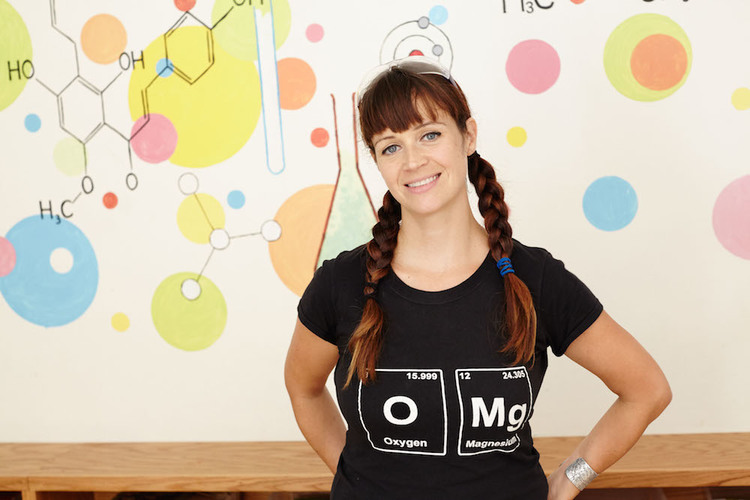
“Because I’m a girl engineer, everyone always thinks I started this business with my husband,” says Jenny Young with a laugh that only vaguely disguises her frustration. An airplane pilot, a graduate of Purdue University’s mechanical engineering program and now, owner of Brooklyn Robot Foundry—one of the borough’s hippest destinations for the under-12 set—Young is, alas, no stranger to cross-eyed looks from a certain stripe of “traditionalist” who thinks that science is better performed by boys and men. And although she owns that women engineers are a definitely minority in the US, “For me, it’s not an issue,” she says.

This may be because of the strong and encouraging start she received from her parents growing up in Chagrin Falls, Ohio. “They were both very hands-on,” Young says. “My dad built a car from scratch, and the lawnmower, and the rototiller, so I was always with him in the garage, building stuff. And my mom makes all kinds of things with her hands.” For a while, Young thought she’d pursue a career as a pilot, then decided to focus on aerospace engineering instead. She moved to New York and began working for a software engineering company called Wireless Generation—where she met both her husband, Ken, a computer scientist, and her original business partner (now out of the picture), David VanEsselstyn, who works in education. And pretty quickly, she began to long for the various joys and liberties that come along with fabricating things on your own.

“It was hard not to have a workspace with all my tools in it,” Young says. “I needed that continuation of being able to build.” She joined an early, shared maker space in artsy East Williamsburg. And then, one fateful afternoon in 2012, she reserved time at a sewing studio further south, in the now gentrifying neighborhood of Gowanus, to stitch up little books for her pending wedding to Ken. She befriended the owner, who asked if she’d be interested in subletting the space. And Brooklyn Robot Foundry in its first incarnation—there’s now a second location in Manhattan’s Tribeca—was hatched.

Young’s own experiences—as an engineer, as a maker of things, and now, as a mom to 2-1/2 year old daughter, Adalina (son, Ero, is on the way)—heavily influenced the weekend, afterschool, and summer curricula she’s developed for toddlers through 7th graders (and sometimes adults). “The way I was raised in the Midwest, we were always taking things apart and asking questions,” she says. “We didn’t watch much television; we were doing things with our hands. It makes your brain work in a different way, and it makes you wonder, how does that work? If you don’t get that experience as a kid, you don’t think about those questions, and that’s a shame.”

A few years back, Young asked an early group of urban kid robot builders, “How does a stoplight work?” Their answers were funny—and slightly unsettling (one example: “There’s a mini Mickey Mouse in there!”). But under her and her assistants’ tutelage, says Young, “By the end of a week, they totally get how things work.” And they’ve learned simple construction and coding skills to boot.

On a recent summer morning, the Gowanus output of the Foundry was humming with tweens collaborating on a host of robot projects. “It’s a nice hum, though, isn’t it?” Young asked. “It’s the hum of people working who are doing things they enjoy.” The robots were being assembled by their excitable but focused overlords out of simple and often up-cycled materials like aluminum foil and cardboard boxes, and were attached by wires to batteries, servos, circuit boards, and laptops, and in some instances, such bells and whistles as LED’s, sound and motion sensors.  They included at least two candy dispensers, a mousetrap, and a maze for racing homemade hexbugs and they were being (mostly) patiently programmed using a language called CREATE Lab Visual Programmer, created at Carnegie Mellon.

Surveying the scene, Young smiled—and continued to smile, ever wider, as she visited worktables and asked and answered questions. “Kids are so much more creative than we are,” she said. “[Adult] people ask me, Why don’t you do Lego robotics? But that’s expensive, and I want kids to know, this is a motor that costs a couple of bucks at RadioShack, this is a gearbox. And you can make anything you want out of whatever you’ve got around, because you have the confidence and the ability.”

The assembled group included some girls—not the almost 50 percent Young can see among younger classes of participants, but somewhere closer to 25 percent. Like female scientists before and concurrent to her, Young is baffled by how, not to interest girls in STEM topics in the first place, but to keep them interested and engaged as they get older. “When it comes to the gender breakdown, the thing I find most disturbing is that the numbers tank around second grade. We’re hoping that as we’re here longer, we can get them excited and keep them longer. I really think you have to catch them young and show them how cool these things can be. That’s how you get them to come with you. I hope.”

Young’s also been doing concerted outreach toward both girls and their parents, with a, women in tech lecture series, meant to act as a sort of sampling of the diverse and fascinating panoply of STEM-related jobs that real women have; and a girls club where parents and daughters can come in and build together. Nevertheless, “We don’t do specific projects for girls,” she says. And perhaps steering clear of this sort of restrictive thinking will help Young yield significant changes in attitudes about girls in math and sciences, as well as how they should act and behave. “I’m an engineer, and I was also a princess for every single Halloween growing up,” she says. “We give them the base of understanding about how to turn components into, say, a crane. Then, if they want to make it look like a princess, we don’t care! We just want them to understand that it’s cool to build.”

Photographs by Roy Beeson

DC Thrifty Mom Nicole Luke and her Family, North Petworth, Washington, DC

The Luke Family at DC's Takoma Park Recreation Center

THE LUKE FAMILY AT DC’S TAKOMA PARK RECREATION CENTER

By Dawn Van Osdell

Just a few short years ago, Nicole Luke was working for the Archbishop Desmond Tutu’s now defunct Tutu Institute, where she organized pilgrimages to South Africa for those seeking spiritual renewal, and even met the Dalai Lama. Today, she’s the mom behind the popular community blog, DC Thrifty Mom, continuing what she calls her “civic responsibility” by helping parents find rewarding experiences to enjoy with their kids—without blowing the family budget or even leaving town. You’re likely to find her; her husband Orin, a local real estate agent; and their 9- and 4-year-old daughters, taking advantage of DC’s incredible parks or tinkering on a project at a free workshop. “It’s just about knowing how to find enriching family experiences,” she says.

Here, Luke talks to us about making the transition to a one-income household before starting her blog and discovering that kids don’t care about expensive stuff nearly as much as they care about spending time together as a family. She shares tips for stretching the family dollar in one of the country’s most expensive cites, and gives advice on where to look for inexpensive family fun no matter where you live.

Which DC neighborhood do you call home? We live in North Petworth, a gem of a neighborhood that borders Petworth and Takoma Park, in Northwest DC. It has a wonderful community feel in an urban environment. We truly know our neighbors, which is something we never expected when we moved here 15 years ago. We don’t have our own families here, but we have a lovely 90-year-old neighbor—Aunt Georgia, as my kids call her—who’s always available to help with the kids.

What else does North Petworth bring to family life? We live on the same block as the Takoma Park Recreation Center, which we visit often. We even held our daughter’s third birthday party there. Thanks to a DC initiative to get kids moving and encourage outdoor play, all city parks have been renovated, many with pools and spray grounds—outdoor play spaces with sprinklers and water features. They are beautiful and a lot of people have no idea just how much they offer. For instance, at Tacoma Park, this fall my daughters will take swim lessons, ballet, no-cook cooking classes, and art classes—and I’ve paid just $150 for it all.

Wow! What other local finds have you discovered? We’re between branches of the DC Public Library, so we’re able to enjoy programming—which is often free—at both. When my girls were younger, we attended story time. Now we take advantage of week-long programming. My oldest attended an amazing science camp held by Glaxo Smith Klein at the Georgetown library branch, and has also done make-and-tinker camps. We’ve also enjoyed free tickets to the Nationals game by each child logging just eight hours of reading over the summer. And we have the Smithsonian  in our backyard, which offers loads of incredible programming.

Did discovering all these incredible deals inspire you to start your blog? Yes, I started it two and a half years ago when I became a stay-at-home parent. My job as director of operations for the Tutu Institute was relocating, and while I had the opportunity to move with it to South Africa, I had a three-month-old infant and the time just wasn’t right; I decided to stay home with my children.

I had been used to simply writing a check without much thought when we wanted to do a family activity. When we moved to being a one-income household, I had to make an intentional effort to find and choose activities to fit our budget. I was amazed at what I found, and wanted to share it with others. I had a goal of acquiring 1,500 followers in the first year. I exceeded that goal in our first quarter, and today the blog has nearly 15,000 followers. People want to know what’s available, and I want them to share what they know, too. A thrifty friend—as I call my readers— recently told me that the National Park Service offers free roller skating. Wouldn’t you know—we went to Anacostia Park and found a skating pavilion that even offered free skate rentals!

Are you also thrifty travelers? We love going to Shenandoah Valley, which happens to have a lot to offer. We fish and go to the indoor/outdoor water park. We also love Bengie’s Drive-In Movie Theater outside of Baltimore, where my sister lives; and White Oak Duck Pin Bowling.

For our readers who live outside of DC and the surrounding area, what do you recommend for finding inexpensive family fun? There are tons of free family workshops at Home Depot, Lowe’s, and craft stores like Michael’s  and Lakeshore Learning, where each kid can make a craft. Barnes & Noble offers free story time and activities every Saturday. Lego stores offer mini-builds. The National Park Service is also an incredible resource for families. Right now, they are offering free park passes for all fourth graders.

And everyone—kids or no kids—loves annual free product days, including free ice cream cone days at Häagen-Dazs, Ben & Jerry’s, and Italian ice at Rita’s Italian Ice.

You tell your readers to find a balance. Where does your family balance out its thriftiness by making a splurge? I tell people to splurge on what your family thinks is fun and worth it. For us, it’s dining out, attending exhibits, such as the recent BEACH Exhibit—an awesome exhibit with an ocean made with a million plastic balls—at the National Building Museum; and taking the Boomerang Boat Tour in Georgetown. A lot of families will splurge on tickets to the circus or Disney on Ice, which is great because it’s all about the experience that kids will remember forever. It’s the time that really matters—that’s what makes kids the happiest. They really don’t care how much you’ve spent.

Photographs by Jeffrey Morris


Kid-Lit Author Linda Urban on the Joys of Reading

By Lela Nargi

Having just released her latest book, an action-packed mystery for kids age 7-10 called Milo Speck, Accidental Agent, kid novelist Linda Urban took time out of her busy author schedule to chat with us about the importance of reading, writing, and building worlds on a page to allow kids to explore who they really are.

There’s a lot of talk about why picture books are so important for kids. But what’s so special about middle grade? When we’re in kindergarten, people say, What do you want to be when you grow up? And we can say, I want to be a fire fighter, or a doctor. And people say, That’s so great! In the middle grade years, when people say, What do you want to be and you say, I want to be a doctor, they say, Well you better start studying! Suddenly, the future has this weight that before was all play, but we want that play to persist. Middle grade novels let us figure out who we are and where we fit; they let us hold on to that childish imaginative past while also recognizing that the decisions we make might have an impact on the future.

My son, Jack, is about to turn 11. He reads adult-level physics books, but he also believes it’s possible that he’s going to get his Hogwarts letter. He both knows and doesn’t know, believes and is skeptical. That’s what so perfect about writing for that age and being that age. My daughter, Claire, is 13 and it’s harder and harder for her to hold on to that magic.

Many kids still love to be read to in the middle grade years. Are you hoping that will happen with Milo? Milo is written with a rhythm and I hope it will be read aloud with a parent or in a classroom. It also has a relationship between a father and son, and I hope a parent reading it aloud will get a connection with his kids as he’s reading to them.

Did anyone read to you as a kid? I have a memory of being read Charlotte’s Web in the 2nd grade by a teacher who was otherwise terrifying. She had a bad temper and was nearing retirement and could see it waiting for her outside the classroom door. But at read-aloud, it got very quiet and we all sat in what we now call criss-cross-applesauce on the green carpet in front of her chair. And her voice changed and her demeanor changed, and it was this magical bubble where we were all safe. At the time, I identified with Fern and Wilbur, but years later when I read the book aloud to my kids, suddenly I was Charlotte—I had never identified with her before. By the end of the book I was bawling and my kids were like, Mom she’s a spider and Wilbur’s fine!

What was the importance of books in your childhood? I grew up outside Detroit, a suburban existence in a subdivision—kind of a Judy Blume childhood. Although, I always felt uncomfortable reading her. I was such a late bloomer I would think, Is that going to happen to me? Am I supposed to be thinking or feeling that? Because I don’t!

But the books that made the biggest difference to me when I was young were all the Beverly Cleary books. I loved Ramona; she was so not like me. I was very well behaved and wanted to please. The audacity of Ramona was just so appealing to experience on the page. I loved the Little House books, too, and I was Laura Ingalls for many a Halloween. I also was child of the bicentennial year, which was so formative. I read every revolutionary biography that there was. I begged to stay up late to see the Bicentennial Minutes on CBS. It made me wish I was an East Coast person, so I could be truly a patriot.

But after 4th grade, I went to a Catholic school where the library was locked all the times unless there was a volunteer, and most of the books were 30 or 40 years old. So when you did get to take a book out, it was about a girl who was deciding whether to become a nurse or just get married. I kind of stopped reading then. But when I did read, I liked a book that saw me in one way or another, and that’s what I want to do for kids—write about small things that matter in a big way to them. Milo Speck is an exception, because it’s an action adventure, but even then, Milo is a small boy in a big world who’s in over his head. That is how I felt often.

We’re sitting today in BookCourt, a great independent bookstore in Brooklyn. Do you think it’s important to bring kids to places like this? Very early on, kids learn by watching us what things are important to us. I lived with my parents near Detroit during a recession and there wasn’t a lot of disposal income around. But when my parents had the money, we got a book. That said to us, This is a valuable thing, and we value you enough to give you this thing. It can be hard at the picture book age to spend $17.95 on a book that has 32 pages that may or may not become that favorite book the kids reads over and over. But when you get one of those for your kids, you’re telling them, This is where our priorities lie. My own kids know I never say “no” to books and art supplies.

Your son is about Milo’s age. Does he identify with him? Milo was actually written for Jack. My first three books are very introspective and, even though I don’t believe in girl books or boy books, they have girl protagonists and they’re quieter. But my son came to me and said, Your books are pretty good but I want you to write something for me. I said, What’s that? And he said, I want HAM. I said, Like lunchmeat? No, like Hero, Action, Mystery.

As I was writing, Jack was reading and he would tell me when he didn’t understand something and he’d laugh at the good jokes and squint at the not-so-good jokes. He was incredibly valuable to me. As far as identifying with Milo, Jack is not as mechanical as Milo is, but he liked that Milo could look at the internal workings of a dryer and figure out how that would work and how you could ruin it, and foil the plot. For Jack, that whole idea of “even a kid can make a difference” was really, really appealing.

Everyone has their own answer to the question, Why is reading important? What’s yours? On a hard day, my daughter can go to the stairs to the attic, where we keep our picture books, and she’ll take down some of her favorites from when we were little, like Miss Rumphius, and some that I didn’t even know meant something to her. She’ll grab those and will be in her bed with them for the evening. It’s a total comfort.

But I think one of the best things that books do is they allow you to say, What would I do in that situation? What would I do for my friends? What skills do I have, abilities, weaknesses? Am I strong enough to say “no” in a terrible situation? Both my kids are really good at “what if.” They don’t always make the right decisions, but they’ve practiced through stories to think outside what everyone else is doing. And that gives them power.


Clean-Water Activist Andrea Neal on Raising Eco-Conscious Kids

Couple swimming

By Dawn Van Osdell

It started with an unexpected life-changing moment at a Jack Johnson concert—a performance often celebrated for its conservation message as much as for its music. In 2008, Andrea Neal, an avid surfer, was newly graduated with a Ph.D. in molecular genetics and lipid biochemistry, and celebrating her birthday when famed oceanographic explorer and environmentalist, Jean-Michel Cousteau, took the stage to speak about the need for better marine conservation efforts.

“Hearing him, I knew I needed to leave academia and pursue helping people and the environment in a different way,” says Neal. The next day she was in his office, offering her help and embarking on a journey in which she explored 8,000 miles of pristine ocean; studied devastating marine pollution—including the Great Pacific Garbage Patch off the coast of California and the aftermath of Japan’s Fukushima nuclear power meltdown—and ultimately, founded Hope2o, a company that enables consumers to test their tap and filter water for harmful toxins.

Andrea Neal and her team at hope20

ANDREA NEAL AND HER TEAM AT HOPE20

“It’s my way of making my safe water dream a reality,” says Neal, now a new mom and step-mom living with her family in Noleta, a wee, tiny California town wedged between Santa Barbara and Goleta. If, as she maintains, “Everyone has a right to both understand and make decisions about their family’s resources,” then with Hope2o she’s giving them—giving us—an affordable, reliable way to do just that.

Here, Neal shares six ways that her fervor and commitment to clean water translates into raising environmentally conscious kids. Maybe there’s something in here that will inspire you to talk a little differently to your kids about what they see at home and in your own neighborhood, and to involve them in making changes that may well improve the world.

1.   Share your passion. Neal’s family is involved in her work, which—lucky for her—also happens to be her passion. Her husband, Stephen Proulx, a professor in the Department of Ecology, Evolution, and Marine Biology at University California Santa Barbara, is credited with naming Hope2o and being a constant support system and sounding board. Neal’s father, Dr. Gordon Neal, is the company’s chief operating officer and a major investor “in both time and money,” she says. Her stepdaughter, Sabrina, helps educate and spread the word at informational booths. And baby Rowan is the star of the company’s advertising campaign. “They are very exposed to my work,” she says. “My environmental passion directly links to a healthy, happy future for them.”

2.   Do your best with the resources you have. Neal admits that her family isn’t always as green as they aim to be, but she’s found simple, healthy approaches that are realistic for her busy family life. For instance, they do not drink from plastic (plastic constitutes approximately 90 percent of all trash floating on the ocean’s surface, a whopping 46,000 pieces of plastic per square mile. They eat local and organic when they can. And, she confesses, they have more reusable bags than anyone on the planet.

3.   Choose an environmental cause that speaks to you. No surprise—Neal’s cause is anything that has to do with water. “I have been to the middle of the ocean and have seen our trash floating there,” she says. “This makes me a huge advocate for environmental solutions.”  She supports many eco-conscious organizations, including Michel Cousteau’s Ocean Futures Society for which she is an advisor; Mission Blue, led by famed National Geographic Society Explorer in Residence Dr. Sylvia A. Earle; Blue Frontier Campaign, which inspired Neal’s Operation Water Legacy program (OWL), an initiative to chemically map the New Jersey water system; and Blue Marble Project, a program that links mental and physical health with a connection to water.

4.   Go outside to play. Both in and out of the water, Neal’s family spends a lot of time outside. She and her husband surf, dive, and snorkel. “We don’t get in the water as much right now with a small baby, but I am very much looking forward to some board time with him,” she says. Their daughter occasionally surfs and is the resident boogey boarder. They also enjoy hiking and camping as a family, and they all play soccer. “As Jacque Yves Cousteau used to say, ‘you protect what you love,’” says Neal. “There is something special with nature that is healthy for us both physically and mentally.”

5.   Encourage critical thinking skills. “You can’t protect what you don’t understand,” says Neal, again paraphrasing Cousteau. “With so much information on the Web, it is hard to sort out what is real and what isn’t.” Help your kids find accurate information and help them process it. “You want them to put their energy and time into real causes,” says Neal.

6.   Commit to your kids’ future. “I hope that our efforts help secure clean water and a clean environment for our kids,” says Neal.  “With the rate of population growth, our ability to support everyone with the resources we have is diminishing quickly. It is going to take a global effort to try and change the current path that we are on. But my kids are 100 percent worth all of my efforts.” The above tips will hopefully help you to maximize the impact you have on yours!

andrea neal and her son rowan

ANDREA NEAL AND HER SON ROWAN

Photographs courtesy of Andrea Neal

Profiles of Childhood: Jessica Asfar, Fashion Student and Sitter, New York, NY

Sewing a dress

Our childhoods shape us and prepare us, not only for our own lives, but for the joys and values we’ll pass on to others. 

As told to Lela Nargi

My parents first started letting me come into the city from the suburbs of Red Bank, NJ, when I was about 16 years old. I’d already known I wanted to be a fashion designer since I was 9 years old—it was either that, or a lawyer, or a dolphin trainer!

But in 2011, I saw the Alexander McQueen exhibit at the Metropolitan Museum’s Costume Institute. That was so breathtaking and beautiful and weird, it really got my mind going, especially this gold coat made of feathers. I’d already taken some classes at the Fashion Institute of Technology (FIT) in high school, and life drawing classes, which got me interested in the science of the body. And in 2012, I moved into the city to study fashion.

On the right, the inspirational Alexander McQueen feathered coat

ON THE RIGHT, THE INSPIRATIONAL ALEXANDER MCQUEEN FEATHERED COAT

The only other person in my family who can sew is my aunt—she helped me make my prom dress. And my grandfather was a tailor, although I never got to meet him, but I guess he’s where I get my talent from. Originally, I wanted to go into costume design but as time went on I realized intimates was the field that interested me the most. Intimates are hard. There are so many things a bra is supposed to do; you have to keep all the utility elements while still making a thing you want to wear. That’s challenging, but fit is the biggest struggle. Eventually I want to have my own company—I wouldn’t mind being the next Agent Provocateur! And I’d like to do lines that cover a bigger spectrum, with more options for women of different sizes. At the moment, though, I’m a sophomore at FIT taking about nine classes a semester, and I also intern at an international wholesale company that specializes in pajamas and intimates.

I started babysitting when I was 11, for my neighbors who had 4 kids: twin 1-year-olds, a 4-year-old, and a 6-year-old. It was insanity, but it was the best crash course I could imagine. I’ve been babysitting ever since. I started sitting for UrbanSitter when I moved into the city. I love it, and I always need money, because living in New York is so expensive. Plus, being away from my family, I get to be with other people’s families, which is really nice; it gets lonely being in the city by yourself.

Fashion has taught me a lot about patience. If you work too fast you make mistakes and then have to do it 10 times instead of once or twice. I’ve learned to slow down and think about what I’m doing, which also helps me in babysitting. Working with children, you have to take a step back and hear what they’re saying to you with their words or their actions. You have to be patient to grasp what they’re telling you.

Photograph of Jess by Roy Beeson

Profiles of Childhood: Nicole Miles, Doula and Sitter, Chicago, IL

As told to Lela Nargi

I grew up on the Southwest side of Chicago and I’m the oldest of three girls. My parents were high school sweethearts and have been married for 28 years. My father works for the Chicago Transit Authority and my mother now works at a local university.

nicole_milesI’ve always been surrounded by babies and children; in church, in school, in my family, babies were always around. So, I loved children from a very young age. In elementary school, I would always volunteer to help out in the preschool class. My middle sister, Kayla, is only two years younger than I am but my youngest sister, Victoria, was born when I was 11 years old, so I became the built-in babysitter—this was the same year my mother opened a home daycare and I helped out there, too. My cousin had triplets my sophomore year of college and when I came home during the summer and holidays, I spent my free time with them.

I attended all-female schools from 6th grade through college, so I’ve always been surrounded by women, too. It was during my mother’s pregnancy with Kayla that I developed a love for medicine, specifically as it pertains to women’s health; I attended childbirth education classes with her and asked questions at her doctor’s appointments. During my senior year at Smith College, I became a trained doula. My passion is working with birthing women, helping them find their inner strength through the labor process. In Chicago, more women are choosing doulas and midwives during their pregnancy and it’s great to see this shift. One of my personal goals is to bring the power of the doula to every woman, especially in communities that are often overlooked.

Becoming a doula is not my ultimate plan, though—I’m in the process of applying to medical schools to become an OB-GYN. However, the personal care and education involved in aiding new mothers to bring life into this world has been invaluable. The first birth I attended alone was a moment I had to step out of my comfort zone. I was the doula on-call at a local hospital and I was brought in to help a mom who was experiencing labor pains and personal issues. This was my first time meeting her, right in the middle of one of the most difficult times in her life! All my training kicked in and the first thing I did was create a safe space for her. I let her know I was there to help in any way that I could. My biggest challenge was getting her to stay calm and trust her body. She had to tune out the world around her and focus on the moment.

In all, I’ve attended about 20 births, which is also helpful when I babysit. New moms appreciate that I’m a doula because I have experience with newborns and postpartum care. New moms, like laboring moms, need to be supported and reassured that their baby is fine and that they’re doing the right things.

When I babysit, I’m notorious for being a bag lady—I always bring homework and food. The kids I sit for always ask why I carry such a big bag. I tell them I’m talking science classes so that I can apply to medical school and become a doctor. The older kids like to see pictures or hear stories about the babies I care for. Becoming a doula has helped me become a better listener, comfort, and healthcare provider—all skills that will be important in my future life as a physician.

Photograph courtesy of Nicole Miles

How to Be a Low-Stress Parent

Person overlooking pond

By Mary Pulido, Ph.D.

Parenting is the biggest responsibility you will ever undertake as an adult. Why didn’t someone tell you it would sometimes mean you’d feel old before your time, exhausted by 7:00 p.m., too stressed out to think straight—and you still have to help your kid with his homework?

Don’t stress your own stress. Plenty of parents feel just like you do. The key to surviving and thriving is taking care of yourself. As they say on the airplane, put your own oxygen mask on first, then assist your children. Too often, self-care for parents is the first thing we let go of. So, here are a few tips to help you keep your calm, balance the competing priorities in your life, and feel energized.

1. Make time for “me” time. This means taking time to care for yourself both physically and emotionally. Find even a few minutes every day to exercise, read, nap, or work on a special project to recharge your batteries. Your role as a parent can be overwhelming. Sometimes just having an hour to go to the gym or walk outside can lift your spirits and can change your perspective. And simply having a cup of coffee with a friend can help you unwind.

2. Cut yourself some slack. There may be days where you get everything done on your to do list. But some days (maybe even most days), everything that you planned to do falls by the wayside. It’s okay to leave the laundry for another day, or skip the vacuuming, especially after a long work week. This is particularly true for new parents, who find their routines turned upside down. Abolish the word “guilt” from your vocabulary. Instead, think about all of the wonderful things you do for your child each day.

3. Shore up your support system and don’t be afraid to ask for help. Many parents are unused to asking for help. Sometimes we think, “I should be able to manage this infant/child on my own.” But often, the people around us are happy to help out. If they don’t ask, make your needs known, to your spouse, significant other, friend, or neighbor. You’ll be surprised how many of them will jump at the chance to watch a baby while Mom or Dad runs to the grocery store.

4. Get the sleep and nutrition you need. Sleep deprivation makes all problems loom large. Health experts recommend at least seven hours a night, but this is probably challenging if you’re the parent of an infant or small child. Grab sleep when you can—naps revitalize too. Also, remember to eat healthy meals; you’ll feel more energized. Pack a nutritious lunch for work the night before so you’re not depending on fast food.

5. Accept that on some days, parenting will be challenging. If the baby won’t stop crying and you are exhausted and feel like crying too, put the baby in a safe and secure place and leave the room for a few minutes. As long as you’re sure it’s not a medical emergency, the baby will stop crying— truly, she will.

Your older children may simply not listen to you at all or break the rules you’ve established. The New York Society for the Prevention of Cruelty to Children encourages the use of effective discipline techniques with children. Discipline is more effective and more nurturing when parents know how to set and enforce limits and when they encourage appropriate behaviors based on their child’s age and level of development. To be effective, discipline needs to be consistent, perceived as “fair” by the child, age-appropriate, and should teach the child how to act in the future.

6. Make friends with other parents. It’s good to have other parents to commiserate with, as well as share the happy stories about your children. It also helps to break the isolation that new parents can feel as their old lifestyle disappears with their new 24-hour responsibility as a parent. Set up a regular get together and perhaps a time to watch each other’s children, too.

7. Make time for your spouse or partner. Just as you need to make time for your children, you need to make time for your parenting partner. Nurture this relationship too. Date nights should be scheduled—or any time that works for you both. Hire a sitter. Spend time talking to each other, about each other!  Keeping the bond strong will benefit your entire family in the long run. On the flip side, if you are single, try not to depend on your children for your emotional needs or companionship; children simply do not have that capacity to act as substitute partners. It’s best to seek out other adults.

8. Have an emergency support plan. If you think you are going to “lose it” and find yourself getting angry or frustrated with your baby or child, reach out for help. Ask your spouse, friend, or neighbor to take care of him while you regroup. If you think you are depressed, and it’s quite common, talk to your doctor about what can help. The demands of parenting can be fierce and draining, but they pass. Call the parent helpline at 1-800- CHILDREN (1-800-244-5373) or the National Parent Helpline at 855-4A-PARENT.

Photograph by Joshua Earle via Unsplash.com

Julie G. is the Pied Piper of Tiny Urban Scientists

Julie G.

By Lela Nargi

For the past several years, kids have been STEMed up the wazoo as the national conversation about education—and more particularly, what’s wrong with it—has centered on a perceived lacking in Science, Technology, Engineering, and Math.  Also lacking in the face of much high-minded assessment? A sense of fun, and of the integral, integrated way that science flows through our lives and the lives of our children, (yes, even city children), if we just know how to pay attention.

Enter Julie G. and her uncluttered outpost hunkered on a bright corner of Brooklyn’s Windsor Terrace, Tiny Scientist. Here, for the last two years, the former metal singer turned elementary science teacher shows area kids what’s fun and oh-so-relevant about science in the city. She’s uniquely suited to the task: “I was never interested in science in school,” she confesses. “We had a third grade teacher, ‘Mean’ MacLean, who was actually mean and didn’t teach us anything.” As a result, she initially shirked college until, enrolled in her 20s in an adult learners program at City College, she found herself taking a basic science course. “The teacher showed us slides of cells multiplying and I was immediately hooked,” says Julie, who went on to get masters in biology, math, and science elementary education at Hunter College.

After 10 years teaching science to public school kids, and having just become a first-time mom herself, to daughter, Quinn (Julie’s husband, Andrew Schneider, is a sound engineer for Blue Man Group), she took the plunge and opened her own little science oasis. We caught up with her to get her take on what’s so fun, and what’s so relevant for city kids, about all kinds of science.

Rocks: In the Tiny Scientist class “Rock Cycle Riot,” geared towards kids aged 5 to 10, children put on their paleontology hats to study the Jurassic period and recreate an excavation. Says Julie, “We use lots of visual references and discuss how all rocks started as one type of rock, and changed into other types of rocks over millions of years with pressure. In a class like this, there’s also measuring, sequential thinking, history, sensory development and literacy, because we read books about it.”

But what do prehistoric times have to do with the science we see in the world around us today? “One of the big things we learn is that things change over time,” says Julie. “That’s a big skill for kids, to be able to observe things that happen in some sort of sequence. One of the ways that kind of thinking is applicable to any environment, but particularly the city, where people think we don’t see any nature, is with leaves changing with the seasons. But there are so many ways it works for kids. Kids living in the ‘concrete jungle’ see buildings being built up from big holes in the ground.  And they can experience how forceful and important nature is by taking a closer look at the ground right beneath their feet. Very few living things can break rocks, but trees can! And especially here in Brooklyn, we see the sidewalks breaking from the tree roots growing out of them.”

Candy: Working with treats isn’t just about satisfying your sweet tooth. In fact, for kids as young as 4 who are enrolled in Tiny Scientist’s “Candy Chemistry” class, there’s almost no sugar-eating at all. Even though Julie does show kids how to add agar agar to sugar syrup to make gummy candy, “Actually,” she says, “it’s just a fun anchor for studying real science concepts, like pressure, which we use to smash things like marshmallows.”

Air pressure, she points out, is literally everywhere, even though we can’t see it. Standing on a subway platform, almost every kid in New York has felt air pushing through the tunnel as the train has neared the station. But even a task as mundane as blowing bubbles on the sidewalk is loaded with useful information for kids who are learning to observe closely.  “Bubbles can tell you about the wind, how fast it’s moving, the direction it’s coming from, how air moves around corners,” says Julie. “Learning about this is training kids to think about what doesn’t seem to be there but is actually all around you.”

Making: Julie’s class “Maker Magic” is a kind of free-for-all of engineering and tech concepts, where kids in grades 2 through 5 make things like lava lamps and put together working circuits. These are building blocks for all manner of things that shelter us, and keep us comfortable as we live and work and move from place to place. “We just looked at propellers and talked about sustainable energy versus fossil fuels. Then we built solar panel circuits attached to small motors,” says Julie.

How does all this pertain to city living? “There’s a block right here in Windsor Terrace that’s becoming a heavy topic of conversation, because there are locally based organizations trying to get homeowners to put solar panels on the roofs of their houses. A lot of schools are experimenting with using them to power machines, and the panels are becoming more and more a part of city life. Even the Brooklyn Botanic Garden uses them, and some of the bridges have solar lights.” And possibly the best part of all for parents hoping to help their kids become keen observers, even after their class at Tiny Scientist has draw to a close: “Trips to see these things cost nothing!” says Julie.

Photographs by Roy Beeson.

Don’t Stress The Homework: We Bust 3 Myths to Show You How

Girl doing homework

By Barbara Dianis

Homework is an integral part of the journey to be educated for students everywhere. But it can cause tremendous arguments when three misunderstandings and misconceptions are prevalent between parents and their children. To clear them up, here are suggestions for making homework more productive and peaceful in your home!

Myth #1: I can’t make my child focus on homework time without making it an endless endeavor.

Truth: The ability of parents to keep kids focused during homework time starts with creating a daily schedule. Look over homework assignments together and decide how long each assignment should take to complete. Write this lightly in pencil at the top of the assignment. You can then determine appropriate breaks—which help improve focus—after one-half of each assignment is completed at an average or above-average level. Each small break can be given in 2-5-minute segments until the homework is completed.

Myth #2: Homework is totally my child’s responsibility and I shouldn’t intervene.

Truth: Generally, the purpose of homework is to help kids master skills on their own at each grade level. In order for it to be effective, though, it needs to be done correctly so learning gaps don’t result. If it isn’t, you may need to give assistance, going over lessons with your kid to make sure he understands what he’s meant to actually learn.

Myth #3: My son’s teacher says he is not consistently turning in his homework, but there’s no way for me to constructively help him to do this.

Truth: Turning in homework is an organizational and executive management skill with which numerous students struggle each year. One easy remedy is to have your kid file all of his completed homework in an accordion-style file folder that has marked spaces for each class. Back this up by placing a sticky note on his agenda book with a reminder to turn in his homework for each class. At the end of each school day, check to see if the homework folder has been emptied.

Barbara Dianis, MA ED, is the author of Grade Transformer for the Modern Student.

Photo via Shutterstock.au

Courtney Brockmeyer Pays it Forward with Backpacks and School Supplies

Courtney's family

By Dawn Van Osdell

Parental guilt can be a powerful motivator. In 2013, Courtney Brockmeyer, like many working moms, felt enslaved by the long, stressful hours that often come with working for a big company in a big city. When her youngest daughter—then 7 years old—asked her why she worked so much, she couldn’t find an answer to justify the time she spent away from her family.

“I knew something had to change,” she says from the home her family now shares in Moraga, CA, a quaint residential town east of San Francisco and the headquarters of Sydney Paige, a “social good company” Brockmeyer started in 2014 and named after her and husband Dale’s daughters, Sydney and Paige. “If I was going to work that hard, my work needed to have an impact. I needed to make a difference,” she says. Brockmeyer can now tell her kids that’s she’s working to help supply the more than 16 million kids who live below our country’s poverty level with the materials and tools they need to stay in school, and to make their own mark on the world.

She started Sydney Paige from her previous home in Los Angeles with little more than a sense of responsibility to her family and the families of others, a desire to do good, and a few other moms willing to lend a hand. It operates on a buy/give business model, similar to the way shoe company Toms and optical outlet Warby Parker work. Through the company’s website, Amazon.com, or local events, buyers purchase high-quality backpacks; accessories like lunch boxes, nap blankets, and bag tags emblazoned with inspiring messages, such as Give Back, Respect and Creativity; and children’s books that Brockmeyer has written to illustrate the importance of education. For every purchase, the company fills a matching product with school supplies, hygiene items, food, clothing, and monetary donations secured through partnerships. It then distributes it to a child in need through a non-profit organization of the buyer’s choice—everything from local schools to national and global organizations like Baby2Baby, Volunteers of America’s Operation Backpack, and the Salvation Army.

Why backpacks? Searching for a way to have a positive impact  on education, a cause that spoke to her, Brockmeyer found that kids most frequently drop out of school because of lack of confidence and lack of supplies. “If you don’t have a backpack to take to school, everybody knows it. It makes you stand out and shouts to the world that you’re poor, “ she says. No kid deserves that stigma, she says, and every kid deserves the chance to proudly go to school, graduate, and eventually break the vicious cycle of poverty that entraps so many disadvantaged kids.

Sydney Paige’s mission originated from more than just anonymous research. A decade-long employee of food giant, Nestle USA, she conducted market research in her role as business manager by meeting with lower income consumers in their homes. She also took them food shopping to observe their buying habits and budgets. She saw first-hand what need looks and feels like. “We all know poverty exists, but we have no idea how others live or how little they have,” she says.  During focus groups and home visits, she saw not only empty refrigerators, but also a lack of books, crayons, and art supplies. “You can’t buy these things when the choice is between that or food,” she says.  And, yet, how can a kid be a kid without them ?

All this helped Brockmeyer to channel a sense of personal responsibility she’d carried since college. She’d won a scholarship to attend Pepperdine University, a highly regarded private institution with a price-tag to match its reputation and Malibu, California zip code. When the scholarship wasn’t renewed her second year of college, a second award—the Raleigh Runnels Memorial Scholarship from the chancellor of her university—allowed her to continue her education. “Winning that scholarship gave me a huge responsibility to prove to myself and to others that I was worthy of such a gift,” she says. “I knew I had to someday make a huge impact.”

Sydney and Paige Brockmeyer

Paying it forward through Sydney Paige—like starting any new business—has been a bumpy, and at times serendipitous journey. Just after starting the company in 2014, Dale, also a Nestle employee, took a job as chief financial officer of Dreyer’s, a promotion that moved the family hundreds of miles north of their hometown LA to the San Francisco Bay Area. Amidst the move—getting kids settled in a new school and setting up a home while getting her business off the ground—half of her first product line, a shipment of backpacks designed by a talented designer friend in Austin, Texas and manufactured overseas, was destroyed at the port of entry into the U.S. A second shipment from another manufacturer came back with inferior stitching. They wouldn’t do. “I want shiny, awesome backpacks that kids can be proud of,” says Brockmeyer. “They need to last through school and even beyond.” Already saddled with hundreds of thousands of dollars in personal debt, she trekked on.

As luck, or fate, would have it, she found a “mompreneur,” a seamstress in a neighboring town, who agreed to reinforce thousands of bags for a fee that wouldn’t break an already tapped-out budget. “We took bags to her, load by load, until they were sturdy and ready to go,” says Brockmeyer. Coincidentally, the seamstress is married to a small business loan officer who agreed to coordinate an additional loan, one that ultimately kept the business afloat. “I just kept going, and I just keep going,” says Brockmeyer.

Today, she works at her home, surrounded by loads of inventory—some 10,000 backpacks in a nearby storage unit. Her new best friend is the PTA president at her kids’ school, who is now also the company’s director of sales.  She says her view is far better than it was in LA—rolling hills and pine trees. Her workforce is a collection of dedicated do-gooders, many working without compensation. Together, they have given nearly $1 million worth of backpacks and school supplies to children in need.

“Believe it or not, backpacks can really make it or break it for a kid who is struggling to stay in school because his family is too poor to provide the supplies he needs to attend,” says Brockmeyer. Dedicated to her business of keeping kids in school, Brockmeyer hopes to expand her product lines, partnerships, and retail outlets; and eventually offer scholarships like the one that ultimately inspired her to make all the difference to kids in need.

Photographs courtesy of Courtney Brockmeyer