Did You Actually Lick the Tire?

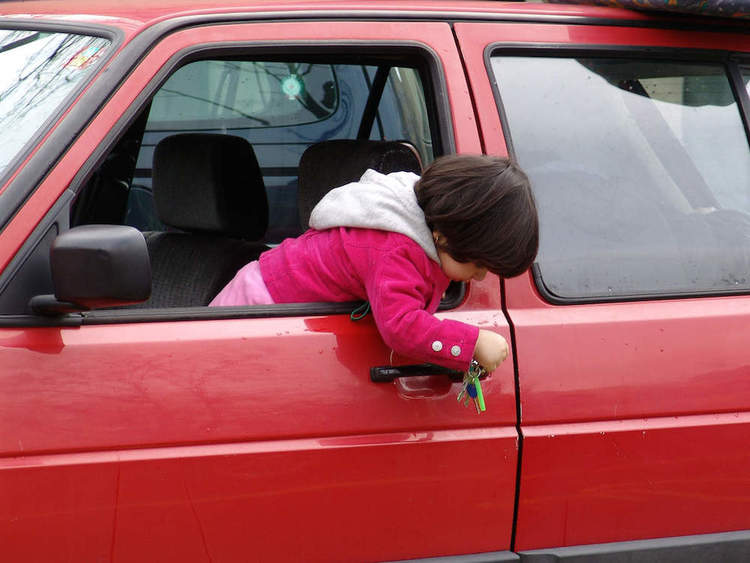
Girl in car

By Leanne Shirtliffe

I wiped my hands on my pants, climbed back into the rental car, and took attendance.

“Will?” I asked. I craned my neck in the direction of the vomit smell and saw an empty booster seat. “Where’s Will?”

Chris looked in the backseat, questioning my ability to conduct a search and rescue operation in a sedan.

“He’s not in here,” Chris said.

I comforted Vivy, who was not upset about her MIA brother as much as she was her soggy stuffed dog. Holding her hand did little to console her.

Chris exited the vehicle to expand his search field.

Through the car window, I heard him address Will in loud muffled tones. I made out the words “disgusting” and “germs,” two terms that cover 95 percent of childrearing topics.

I let go of Vivy’s hand.

“What happened?” I asked as testosterone reentered the vomit sphere.

“Will was licking the tire,” Chris said, reaching for the collection of antibacterial products he’d already unpacked in the glove compartment.

I twisted my neck to look at Will, who was struggling with the seatbelt.

“Did you actually lick the tire?”

“Yes,” he said. He had not yet learned the art of lying, blaming his sister, or farting to draw attention away from the real issue at hand.

“Why?” It was my favorite question to ask rhetorically, in a half-prayer, half-swear manner.

“I don’t know.”

“Did you pee on it, too?” Chris asked.

“No.”

I heard the seatbelt click.

“Let’s go before we have to deal with another bodily fluid,” I said.

Chris put the car in gear and merged back onto the interstate.

We arrived at the RV park none too soon. Vivy’s stomach was churning, Will was bored with my count-the-cacti game, and Chris was tired of driving with his head stuck out the window to avoid the smell of puke.

We stopped at the security gate. A septuagenarian with a clipboard limped to Chris’s window. I was pretty sure we’d just arrived at Springfield’s Nuclear Plant and were being greeted by Mr. Burns himself. Homer was nowhere to be seen.

“Where are ye headed?” he asked.

We handled this question like we handled every customs line up and security checkpoint since we’d started dating a decade ago. Chris stayed silent; I talked.

“We’re visiting my parents,” I said.

Mr. Burns raised his eyebrows. I volunteered more infor­mation, too much as was my habit. I told him the names of my parents, where they were from, how we were not staying with them but my mom’s cousin who’d gone back to Canada for Christmas. I offered to sketch our family tree on his clip­board, but retches from the back seat distracted me. It was Will, who was either imitating his sister or coughing up a fur ball from licking the upholstered seats. Vivy slept.

Mr. Burns unleashed his weapon from a holster. He was packing a walkie-talkie.

He peppered us with more questions than we had at pass­port control.

Finally, he let us through with instructions to return to the office the next morning and fill out some IRS-looking forms in triplicate.

Mom and Dad’s pre-lit palm tree leaned against their RV. We had arrived. We unloaded and I asked for the three things college students request after a night out: a bathroom, a bucket, and a beer.

Mom grabbed a pail and then cradled a gray-looking Vivy in a lawn chair.

Dad handed me a beer.

“I’m hungry,” Will whined.

“I bought cheese sticks and yogurt,” said Mom. “They’re in the fridge.”

I walked into their movie star RV, used some of my bur­glary skills to open the locked fridge, and brought Will a snack he’d eventually vomit up.

I sat down next to my dad, tossed Chris a Coke, and took the first sip of the beer I’d been cradling for the past five minutes.

We recounted the vomit fest and the negotiations that took place at the front gate. Vivy stirred, groaned, bolted upright. While still talking, I grabbed the pail and caught her puke.

I was on my way to dump the pail when I saw Will once again exploring his environment with his senses, something encouraged by his kindergarten class.

“Will you stop licking yogurt off your glasses?” I asked.

Somehow, we survived the Arizona puke-a-thon. We were all healthy for the flight home, but as good guests do, we left a gift for our hosts. My enduring memory of saying goodbye to my parents in their RV was of my mom hugging me as my dad speed-walked to the bathroom, leaned over the mini-toilet, and hurled his breakfast into the sewer. We shared everything.

Hours later, after enjoying a puke-free flight, we arrived home. The week progressed, and the few cardboard dinners I prepared reminded my family that it was a blessing that Chris cooked most of the time. It wasn’t long, though, until we had another food escapade.

When healthy, Vivy—a.k.a. Princess Squirm-a-Lot—was incapable of remaining still for anything as mundane as a meal. She didn’t sit on her dining room chair as much as use it as a pommel horse, a move she’d perfected in utero. On the chair, she squatted, stood, pivoted in a series of practiced moves, plopping down onto her chair for a rest.

“Tie yourself to the chair, Princess Squirm-a-Lot,” I said, as Chris doled out our favorite meal: mystery-meat-on-a-stick fresh from the barbecue. Chris is one of those men who enjoy barbecuing in all weather. The snowier, the better.

Vivian ignored my request. Soon, she wriggled from side to side and front to back over the surface of the chair like she was a gymnast whose score depended upon covering all four corners of the mat. And like the best gymnasts, she sometimes stumbled out of bounds. She was in the midst of informing us which of her kindergarten classmates had been naughty. Dishing out the dirt on other five year olds was a practice we encouraged as it reminded us that other people’s children misbehaved too.

“If Toby pushes one more student,” she said, “the teacher’s going—”

And poof, she was gone. She’d fallen out of bounds, off the chair. Picture the scene from Looney Tunes where Wile E. Coyote sends an anvil hurtling off the cliff heading for the Road Runner, and you have a sense of the speed at which she fell. The sound of skull meeting ceramic tile gave way to a pregnant moment of silence; then a scream was born.

On cue, Will was off, a sprinter out of the blocks. Before she could crawl back onto the chair and reach for another cube of meat, he presented a stuffed animal. “Don’t worry, Vivy,” he said. “I fall off chairs all the time.” It was a lie, the kind I liked. Maybe there was hope, at least for the children.

Excerpted with permission from Don’t Lick the Minivan: And Other Things I Never Thought I’d Say to My Kids by Leanne Shirtliffe. Copyright 2015, Skyhorse Publishing, Inc.

Photograph via tOrange.us & Creative Commons


3 Misconceptions About Moms & Work-Life Balance–Busted

There’s a lot of contradictory and downright erroneous parenting info floating around out there. We’re not afraid to tackle it head-on!

If there’s one thing moms know absolutely it’s that finding just the right balance between work life and home life can be a challenge. But are there prejudices we bring to this equation that might actually be making that challenge bigger than it has to be? To find out, we asked work-life expert and author of the Expert’s Guide book series, Samantha Ettus—herself mom to 9-year old Ella, 7-year-old Ruby, and 4-year-old Bowen—to bust three bit common myths about keeping it all together.

Myth #1: I’m hurting my kids by working.

Truth: Unfortunately, a lot more moms than dads seem to be fueled by guilt about going off to work. And that, says Ettus, can lead to women blaming their careers for anything that goes “wrong” at home, like kids acting up or sleeping poorly at night. But, she says, “A parenting study just came out that shows that there’s no correlation between the time you spend with your kids and how they turn out—and what’s so great about that is that we now have actual data showing as long as you are engaged in your child’s life, you’re helping them to grow and thrive.” An even bigger plus to our careers, Ettus points out, is that most working parents are immune to becoming helicopter parents, “because we have to focus on something beyond our children.” And that’s a win for the whole family.

Myth #2: I should never talk about my work when I’m at home with my family.

Truth: Says Ettus, “In my own life, what I have seen is that when I bring my work home and talk about what I do all day, my children hear the passion in my voice and they’re proud of me.” And that, she says, is the greatest opportunity to teach them that a career is something to look forward to and to be excited about—surely something that we all want to pass on to our kids. She recalls having dinner at the home of a senior-level executive at a company she was working for, when someone asked the executive’s wife what she did with her time. Says Ettus, “She said, ‘Unfortunately, I have to work.’ I couldn’t believe it—what a missed opportunity for her own daughter to hear that she was proud of what she did!” Your own positive attitude about what you do when you shuttle off to work in the morning can have almost-instantaneous benefits. “A while back, I was working on logo for a company, and back at home I was brainstorming ideas in the living room with my husband,” says Ettus. “My older daughter was listening and she came back with four doodles she thought would work for my project.” Ettus’s project became a family project, and her daughter learned that a job can be fun and fulfilling.

Myth #3: When we have kids, we fall into traditional gender roles whether we like it or not.

Truth: “I’m amazed at how many women come up to my husband and tell him how lucky I am that he’s such a great dad,” says Ettus. But the truth is, there’s no luck involved. “I chose him knowing that he would be great partner and father. But women forget how much control they have over whom they choose, and that choice decides work-life balance more than anything.” And when it comes to having a family, so does setting the expectation bar high—or rather, even—on a full 50 percent of shared responsibility between partners. Sadly, though, says Ettus, women “don’t actually have full expectations for equality so a lot of times, moms take on everything in the parenting department,” either thinking that’s their responsibility or that their “spouses are imbeciles who are incapable of doing their part.” Rather than falling into that negativity trap, she says moms- and dads-to-be should start things off right by going to doctors appointments together when you’re pregnant. That way, she says, “Your family is your creation together.” But even if you missed that chance, Ettus says “There’s always the opportunity for women to change their relationships. Never think your partner won’t change—at that point, you’ve given up. And I’ve never seen a working mom reach her full potential if she gives up on being an equal partner.”

Photography by Renata Lynn via Flickr/Creative Commons

Making the Pump Work at Work: 6 Tips for Returning To Work After Maternity Leave

Vintage breast pump

By Gina Ciagne

Congratulations! You’re a mom who’s heading back to work, breast pump packed, after a few weeks or months spent at home with your newborn. Here are some tips to make it a win-win-win situation for you, your baby and your employer.

1. Make a connection. Every breastfeeding mother has a story about what worked for her when she returned to work. If you know other women who have pumped at work, talk to them about their experiences and solutions to any challenges they may have had. You can also connect with other mothers on breastfeeding message boards.

2. Find time to pump. Plan your pumping schedule to replicate your baby’s nursing times, so that your body gets the necessary signals to continue producing milk. Avoid skipping sessions, as this signals your body to produce less milk.

3. Be flexible, but don’t neglect your breasts. Consider your employer’s needs, as well as your own. Even if you only have a few minutes, still pump and don’t skip a session, if at all possible.
It will be uncomfortable as your breasts fill with milk, and regular stimulation is more important for your body’s response than pumping time. However, a drained breast will replenish more milk, so ideally pump until your breasts are noticeably less full. Set aside time if your schedule is unpredictable, or be creative about when you pump. For instance, it’s possible to read or eat lunch while pumping especially when using a hands-free pumping bra.

4. Find a private place to pump. It’s important to pump without disruption, so that the necessary hormones are released for let-down. Having a lactation room at work is ideal, but other options are a private office or storage room that can lock. Avoid using the bathroom, as it’s not a sanitary place to pump.

5. Discuss the situation with your employer. It’s important to explain your need to have regularly scheduled pumping sessions to your employer. And remember, The Affordable Care Act is on your side! This healthcare law stipulates that an employer must provide the time and space for pumping moms.  And, by the way, it specifically points out that the “space” should not be a bathroom. For more details, you can visit The Department of Labor’s website.

6. Know your facts. Hopefully, you won’t run into any obstacles with your employer.  But if you do, the following facts can help you make a convincing argument to gain support. A study published by the United States Breastfeeding Committee states:

  • Lactation programs are cost-effective, showing a $3:1 return on investment.
  • Breastfeeding lowers insurance claims for businesses. One study showed that for every 1,000 babies not breastfed, there were over 2,000 extra physician visits, 212 extra hospitalization days, and 609 extra prescriptions to treat just three common childhood illnesses.
  • Overall, by supporting lactation at work, employers can reduce turnover, lower recruitment and training costs, cut rates of absenteeism, boost morale and productivity, and decrease health care costs.

We know that pumping takes extra effort, especially at work. But it can be worth it for your baby, for you and even for your employer!

Gina Ciagne, Lansinoh’s Global Vice President, Healthcare Relations is a nationally recognized expert on breastfeeding.

18th c. image of breast-pump and nipple-shields, Pierre Dionis, via Creative Commons

Crafty Kids: Floating Container Ship

By Chris Barnardo

A super quick and easy model to put together, this floating container ship is made from a couple of old dishwasher or washing machine liquid bottles, along with a few other bits and pieces. There’s plenty of fun to be had both making and playing with it—kids love naming their ship, writing its name on it in permanent marker, and then sailing it across the great Bath (or Swimming Pool) Ocean.

What you’ll need:

  • Glue gun
  • Marker
  • Craft knife
  • Large dishwasher soap bottle
  • Small dishwasher soap bottle
  • Piece of cardboard
  • A few small stones
  • Shower gel bottle
  • Milk carton cap
  • Liquid detergent bottle cap
  • Yogurt cup base

1.     To make a floating ship, you’ll need a plastic bottle for the hull, and another, smaller bottle for the cabin. Mark lines around the bottles following the diagram above, using a permanent marker. Use your craft knife to cut.

2.     Place the hull part upside down on a piece of thick cardboard and draw around it with a marker.

3.     Cut out the deck slightly inside the line so that the cardboard will just fit inside the hull.

4.     Cut some small supports out of cardboard, at the right height to allow the deck to be slightly recessed. Glue these to the underside of the deck. Glue around the edge of the deck and slide in. Glue the milk bottle top into the detergent bottle opening. To prevent your ship from being top heavy, glue a few small stones inside the hull before you glue the deck into position.

5.     With deck in place, glue around its seams to make sure it’s waterproof.

6.     Glue the cabin upside down to the deck, then glue the yogurt cup end to the deck.

7.     Cut the end off a shower gel pack and glue to the front of the cabin to make the bridge. Glue a detergent bottle top to the top of the bridge to make a funnel.

8.     Decorate with marker, then get ready to launch your ship!

Excerpted from Made with Dad by Chris Barnardo, (c) 2015 Skyhorse Publishing.

New Grill Classics the Whole Family will Devour

By David Guas

Just in time for summer come these grilled treats from David Guas, host of Travel Channel’s “American Grilled.” Whether your lighting the coals to feed a whole crowd, or keeping it a low-key family affair, these two mouthwatering recipes will have everyone clamoring for seconds—and thirds!

Grilled Smoked Bologna with Yellow Mustard Slaw
Serves 8

I grew up just a few blocks from the Bunny Bread factory in New Orleans. The irresistible smells of freshly baked bread filled the neighborhood, taunting me because white bread was strictly forbidden in my house. My bologna sandwiches—which I frequently traded at school lunch—were stacked on slices of fiber-rich whole wheat. Now, I get to make my own rules, and sometimes I just want grilled bologna on extra-thick white bread.

1 head green cabbage, quartered
3 Tbsp. extra virgin olive oil
Table salt
Freshly ground black pepper
¼ cup mayonnaise
3 Tbsp. yellow mustard
½ tsp. celery seeds
¼ tsp. ground red pepper
½ cup grated Vidalia onion
8 (½-inch-thick) slices bologna
Wood chips
16 slices Texas toast
¾ cup unsalted butter, melted

1. Light 1 side of charcoal grill or preheat gas grill to 350° to 400° (medium-high); leave other side unlit. Drizzle cabbage with oil, and season with salt and pepper. Place cabbage, cut sides down, on cooking grate; grill, turning occasionally, 7 minutes or until grill marks appear on all cut edges. Using a serrated knife, thinly slice the cabbage.

2. Combine mayonnaise, mustard, celery seeds, and red pepper in a large bowl, and mix until smooth. Add onion, and blend well; add sliced cabbage, and blend until thoroughly coated with dressing. Season with salt and freshly ground black pepper; refrigerate until ready to use.

3. Place bologna slices on cooking grate on lit side of grill, and grill 2 to 3 minutes on each side or until grill marks appear. Sprinkle wood chips over lit charcoal. Move bologna slices to unlit side of grill; cover with grill lid, and smoke for 10 minutes.

4. Brush 1 side of each slice of bread with melted butter, and place on cooking grate on lit side of grill; grill 45 seconds to 1 minute or until grill marks appear. Remove from grill (do not toast other side). Place 1 bologna slice on untoasted side of each of 8 bread slices; top each with ½ cup slaw and another bread slice, toasted side up.

South-of-the-Border Barbecue Chicken

It’s a Mexican fiesta in your mouth! This easy grilled chicken recipe is a crowd-pleaser you’ll turn to again and again. Serve zesty Southwestern-flavored chicken over a bed of Mexican rice, or slice it to use in soft tacos.
Serves 4

1½ cups fresh lime juice
1 cup olive oil
½ cup chopped fresh cilantro
2 tsp. seasoned salt
2 tsp. freshly ground black pepper
½ tsp. ancho chile powder (optional)
8 garlic cloves, minced
4 skinned and boned chicken breasts (about 2 lb.)

1. Whisk together first 7 ingredients in a small bowl; reserve 1 cup marinade for basting, and chill. Place remaining marinade in a large shallow dish or zip-top plastic freezer bag; add chicken, turning to coat. Cover or seal, and chill 24 hours, turning once.

2. Light charcoal grill or preheat gas grill to 300° to 350° (medium). Remove chicken from marinade; discard marinade. Grill chicken, covered with grill lid, 12 to 13 minutes on each side or until a meat thermometer inserted into thickest portion registers 165°, basting frequently with reserved 1 cup marinade.

Excerpted from Grill Nation: 200 Surefire Recipes, Tips, and Techniques to Grill Like a Pro. Copyright © 2015 Time Inc. Books. Reprinted with permission from Oxmoor House, an imprint of Time Inc. Books. All Rights Reserved.

6 Must-Pack Must-Haves for Your Sleepaway Camper

By Julie Cole

If you’re sending your kids to sleepaway camp this summer, you’ve probably already received the standard camp packing list. But there are a few other essentials that probably didn’t make it onto that list, that newby campers especially will be thrilled to have on hand.

1. Glow Bracelets. These are a great solution for campers who are afraid of the dark—and that can include tweens as well as younger children. Once it’s “lights out” in the bunk, some kids may be left a bit afraid. Send them off with a pack of 50 (just to be on the safe side! And also to provide enough to share). They’re bright enough to give comfort, without being so bright that they’ll bother light-sensitive bunkmates.

2. Spare sleeping bag. Do you have a bed wetter? Camps can actually set up an arrangement that will ensure your child’s privacy around this issue—if you give them some advance warning. Send your child off with two identical sleeping bags, one of which will be kept in the camp office. Each morning when campers head off for breakfast, a staff member can inspect the sleeping bag that’s on your child’s bed. If there’s been an accident, he can replace the wet bag with the dry one. It’s a simple and respectful solution to a potentially embarrassing issue.

3. A notebook. Pack a special notebook that your camper can use at the end of the summer, for jotting down the contact details for new camp friends, and for collecting autographs and messages. This makes a tangible souvenir that your child will enjoy using and reminiscing over for years to come.

4. Spare glasses and/or contact lenses. Yes, these things have a tendency to get lost or misplaced for prolonged periods, and since camps can’t rush your kid out to the nearest optometrist for replacements, spares are the obvious solution. Also be sure to get your kid’s eyes checked before she leaves for camp, so she can enjoy her time away with the clearest possible vision.

5. A headlamp. If you have a kid who likes to read in bed, a headlamp beats any old flashlight by providing hands-free light for your little page-turner. It’s easier to focus on the words on the page if she’s not trying to hold a flashlight at the same time. And it’s a whole lot cooler than your average book light. Spelunking, anyone?

6. Odds and Sods. Don’t forget the bits and pieces that kids think they won’t need at camp—until they get there: nail clippers, safety pins, sticky tape, craft supplies, and a deck of cards. These will come in handy more often than you know!

Julie Cole is a co-founding Mom entrepreneur of Mabel’s Labels Inc. and the mother of six.

Summertime Siblings: What’ll It Take to Stop the Bickering?

by Lela Nargi

You’ve spent the better part of the school year taking deep, cleansing breaths as your kids nagged and picked at each other. You sipped (or guzzled) wine in a search for calm as they battled for supremacy over who would get the coveted first shower after soccer practice. You intervened gently—and sometimes not so gently—as they attempted to strangle each other on the living room floor. And now summer is almost upon you: two months in which you hope against hope for peace and quiet and tolerance. Can it be done? Do you dare to dream? And what’s it going to take to get there?

The answer might very well be signing your kids up for separate camp activities—even if it means extra time and effort on your part to shuttle them around. “In an ideal world,” says Kimberly Lemke, a Chicago-based licensed clinical psychologist specializing in children and adolescents and author of I Just Don’t Get My Parents’ Rules, “you’ll put them onto a summer sports team together and they’ll become the best of friends. In reality, that’s not how it goes. First and foremost, you need to ask yourself what each child needs.”

Siblings fight for all kinds of reasons, a big one of which is to assert their individuality. For example, says Lemke, “You might have one child who has self-esteem issues, who compares herself to her sibling and says, ‘She’s always better, I’m going to fail.’” This, she maintains, is a perfect example of when siblings might benefit from time spent apart. “It limits comparisons,” she says, and as a result, conflict. Which in turn leads to less stress for you.

Separating kids in the summertime can lead to enhanced self-esteem in more ways than one. Lemke, who is mother to 4-1/2 year old twins who are always together in school and afterschool classes—and actually like it that way—concedes that sometimes, it’s better to push kids to do things away from each other. “It can be uncomfortable for them to be separated, but a little anxiety is good,” she says. “It lets them practice social skills rather than parenting each other.” But she also warns that separating kids who really want to be together can lead to a power struggle, between them and you.

In this instance, it’s important to let children know the situation is temporary—one month spent apart doing separate activities they’re each good at or have expressed interest in, one month together. “This is a more manageable strategy than just forcing them to do things without each other,” says Lemke. “Tell them, ‘I think it’s wonderful for you to want to share your time with your brother. And I also think this art class looks really cool. Let’s give it a shot, then we can go back to doing something together.’”

Got kids who squabble but don’t have the time or energy to split them up? It’s not always necessary. Some scuffling siblings know inherently what they like and are good at and fight, not for validation, but to get your attention, for example. Remove you from the equation and the squabbling becomes a non-issue, which means kids like these can benefit from being signed up for the same activity—and you score a carefree, one drop-off suits all scenario. Says Lemke, “Individual players know how to engage on their own, and how to enjoy activities on their own. So when you sign them up together,” they’re perfectly comfortable going off to their separate corners to read or talk to other kids. When group activities force them together, without you around they can learn to problem-solve their own conflicts, and this “actually helps to build their relationship,” says Lemke.

Don’t expect the miracle of temporary sibling detente to seep into the pre- and post-camp hours, though; as soon as you and your partner are back in the picture, conflicts are likely to rear up all over again. To counteract this, Los Angeles mom Abbie Schiller, founder of the parenting site The Mother Company, which produces The Siblings Show, recommends attempting to minimize power struggles before they even get off the ground. And to figure out what role you might be unconsciously playing that keeps them going. “One of the things our generation was told was that our parents loved us the same,” Schiller says. “That’s a mixed message. Children are inherently different and when you tell them you love them the same, you set them up to constantly try to catch their parent in an inequity: ‘You gave him two hugs!’ But if you set it up that you love them differently, they stop looking for a-tit-for-a-tat; you eliminate competition.”

Lemke says you can downplay siblings’ inherent competitiveness by getting them to work together to reach a common objective. Each time you see them engage appropriately in a shared activity, reward them with something like a marble. After they’ve accumulated 20 marbles, the whole family gets to go out for a special dinner, or a trip to a water park. “Having a goal helps you direct their behavior, rather than just crossing your fingers they’ll act appropriately,” says Lemke. “But I tell parents, for this to be successful, they’re going to have to be very creative and catch the small behaviors. If your kids are walking through the door screaming at each other but one holds the door for the other, and the other one walks through calmly, ignore for a moment the bickering and say, ‘That was really kind of you to hold the door for your brother like that, and great job walking through the door without shoving.’ Once you start rewarding them both, they realize they can get attention that way, and they have a common mission.”

Much as you might all desire it, working parents don’t always have the luxury of taking time off in the summer months. But this doesn’t mean quality family time is out of the question. Says Schiller, after a day of work and camp, “You can combat the attention needs of your kids by giving them special time as often as possible.” Adds Lemke, five minutes of concerted, present time without you checking your phone for messages, is preferable to 20 minutes of distracted time. Let your child decide how to use your minutes together—snuggling, reading a book, doing a puzzle; then do the same for your other children. Says Schiller, “This makes them feel secure and lets them know you have enough love in your heart to go around.”

Lemke asserts, those concentrated minutes of together time will really add up: to a summer in which each child is reinforced, and reassured, and successful—positive feelings that will hopefully see you well past Labor Day, into autumn and beyond.

Photograph via Creative Commons

Keeping the Nursery Cool in Summer

photo via creative commons

PHOTO VIA CREATIVE COMMONS

Even new parents quickly realize that an uncomfortable baby is an unhappy baby. When homes start to heat up in summer, letting young children run around in nothing more than a diaper can keep them comfortable during the day. But nighttime and nap-time coolness requires making a few adjustments to the nursery, to ensure that baby sleeps well.

For starters, block direct sunlight from streaming into the room. This is particularly important if the nursery is on the west side of your home, or otherwise receives direct sunlight for the majority of the day. Hang black out curtains, which will reduce heat transfer from windows.

Another way to reduce the amount of heat coming through is to install specialty sunscreens on the exterior of the nursery windows. This type of screen can block up to 95 percent of sunlight, and can be easily removed and stored when winter comes.

Maximizing airflow is also a must. And while cribs filled with teddy bears, blankets, and crib bumpers might look cute and cozy, all that extra fluff blocks airflow (it can also be a suffocation risk). Instead, choose a crib guard that leaves space for air to move freely into the crib through the rails. And swap out blankets for a lightweight swaddler or sleep sack. Put everything else away.

Also remember that during the summer months, ceiling fans should be set to rotate counter-clockwise. This pushes air straight down to cool the room, rather than pulling it up, to warm it. The hotter it gets, the higher the speed of your fan should be.

Clogged and dirty air ducts can reduce the flow of A/C into the nursery, especially if the room is far from the central unit. Hire a pro at an HVAC company, who can measure airflow coming from vents in the nursery and help determine if a duct cleaning is needed, or if the A/C unit needs servicing.

For more nursery tips, visit Go Mama Go.

What Happened To The Stars?

Guillaume.JPG

By Justin and Le-Anne Noble

Have you seen the greatest show on earth? It boggles the mind and will leave you in awe. You won’t see this show in any theater, on any TV, or in any arena. It’s a show that has taken billions of years to produce. It will send you through time, and take your imagination to amazing heights. It’s a show that is free to us all, yet most of us don’t take the time to tune in. It’s a huge part of us, and yet we neglect it more and more every passing day. This amazing show is the night sky, and it’s more important to you and your child’s health than you think.

Every clear night, not too long after the sun sets, we are all offered front row seats to the wondrous spectacle that is our universe. Humankind has tuned in to this show for as long as we have existed. It’s been the source of legends and myths. It has inspired some of the most breathtaking works of art ever created. It was an instrumental tool in helping us navigate the seas and explore our own planet. It was the subject of our earliest forms of science and philosophy. It has been the launching pad of dreams. And it continues to provide perspective on humanity and our place in the universe.

So, why don’t we look up at the night sky anymore? What happened to the stars? There are a few reasons. First, we are so distracted by TV shows, movies, video games, sports, and other kinds of man-made entertainment that we rarely take the time to go outside and look up. We are so bombarded by fast-paced special effects and 10-second trending video clips that something like the night sky seems boring. Second, light pollution. We simply can’t see the stars, even if we do take the time to look up. In many large cities, you can only see about a dozen stars in the sky due to the pollution created by the city lights. Two-thirds of the global population suffers from light pollution. Third, we live in a bubble: the “me” bubble. If I don’t get Johnny to soccer practice, do the laundry, make dinner, get to work on time, pay this bill, then my bubble could burst. We are so wrapped up in our own little universes that we forget to look up at the actual universe.

How does all of this affect your child’s health? Light pollution does more damage than you think. Naturally, at night, we should see pitch darkness highlighted by the dim light of the moon and stars. Instead, most of us are surrounded by bright electric lights the minute the sun sets. Studies show that nighttime light can disrupt circadian rhythms, which can be a contributing factor to depression, insomnia, cardiovascular disease, and cancer.

A more direct health concern associated with not seeing the stars is the unnecessary stress that comes from a lack of perspective. When you look up at the stars you realize how insignificant some of the things that we stress out about actually are. Billions of stars separated by billions of miles. This vast expanse and I exist in a tiny corner of an even more expansive universe. So, maybe the F on my history test or the strikeout in my championship baseball game isn’t that big of a deal. Do not underestimate the power of stress. It can have as large an impact on health as diet and exercise.

Negative stress is a major contributing factor to chronic illnesses such as diabetes and high blood pressure and can lead to anxiety, depression, digestive problems, sleep problems, and weight gain, as well as memory and concentration impairment. Reducing these unnecessary stressors from your child’s life now will have a huge impact on their overall health later in life. An easy way to reduce some stress is to expose your child to things such as nature and the stars.

A fun way to get the family out there and excited about the sky is to make a night of it! On the next clear night, turn off the TV, the video games, and your mobile devices. If you live away from city light, turn off all the lights in your house and go out in your yard. If you live in the city, pile into the car, and drive an hour or so out into the country. Lie down a blanket and tune in.

At first, simply lie there and take it all in. Then, if you’d like, start exploring together. Locate Orion’s Belt in the sky, and tell your child the story behind the Orion constellation. In Greek mythology, Orion was the greatest hunter in the world, but his ego led him to boast that he could best any wild animal—only to have a single sting from a tiny scorpion kill him. This might lead you to search for the Scorpius (Scorpio) constellation together. You can search for other constellations, or create your own constellations and make up your own stories. As you gaze at the stars, sharing stories and creating your own myths, you and your child will join the great philosophers, storytellers, dreamers, artists, scientists, and earliest humans who came before you.

Seeing the stars in the sky allows you to better understand your place in the universe and this place we call home. Earth is just one planet in the Milky Way. There are 300 billion stars in the Milky Way galaxy, and there are 100 billion galaxies in the known universe. That’s hundreds of billions. To put it in perspective, there are roughly 7 billion people on earth. Looking up at the stars reminds us that we are on this tiny rock floating in space, with all these other people, and we’re all doing the best we can. No matter how bad things may get, you are not alone. You are among the stars.

So, what happened to the stars? They’re there—waiting for you to see them.

Justin Noble is a certified nutrition coach, children’s book author, and long time lover of children’s stories. Le-Anne Noble has a BA in creative writing and a BA in theatre performance from Western Michigan University. For more information visit them at MyBodyVillage.

Photograph by Guillaume, via Unsplash.com.

Healthy Living with Dean, Anne, Lucas & Jasmine Ornish, Sausalito, California

By Dawn Van Osdell

Dean Ornish, M.D., his wife Anne, and their two children—Jasmine, age 6 and Lucas, age 15 (from Dean’s previous marriage)—live the holistic lifestyle they teach others by embodying a simple motto: “Eat well, stress less, move more, and love more.”

Dr. Ornish is passionate about helping people live healthier, happier lives by making better lifestyle choices. He’s the founder of the nonprofit Preventive Medicine Research Institute, a clinical professor of medicine at the University of California, San Francisco, and the author of six best-selling books that claim that lifestyle and diet can reverse aging and improve chronic diseases—such as heart disease, type 2 diabetes and prostate cancer—and can also change your genes by turning off disease-promoting elements. “We’re committed to creating healthcare, rather sick-care,” he explains about his pursuits. Anne, a former yoga instructor, is the digital director for Ornish Lifestyle Medicine at Healthways, Inc., focused on bringing their holistic principles to the masses by providing inspiring tips for creating a better balanced life.

The couple took time away from their work to talk with us about their daily life with Jasmine, a rising first-grader at Mark Day School in San Rafael, and Lucas, who is returning from summer camp and starting his freshman year at The Bay School of San Francisco in the Presidio, which is just over the Golden Gate Bridge from their home in the picturesque, water’s-edge town of Sausalito.

the ornish family in 2014

THE ORNISH FAMILY IN 2014

What makes Sausalito conducive to living the healthy lifestyle you teach?
Dean: I’ve lived in Sausalito since 1988. It allows us to embody the principles we teach others, and to implement them into our daily lives. We can walk to work, find healthy foods from local farmers’ markets, and incorporate exercise into every day. It feels good just being in Sausalito.

Anne: Sausalito has a network of stairs—our daughter calls it “the secret passageway”— that take us from home to our office, and comes out by Poggio, one of our favorite restaurants. We almost never have to get in our car. We have electrical packs on our bikes so when we leave Sausalito, we can bike all the way to Point Reyes, Fort Baker, Cronkhite, Cavallo Point, or to the (Bay Area) Discovery Museum. We have a special, covered doggy basket on our bikes for our Maltipoo, Cocoa, so she can come, too.

Aside from walking and biking as transportation, how else do you incorporate exercise into your busy lives?
Anne: We have two double kayaks with recumbent pedals that are like sea turtle paddles. We kayak bayside—around Sausalito and Mill Valley, or head out to Belvedere and Angel Island.

Dean: If exercise is fun and easy to incorporate into daily life, it works for me. In addition to walking to work, riding bikes with my family, and kayaking, I like to swim and play tennis. I have a treadmill desk at work so I can get some exercise while I’m checking my email. I also have a personal trainer who comes to my home gym and helps me incorporate strength training and cardio.

Building a stronger mind/body connection and reducing stress are a big part of your lifestyle philosophy. Is this something you practice daily?
Anne: For me, mind/body practice, like yoga, is essential. I was a private yoga instructor in my 20s. Now, like all working mothers, I practice whenever I can squeeze it in. On busy workdays, that usually means meditation time in the morning to get grounded and focused. On other days, I get in longer practices. I can’t always practice everyday, but if the majority of my seven days are well balanced, the whole week seems balanced.

Jasmine must have been a yoga teacher in a former life—she’s a natural, even in her mannerisms. She’s always teaching me something, especially with our dog around to show her some poses!

Where do you like to go when we venture away from home?
Anne: We like to take the ferry from Sausalito into San Francisco, especially when we have guests. Last weekend, the grandparents were visiting and we took them to the Ferry Building for the great restaurants and market, visited the Exploratorium, and the Academy of Sciences.

On the mainland, as we like to call it, we like to visit Big Sur, Napa and Sonoma, where we recently visited the beloved Train Town. Additionally, we spend a couple of weeks every year in Kauai. It’s like a healing sabbatical for us—our time to recharge and enjoy the fresh food, like the amazing local bananas and mangoes.

You have so many fantastically healthy, flavorful recipes on your site and in your books. What are some of your family favorites?
Anne: We have four or five salads that everyone loves that are in rotation right now. We tend to think in themes: Asian or kale/Brussels sprouts, for instance. But then we’ll go the farmer’s market and throw in whatever is fresh, like a perfect peach. Right now my favorites are shredded Brussels sprout salad, similar to the Kale and Brussels Sprouts recipe on our site, and a kale and mint salad we make with sugared pecans and sliced apples. Having so many great markets nearby makes it easy to get fresh, good food. We all enjoy going to the farmer’s market in San Rafael, where they have pony rides for the kids on Thursday nights. It’s like a street fair.

kale and brussels sprouts salad, an ornish family favorite.

KALE AND BRUSSELS SPROUTS SALAD, AN ORNISH FAMILY FAVORITE.

Where do you enjoy eating out around Sausalito?
Anne: In addition to Poggio, we like Sushi Ran; Fish, which offers sustainable fish and local, organic produce; and we’ve just tried and really enjoyed a new restaurant, Barrel House—we order all the vegetables and eat them family style, with a great view.  We also really like Greens in San Francisco.

Do your kids eat what you eat? If so, what’s the trick!?
Anne: If left to her own, Jasmine would eat the food all kids like. But we’ve been exposing her to what we eat since she was very young, and working at developing her palate. If kids see what everyone else is eating, they want to be a part of it and will usually want to eat the same thing. Sometimes it’s about picking the parts that work for them.

Photos: Grapes via Maja Petric at Unsplash; Kale and Brussels Sprouts Salad via Ornish Lifestyle Medicine; Ornish family photo via the Ornishes