Did You Actually Lick the Tire?

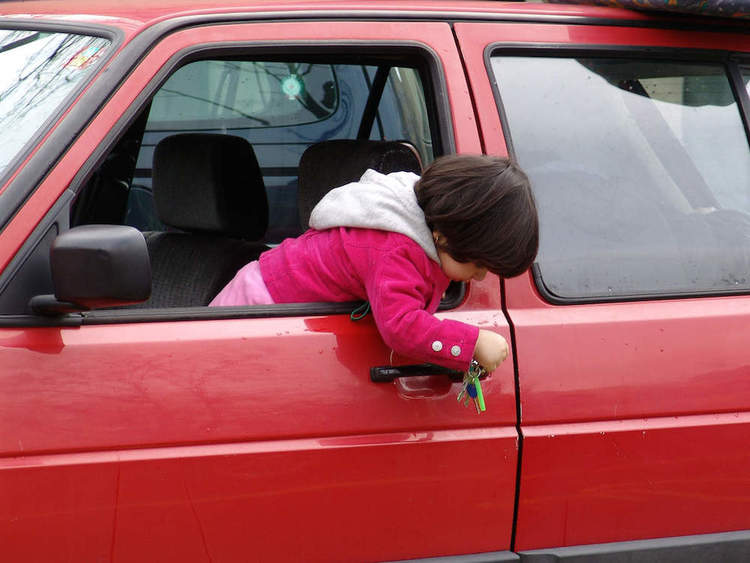
Girl in car

By Leanne Shirtliffe

I wiped my hands on my pants, climbed back into the rental car, and took attendance.

“Will?” I asked. I craned my neck in the direction of the vomit smell and saw an empty booster seat. “Where’s Will?”

Chris looked in the backseat, questioning my ability to conduct a search and rescue operation in a sedan.

“He’s not in here,” Chris said.

I comforted Vivy, who was not upset about her MIA brother as much as she was her soggy stuffed dog. Holding her hand did little to console her.

Chris exited the vehicle to expand his search field.

Through the car window, I heard him address Will in loud muffled tones. I made out the words “disgusting” and “germs,” two terms that cover 95 percent of childrearing topics.

I let go of Vivy’s hand.

“What happened?” I asked as testosterone reentered the vomit sphere.

“Will was licking the tire,” Chris said, reaching for the collection of antibacterial products he’d already unpacked in the glove compartment.

I twisted my neck to look at Will, who was struggling with the seatbelt.

“Did you actually lick the tire?”

“Yes,” he said. He had not yet learned the art of lying, blaming his sister, or farting to draw attention away from the real issue at hand.

“Why?” It was my favorite question to ask rhetorically, in a half-prayer, half-swear manner.

“I don’t know.”

“Did you pee on it, too?” Chris asked.

“No.”

I heard the seatbelt click.

“Let’s go before we have to deal with another bodily fluid,” I said.

Chris put the car in gear and merged back onto the interstate.

We arrived at the RV park none too soon. Vivy’s stomach was churning, Will was bored with my count-the-cacti game, and Chris was tired of driving with his head stuck out the window to avoid the smell of puke.

We stopped at the security gate. A septuagenarian with a clipboard limped to Chris’s window. I was pretty sure we’d just arrived at Springfield’s Nuclear Plant and were being greeted by Mr. Burns himself. Homer was nowhere to be seen.

“Where are ye headed?” he asked.

We handled this question like we handled every customs line up and security checkpoint since we’d started dating a decade ago. Chris stayed silent; I talked.

“We’re visiting my parents,” I said.

Mr. Burns raised his eyebrows. I volunteered more infor­mation, too much as was my habit. I told him the names of my parents, where they were from, how we were not staying with them but my mom’s cousin who’d gone back to Canada for Christmas. I offered to sketch our family tree on his clip­board, but retches from the back seat distracted me. It was Will, who was either imitating his sister or coughing up a fur ball from licking the upholstered seats. Vivy slept.

Mr. Burns unleashed his weapon from a holster. He was packing a walkie-talkie.

He peppered us with more questions than we had at pass­port control.

Finally, he let us through with instructions to return to the office the next morning and fill out some IRS-looking forms in triplicate.

Mom and Dad’s pre-lit palm tree leaned against their RV. We had arrived. We unloaded and I asked for the three things college students request after a night out: a bathroom, a bucket, and a beer.

Mom grabbed a pail and then cradled a gray-looking Vivy in a lawn chair.

Dad handed me a beer.

“I’m hungry,” Will whined.

“I bought cheese sticks and yogurt,” said Mom. “They’re in the fridge.”

I walked into their movie star RV, used some of my bur­glary skills to open the locked fridge, and brought Will a snack he’d eventually vomit up.

I sat down next to my dad, tossed Chris a Coke, and took the first sip of the beer I’d been cradling for the past five minutes.

We recounted the vomit fest and the negotiations that took place at the front gate. Vivy stirred, groaned, bolted upright. While still talking, I grabbed the pail and caught her puke.

I was on my way to dump the pail when I saw Will once again exploring his environment with his senses, something encouraged by his kindergarten class.

“Will you stop licking yogurt off your glasses?” I asked.

Somehow, we survived the Arizona puke-a-thon. We were all healthy for the flight home, but as good guests do, we left a gift for our hosts. My enduring memory of saying goodbye to my parents in their RV was of my mom hugging me as my dad speed-walked to the bathroom, leaned over the mini-toilet, and hurled his breakfast into the sewer. We shared everything.

Hours later, after enjoying a puke-free flight, we arrived home. The week progressed, and the few cardboard dinners I prepared reminded my family that it was a blessing that Chris cooked most of the time. It wasn’t long, though, until we had another food escapade.

When healthy, Vivy—a.k.a. Princess Squirm-a-Lot—was incapable of remaining still for anything as mundane as a meal. She didn’t sit on her dining room chair as much as use it as a pommel horse, a move she’d perfected in utero. On the chair, she squatted, stood, pivoted in a series of practiced moves, plopping down onto her chair for a rest.

“Tie yourself to the chair, Princess Squirm-a-Lot,” I said, as Chris doled out our favorite meal: mystery-meat-on-a-stick fresh from the barbecue. Chris is one of those men who enjoy barbecuing in all weather. The snowier, the better.

Vivian ignored my request. Soon, she wriggled from side to side and front to back over the surface of the chair like she was a gymnast whose score depended upon covering all four corners of the mat. And like the best gymnasts, she sometimes stumbled out of bounds. She was in the midst of informing us which of her kindergarten classmates had been naughty. Dishing out the dirt on other five year olds was a practice we encouraged as it reminded us that other people’s children misbehaved too.

“If Toby pushes one more student,” she said, “the teacher’s going—”

And poof, she was gone. She’d fallen out of bounds, off the chair. Picture the scene from Looney Tunes where Wile E. Coyote sends an anvil hurtling off the cliff heading for the Road Runner, and you have a sense of the speed at which she fell. The sound of skull meeting ceramic tile gave way to a pregnant moment of silence; then a scream was born.

On cue, Will was off, a sprinter out of the blocks. Before she could crawl back onto the chair and reach for another cube of meat, he presented a stuffed animal. “Don’t worry, Vivy,” he said. “I fall off chairs all the time.” It was a lie, the kind I liked. Maybe there was hope, at least for the children.

Excerpted with permission from Don’t Lick the Minivan: And Other Things I Never Thought I’d Say to My Kids by Leanne Shirtliffe. Copyright 2015, Skyhorse Publishing, Inc.

Photograph via tOrange.us & Creative Commons


Making the Pump Work at Work: 6 Tips for Returning To Work After Maternity Leave

Vintage breast pump

By Gina Ciagne

Congratulations! You’re a mom who’s heading back to work, breast pump packed, after a few weeks or months spent at home with your newborn. Here are some tips to make it a win-win-win situation for you, your baby and your employer.

1. Make a connection. Every breastfeeding mother has a story about what worked for her when she returned to work. If you know other women who have pumped at work, talk to them about their experiences and solutions to any challenges they may have had. You can also connect with other mothers on breastfeeding message boards.

2. Find time to pump. Plan your pumping schedule to replicate your baby’s nursing times, so that your body gets the necessary signals to continue producing milk. Avoid skipping sessions, as this signals your body to produce less milk.

3. Be flexible, but don’t neglect your breasts. Consider your employer’s needs, as well as your own. Even if you only have a few minutes, still pump and don’t skip a session, if at all possible.
It will be uncomfortable as your breasts fill with milk, and regular stimulation is more important for your body’s response than pumping time. However, a drained breast will replenish more milk, so ideally pump until your breasts are noticeably less full. Set aside time if your schedule is unpredictable, or be creative about when you pump. For instance, it’s possible to read or eat lunch while pumping especially when using a hands-free pumping bra.

4. Find a private place to pump. It’s important to pump without disruption, so that the necessary hormones are released for let-down. Having a lactation room at work is ideal, but other options are a private office or storage room that can lock. Avoid using the bathroom, as it’s not a sanitary place to pump.

5. Discuss the situation with your employer. It’s important to explain your need to have regularly scheduled pumping sessions to your employer. And remember, The Affordable Care Act is on your side! This healthcare law stipulates that an employer must provide the time and space for pumping moms.  And, by the way, it specifically points out that the “space” should not be a bathroom. For more details, you can visit The Department of Labor’s website.

6. Know your facts. Hopefully, you won’t run into any obstacles with your employer.  But if you do, the following facts can help you make a convincing argument to gain support. A study published by the United States Breastfeeding Committee states:

  • Lactation programs are cost-effective, showing a $3:1 return on investment.
  • Breastfeeding lowers insurance claims for businesses. One study showed that for every 1,000 babies not breastfed, there were over 2,000 extra physician visits, 212 extra hospitalization days, and 609 extra prescriptions to treat just three common childhood illnesses.
  • Overall, by supporting lactation at work, employers can reduce turnover, lower recruitment and training costs, cut rates of absenteeism, boost morale and productivity, and decrease health care costs.

We know that pumping takes extra effort, especially at work. But it can be worth it for your baby, for you and even for your employer!

Gina Ciagne, Lansinoh’s Global Vice President, Healthcare Relations is a nationally recognized expert on breastfeeding.

18th c. image of breast-pump and nipple-shields, Pierre Dionis, via Creative Commons

Summertime Siblings: What’ll It Take to Stop the Bickering?

by Lela Nargi

You’ve spent the better part of the school year taking deep, cleansing breaths as your kids nagged and picked at each other. You sipped (or guzzled) wine in a search for calm as they battled for supremacy over who would get the coveted first shower after soccer practice. You intervened gently—and sometimes not so gently—as they attempted to strangle each other on the living room floor. And now summer is almost upon you: two months in which you hope against hope for peace and quiet and tolerance. Can it be done? Do you dare to dream? And what’s it going to take to get there?

The answer might very well be signing your kids up for separate camp activities—even if it means extra time and effort on your part to shuttle them around. “In an ideal world,” says Kimberly Lemke, a Chicago-based licensed clinical psychologist specializing in children and adolescents and author of I Just Don’t Get My Parents’ Rules, “you’ll put them onto a summer sports team together and they’ll become the best of friends. In reality, that’s not how it goes. First and foremost, you need to ask yourself what each child needs.”

Siblings fight for all kinds of reasons, a big one of which is to assert their individuality. For example, says Lemke, “You might have one child who has self-esteem issues, who compares herself to her sibling and says, ‘She’s always better, I’m going to fail.’” This, she maintains, is a perfect example of when siblings might benefit from time spent apart. “It limits comparisons,” she says, and as a result, conflict. Which in turn leads to less stress for you.

Separating kids in the summertime can lead to enhanced self-esteem in more ways than one. Lemke, who is mother to 4-1/2 year old twins who are always together in school and afterschool classes—and actually like it that way—concedes that sometimes, it’s better to push kids to do things away from each other. “It can be uncomfortable for them to be separated, but a little anxiety is good,” she says. “It lets them practice social skills rather than parenting each other.” But she also warns that separating kids who really want to be together can lead to a power struggle, between them and you.

In this instance, it’s important to let children know the situation is temporary—one month spent apart doing separate activities they’re each good at or have expressed interest in, one month together. “This is a more manageable strategy than just forcing them to do things without each other,” says Lemke. “Tell them, ‘I think it’s wonderful for you to want to share your time with your brother. And I also think this art class looks really cool. Let’s give it a shot, then we can go back to doing something together.’”

Got kids who squabble but don’t have the time or energy to split them up? It’s not always necessary. Some scuffling siblings know inherently what they like and are good at and fight, not for validation, but to get your attention, for example. Remove you from the equation and the squabbling becomes a non-issue, which means kids like these can benefit from being signed up for the same activity—and you score a carefree, one drop-off suits all scenario. Says Lemke, “Individual players know how to engage on their own, and how to enjoy activities on their own. So when you sign them up together,” they’re perfectly comfortable going off to their separate corners to read or talk to other kids. When group activities force them together, without you around they can learn to problem-solve their own conflicts, and this “actually helps to build their relationship,” says Lemke.

Don’t expect the miracle of temporary sibling detente to seep into the pre- and post-camp hours, though; as soon as you and your partner are back in the picture, conflicts are likely to rear up all over again. To counteract this, Los Angeles mom Abbie Schiller, founder of the parenting site The Mother Company, which produces The Siblings Show, recommends attempting to minimize power struggles before they even get off the ground. And to figure out what role you might be unconsciously playing that keeps them going. “One of the things our generation was told was that our parents loved us the same,” Schiller says. “That’s a mixed message. Children are inherently different and when you tell them you love them the same, you set them up to constantly try to catch their parent in an inequity: ‘You gave him two hugs!’ But if you set it up that you love them differently, they stop looking for a-tit-for-a-tat; you eliminate competition.”

Lemke says you can downplay siblings’ inherent competitiveness by getting them to work together to reach a common objective. Each time you see them engage appropriately in a shared activity, reward them with something like a marble. After they’ve accumulated 20 marbles, the whole family gets to go out for a special dinner, or a trip to a water park. “Having a goal helps you direct their behavior, rather than just crossing your fingers they’ll act appropriately,” says Lemke. “But I tell parents, for this to be successful, they’re going to have to be very creative and catch the small behaviors. If your kids are walking through the door screaming at each other but one holds the door for the other, and the other one walks through calmly, ignore for a moment the bickering and say, ‘That was really kind of you to hold the door for your brother like that, and great job walking through the door without shoving.’ Once you start rewarding them both, they realize they can get attention that way, and they have a common mission.”

Much as you might all desire it, working parents don’t always have the luxury of taking time off in the summer months. But this doesn’t mean quality family time is out of the question. Says Schiller, after a day of work and camp, “You can combat the attention needs of your kids by giving them special time as often as possible.” Adds Lemke, five minutes of concerted, present time without you checking your phone for messages, is preferable to 20 minutes of distracted time. Let your child decide how to use your minutes together—snuggling, reading a book, doing a puzzle; then do the same for your other children. Says Schiller, “This makes them feel secure and lets them know you have enough love in your heart to go around.”

Lemke asserts, those concentrated minutes of together time will really add up: to a summer in which each child is reinforced, and reassured, and successful—positive feelings that will hopefully see you well past Labor Day, into autumn and beyond.

Photograph via Creative Commons

Don’t Stress The Homework: We Bust 3 Myths to Show You How

Girl doing homework

By Barbara Dianis

Homework is an integral part of the journey to be educated for students everywhere. But it can cause tremendous arguments when three misunderstandings and misconceptions are prevalent between parents and their children. To clear them up, here are suggestions for making homework more productive and peaceful in your home!

Myth #1: I can’t make my child focus on homework time without making it an endless endeavor.

Truth: The ability of parents to keep kids focused during homework time starts with creating a daily schedule. Look over homework assignments together and decide how long each assignment should take to complete. Write this lightly in pencil at the top of the assignment. You can then determine appropriate breaks—which help improve focus—after one-half of each assignment is completed at an average or above-average level. Each small break can be given in 2-5-minute segments until the homework is completed.

Myth #2: Homework is totally my child’s responsibility and I shouldn’t intervene.

Truth: Generally, the purpose of homework is to help kids master skills on their own at each grade level. In order for it to be effective, though, it needs to be done correctly so learning gaps don’t result. If it isn’t, you may need to give assistance, going over lessons with your kid to make sure he understands what he’s meant to actually learn.

Myth #3: My son’s teacher says he is not consistently turning in his homework, but there’s no way for me to constructively help him to do this.

Truth: Turning in homework is an organizational and executive management skill with which numerous students struggle each year. One easy remedy is to have your kid file all of his completed homework in an accordion-style file folder that has marked spaces for each class. Back this up by placing a sticky note on his agenda book with a reminder to turn in his homework for each class. At the end of each school day, check to see if the homework folder has been emptied.

Barbara Dianis, MA ED, is the author of Grade Transformer for the Modern Student.

Photo via Shutterstock.au

How to Have Actual Fun on the Family Road Trip

Cars stuck in traffic

By Meghan Khaitan,  MyBuckleMate.com

Pretty much every family takes a road trip by car with their kids during the  holidays. And whether those kids are toddlers or teens, the actual trip itself  can be a wonderful bonding and learning experience for the entire family.  With a little forethought and preparation, you can sidestep the dreaded travel  fiascos and keep everyone content through through those stretches of  highway!

1. Make it a Fun History Lesson. Build some excitement around your trip by getting together as a family a  couple of weeks beforehand to plan your road trip path with an old-school paper map. Talk to kids about  the different cities and states you’ll be driving through. Then jump online together and do a little research  on a few that look interesting. Learn about their history and pick some prime sightseeing destinations.  This opens your trip into a journey of exploration—all the more inspiring if you give kids a disposable  camera they can later use to make a trip scrapbook.

2. Expect the Unexpected. Keeping a first-aid kit and tools for a flat tire in your car is a no-brainer, but also be sure to bring along items like a flashlight, garbage bags, paper towels, big pack of wet wipes, and cell phone car charger. If you have young children that are new to potty training, it’s a smart idea to also pack a portable plastic potty in case your little one can’t wait for the next rest stop. Kids also tend to rest better with a few items from home, like a stuffed animal and blanket. You can also pick up an inexpensive travel pillow to make car-sleeping more comfortable.

3. Pack Healthy Snacks & Drinks. Truck stops, gas stations and fast food joints are okay in a pinch, but if you bring a cooler filled with your own healthy foods, you will save time and money on the road. Think granola bars, sandwiches, fruit and nuts, yogurt tubes, pretzels, cheese and crackers, baby carrots, packs of sliced apples, cereal bars, and any of the (non-sticky) foods your family usually likes to nosh on.

4. Create a Road Trip Adventure. Instead of just looking at the trip in terms of its end destination, make the whole trip an adventure. This will give the kids something to look forward to and break up the travel time. Take a family selfie in each city or state in front of a sign with its name or something it’s famous for. Also look for rest stops with playgrounds where kids that can burn off some pent-up energy.

5. Make Each Child a Travel Activity Kit. To help pass the time, buy inexpensive totes and pack them with things like new crayons, coloring books, story books, white boards, magnetic travel and card games, and other small games or toys, like Matchbox Cars and small dolls. Anything that’s inexpensive and new to your kids is sure to please—both of you.

6. Check Out At Your Local Library. Before you embark,  head to your local library and check out DVDs, books on CD, and chapter book collections for your older reader. They’re free! You’ll have new movies to watch that your kids haven’t seen yet, and when quiet time becomes mandatory for saving your sanity, put in a book on CD for the entire family to enjoy.

7. Don’t Forget the Electronics. If ever there was a perfect time to bust out the electronics, the  car trip is it. Load up iPads and Kindles with new apps, books, and movies, making sure you put different apps on each child’s device so they can swap with for more options. And whatever you do, don’t forget the headphones! A few of my family-favorite apps: Waze (the superhero of navigation apps for parents), RoadsideAmerica (find the weird and wonderful across the U.S.), Tales2Go.com (the Netflix of audio books), MadLibs (old school road trip fun meets the digital age), and VisitedStates (kids can mark the states they’ve been to and upload photos they’ve taken).

8. Pack Classic Travel Games. Electronic games are fun, but don’t forget about the old school travel games to help fight boredom on the road: I Spy, 20 Questions, The Alphabet Game (work together as a family to find things along the road that start with each letter of the alphabet), Who Am I? (take turns trying to guess the famous person in history or pop culture), and the good old License Plate Game.

9. Pick Mile Marker Treats. If you’re okay with a little bribery, plot a few places on the map for the kids to get special surprise treats. Among other things, this will encourage them to learn to read a map. The treat can be something small, like sweets or a little something they can play with in the car. The only requirement to earning them is that kids be kind, get along with each other, and be patient for the trip. You might be handing out fewer of these than you’d feared!

10. Consider an Overnight Stay. If the trip is long enough, consider an overnight stay halfway through at an affordable hotel with a pool. If you book the stay right before you leave or on the way, you’ll find the best deals.

Photograph by Nabeel Syed, via Unsplash

News You Can Use: Lighten Up! Humor Helps Kids Learn

Boy

By Dawn Van Osdell

A team of French scientists has reported in the journal Cognition and Emotion that laughter doesn’t just make us feel good. It also helps us learn.

The researchers, led by Rana Esseily, who studies emotion, developmental psychology, and cognitive psychology at Paris West University Nanterre La Défense, studied a group of 18-month-olds—roughly the age when humans develop a sense of humor—to determine whether toddlers’ cognitive abilities improve when laughter is involved. They designed an experiment where each tot observed an adult using a tool to grab an out-of-reach toy. In one group, the adult simply played with the toy after retrieving it. In a second group, the adult threw the toy immediately on the floor, which made half the kids in that group laugh.

The researchers found that 94 percent of the tots who laughed at the antics of the adults were able to repeat the action themselves more successfully than those who didn’t laugh, as well as those in the “humorless” control group.

Why laughter seems to be linked to learning isn’t entirely clear, but Esseily and her team cite two possible explanations. The first relates to temperament. “In this case, it is not humor per se that may have facilitated learning, but [that] temperamentally ‘smiley’ babies were more likely to engage with the environment, and therefore to attempt and succeed at the task,” says Esseily. She suggests that “laughing babies” may have higher social skills or cognitive capacities, allowing them to interact more easily with others and making them more amenable to mimickery.

Esseily’s second explanation relates to brain chemistry. It is well known that positive emotions, such as laughter, can increase dopamine levels in the brain, which in turn has a positive effect on learning.

Though more research is needed to determine the extent of the relationship between laughter and learning, there’s ample reason to keep your kids giggling: it’s fun for all of you! Plus, they just might learn something from it.

Photo by Barry Lenard via Compfight

Making Sense of Screen Time: Is It Really So Bad for Our Kids?

download (40)

By Dawn Van Osdell

There’s a lot of contradictory and downright erroneous parenting info floating around out there. We’re not afraid to tackle it head-on!

It’s been drilled into our heads that allowing our kids to watch too much television or play apps and games will rot their growing brains. Over and over we’ve heard from various experts that screen-time overload keeps kids from necessary active or outdoor play, limits human interactions that are critical to proper development, and exposes kids to violence and content that is too mature for them to properly process.

While there’s truth in all of this—families are wise to heed the American Academy of Pediatrics’  recommendation to limit kids’ screen time to no more than two hours per day— it’s also important to recognize the educational and developmental benefits that kids can glean from technology, including better hand-eye coordination, school readiness, and boosts to cognitive development.

To help us dispel common myths around our kids’ use of tech (and ease a little of our guilt about handing over our iPhone), we spoke to Jordan Lloyd Bookey, a mom of two and co-founder of Zoobean, a service that helps families locate children’s books and apps that are worth their time. A former Google employee, Bookey is passionate about tech innovations, and an expert at making smart media choices on behalf of kids. Here she shares her advice on how to create a healthy media diet, and use it to enrich childrens’ ever-curious minds.

Myth #1: Kids should be doing something active or imaginative rather than relying on technology for entertainment.

Truth: Active play and socializing with family and friends should be an integral part of your child’s life, but there’s an important role for technology to play, too. “We just need to remember that all screen time is not created equal,” says Bookey. “It’s about the content and how your child is engaging with it.” You can plop your kids in front a television or a tablet to watch a cartoon or play a game while you’re getting ready for the day—essentially, using the device as a babysitter, which every parent does on occasion. Conversely, you can use technology as a powerful way to engage with your kids. According to Bookey, “It can give us opportunities to co-play together—to ask questions and help kids develop and process a deeper meaning from what they are seeing.” Build a healthy media repertoire that consists of quality, parent-approved content, to balance the occasional just-for-fun cartoons and games with interactive experiences for both of you.

Myth #2: Kids have to choose between inside screen time and outside play.

Truth: “Technology can be an excellent complement to outdoor play,” says Bookey. It can enhance outdoor exploration, spark kids’ curiosity, and get them excited about learning about their surroundings. Using technology outside can be as simple as taking a minute to look up questions about the world around them—for instance, Why do ants build hills? Or why are there so many worms out after it rains? You can use a smart phone to document finds or visit websites like National Geographic to dive deeper into the topic, exploring where insects live, how big they get and what they eat. Apps like the National Park Field Guide act as guide books; others, like Munzee, can be used to initiate a scavenger hunt; and Leafsnap is fun for identifying trees. For kids living in urban environments, technology can provide a window into a bigger world, allowing them to explore and experience nature beyond just a park or green space.

Myth #3: Playing on the computer, iPad, or Mom’s phone is a mindless activity to pass the time, and it’s addictive!

Truth: Every parent should have their own rules about the use of technology at home—setting boundaries on content, restricting devices from the dinner table, and forbidding it before bedtime, for instance—in order to ensure that kids get plenty of human interaction. “If you let kids overload on technology, they are going to miss out on developing good communication skills and building their emotional IQ. But, if you find a balance and allow its use in moderation, you can help your kids embrace new skills that are hugely beneficial,” says Bookey. For instance, kids are often more willing to take risks and make mistakes when playing apps that help them practice math, reading, and writing skills. “Apps are non-judgmental,” says Bookey. “No one knows if a a kid messed up an answer, so they’ll keep trying.” Games like the eternally popular Minecraft can help kids build analytical thinking and drive creativity. “Think of technology like food,” says Bookey. “You want your child to know what’s good for him—to know the difference between a chocolate chip cookie that’s okay in moderation, and healthier alternatives that he should choose more often; and you want him to be able to make smart decisions when choosing between the two.” As with any diet, it’s all about creating a balanced mix.

Photograph by William Iven

Carina Tannenberg Wants to Demystify Poop for American Kids and Parents

Carina Tannenberg

By Lela Nargi

Carina Tannenberg is the owner of online shop Sweden Toys, which brings a whole host of adorable, educational Scandinavian playthings to American tots.  But perhaps none of the shop’s offerings is quite as…unexpected as its duo of plushies called Pee & Poo.

You read that right: Pee & Poo plushies, meant to lift some of the mystery for kids from the always tedious and challenging event of potty training. Here, Tannenberg, not a mom herself but doting auntie to Maya, age 10, and Noah, age 8—they call her their “extra mom”—talks about what she sees as some critical differences between raising kids in the U.S. and raising them in her native Sweden.

Where did you grow up, and when did you move to the U.S.? I moved here in 1996 to go to film school. I currently live in LA’s Westwood area, where I’ve been for the last 15 years. There are some similarities here to back home in Stockholm: I live in a residential area in a big city. I think it’s a good place for kids to grow up, but it is not as free here for them. My niece, Maya, rides on the Stockholm subway by herself or with friends. I think that shows a lot about the difference in how we perceive a child’s maturity.

What are some of the differences you’ve seen between Swedish and American parenting styles? I know many of my Swedish friends who are parents feel locked into all the rules. But in Sweden you can easily have a career and be a mother. Here, it is very difficult, as schools seem to expect mothers to spend a lot of time with the school’s programs, as if they have a free schedule.

I also see is how important it is for kids to see that they can do things for themselves; being so dependent on their parents, as they must be in LA to get everywhere, can prevent them from evolving freely. I would add that there is a gender difference that is imposed more here than in Sweden. We are very careful in Sweden not to impose our ideas on our kids, and to try to let them learn and grow freely.

What’s your background, and how did you get involved in selling kid’s toys?I have a degree in Building Engineering from a university in Stockholm, Art and Graphic Design from a university in Paris, and Film Producing and Business from a school here in LA. Overall, I am interested in design and wellbeing, but especially for kids. I have Swedish friends who have designed these amazing products, and I wanted to get them out there.

The response to Pee & Poo has been great! I believe that even at a very young age, kids like to learn responsibility. I think this is why they love dolls and puppies so loved much—caring for them is in our nature. Once we find that teddy bear we love, we become very involved and “listen” very carefully to what it needs. With the Pee & Poo characters, we can get the child’s attention and explain how Pee & Poo needs to go to the potty and not in the diaper. We will also soon come out with Apps for Pee & Poo potty training, so that the child can be part of a rewarding program for their potty visit.

You are a breast cancer survivor. How has this changed your perspective on what you do? I was diagnosed in 2010 and I have been clear for 5 years, so I can call myself “cancer free!” I have always been interested in health and wellbeing—both physical and mental, they go together. I believe this interest started at a young age, so working with kids and health makes my life so exciting.

Going through cancer was life changing. When you don’t know if there is a tomorrow, you let go of all of your expectations and start to look at life as new again. Everything in front of you becomes a blessing because you no longer can expect anything—like a child; children are so excited about everything. It’s amazing to be able to have that again as a grown.

Tips for Helping Your Teething Tot

Teething can be a difficult time for both babies and their caregivers. You can help a little one through the process by knowing what to expect, how to spot the telltale signs and by following helpful tips for easing discomfort.

image via mass distraction, flickr

What to Expect

Since babies can’t tell us what’s going on, parents are often left wondering why their normally content baby is cranky or fussy. Knowing when to expect new teeth will help to know if teething is to blame for the discomfort.

Teething typically begins as early as 3 months with your baby’s first tooth starting to push through between 4 and 7 months old. The first teeth to appear usually are the two bottom front teeth, also known as the central incisors. They’re usually followed 4 to 8 weeks later by the four front upper teeth (central and lateral incisors). About a month later, the lower lateral incisors (the two teeth flanking the bottom front teeth) will appear. Next to break through are the first molars (the back teeth used for grinding food), then finally the eye teeth (the pointy teeth in the upper jaw). Most kids have all 20 of their primary teeth by their third birthday.

Signs to Watch For

When your baby is cutting a tooth, she may experience any or all of these symptom and sometimes none at all.

  • Drooling more often than normal
  • Desire to chew on things, such as your finger, a toy, blanket or clothing
  • Periods of irritability or crankiness
  • Crying spells
  • Disrupted sleeping or eating patterns
  • A slight rise in temperature due to swollen gums

According to the experts, some babies feel no discomfort at all while teething and others are quite uncomfortable throughout the process. If your baby is unusually fussy, talk to your doctor.

Tips and Toys for Easing Teething Pain

  • Wipe drool to prevent skin irritation.
  • Offer a cold, wet cloth for baby to chew on. While a few minutes in the freezer will make the cloth cold enough to provide some relief, freezing it too long can cause irritation to your child’s gums.
  • Gently massage gums with a clean finger.
  • Give baby a chilled teether, such as this one MAM that has a handle that won’t get too cold to hold.MAM BPA Free Cooler Teether, Toys R Us
  • Offer a teething necklace. Chewable necklaces and jewelry, such as Chewbeads have been popular. The latest trend in teething necklaces is Amber Beads, reportedly safe and naturally soothing for gums.Chewbeads, Amazon
  • If she’s eating solid food, offer frozen food, such as a banana or peach. Munchin Fresh Food Teether allows you to put the frozen food in an enclosed mesh bag so you don’t have to worry about your baby getting too big of a piece in her mouth.

Munkin Fresh Food Teether, Diapers.com

  • The famed Sophie the Giraffe. Why is this rubber toy so popular…and why pay $20 for a chew toy? Sophie is made of all-natural rubber that feels great on the gums, squeaks to keep baby entertained, and even comes in a Vanilla scent that is said to sooth.Vulli Sophie the Giraffe Teether, Amazon
  • Try more than one teething toy, as all babies are different and may find toys some more comforting than others.
  • Ask your doctor about giving baby pain reliever, such as Advil or Tylenol for babies.

Teething is no fun for babies or those who care for them, but knowing what’s coming and how to ease the pain can make the process a lot easier on both of you. Make sure you tell your sitter if your child is cutting a tooth, and share these suggestions for soothing a sore mouth.

5 Tips from Working Moms on Managing Child Care

working mom
It’s the most wonderful time of the year! No, we’re not talking about the holiday season, but rather the back-to-school season! For many working moms who struggled to cover child care over the summer, sending the kids back to school can be a welcome sigh of relief. But even if you have kid care covered during school hours, you may still have to scramble to cover child care for after school hours or if your little ones are too small to be in school yet.
 

Here are five tips from working moms themselves on how to manage child care—and how to control the back-to-school chaos.

Determine your needs.
No two working mom’s child-care needs are alike. Some may need full-time coverage, while others just need someone to watch their child a few hours sprinkled throughout the week. So go over your schedule as well as your partner’s to decide exactly how much kid care coverage you actually need. By being very specific in determining your needs, you can potentially save yourself a lot of money—and frustration—in the long run.

Find child care that works for you.
Not all child care is created equal. Depending on your child’s age, you may discover that certain types of child care work better for you and your family than others. For example, if you have a baby, you may opt to have an in-home nanny stay with you while you work to avoid exposing your little one to icky germs. As your child gets older, socialization may be what you’re seeking, so you may want to enroll your child in a local day care. And if your kid is school-aged, a part-time sitter may do the trick to cover those extra hours until you’re done working for the day.

Score a flexible schedule.
If you thought working from home meant that you’d never, ever need child-care coverage again, well, think again. Having a flexible schedule does mean that you can creatively cover child care more easily than your in-office colleagues, though. You may find a telecommuting position that allows you to work around your children’s schedules (i.e., early in the morning or late at night) or right smack in the middle of the day—when kids are in school. Other work-at-home-moms (WAHMs) may find that doing a kid swap on certain days helps to take care of child-care coverage issues without costing a pretty penny.

Once you’ve got child-care coverage established, it’s time to start planning how you’ll prep for getting kids ready for back to school.

Do a run through.
If it’s possible, see if you can attend a tour of your child’s school. Point out the different rooms (such as Art or Language Arts) that your child will be going to. If your kid will be going on the bus, you can drive him along the bus route so he can get used to the ride. That way, the new school year won’t seem as scary.

Prepare ahead of time.
Nothing adds to the stress of a back-to-school morning like leaving everything for the morning! So try to get as much done as you can in the days prior and even the night before. Have outfits ironed and ready to wear, and pack lunches and store in the refrigerator. By having most of the prep work done prior, you’ll minimize the stressfulness of the morning and have both you and your kid calm and ready for a fun school year!


Jennifer Parris is a Career Writer for FlexJobs, an award-winning service that helps job-seekers find professional opportunities that offer work flexibility, such as telecommuting, freelance, part-time or alternative schedules. To learn more about Jennifer, visit FlexJobs.com or tweet @flexjobs.

Looking for a babysitter or nanny? Join UrbanSitter to browse profiles, sort by pay rate, and book jobs online.