
Childcare Jobs: The 6 Most Popular Types of Caregivers

childcare jobs

Childcare jobs come in a wide range of different capacities. Whether you’re a parent determining which type of childcare is right for your family or a caregiver deciding what sort of childcare job you’re looking for, it is essential to understand the differences in order to make the right choices for your preferences and lifestyle. Here are some of the most common types of caregivers.

Types of Childcare Jobs

  1. Au pair
    An au pair is a young adult from a foreign country who lives with a family and helps to care for children and do housework in return for a monetary allowance (and the opportunity to learn the family’s language and culture). An au pair will almost always reside in the family home and be treated as another member of the family. Au pairs are enrolled in post-secondary education and their labor is regulated by the Department of State. Hiring an au pair requires extensive commitment on the parts of both the au pair and the hiring family. The process sometimes requires a large sum of money up front, and employers may be expected to provide healthcare and transportation to au pairs during their stay. In exchange, the family will benefit from exploring a new culture and exposing their children to the world from the convenience of their own living room.
  2. Babysitter
    A babysitter is a caregiver who comes to a family’s home to watch children for a limited number of hours or sometimes overnight. Some babysitters work out of their own homes. Most are hired by families on an occasional basis and are paid an hourly rate. More often than not, babysitters work for many different families as their schedules permit. While babysitters’ ages fall into a wide range, all sitters on UrbanSitter are at least 18 years old.
  3. Doula
    A doula is hired to help provide comfort and care to a woman and her family before, during, and/or after childbirth. A doula attends births and imparts constant emotional and instructional support during labor. Doulas are trained professionals, but are not doctors. Usually a doula’s job is done once the baby is born, although some doulas offer breastfeeding instruction, night nurse services, and even postpartum care for a period after the birth.
  4. Mother’s helper
    A mother’s helper is a pre-teen or teenager who is not yet experienced enough or old enough to watch children alone. A mother’s helper may be a neighbor, relative, or other acquaintance of the child’s parent(s) who has expressed an interest in babysitting or caring for the child(ren) in the home. A mother’s helper may be paid or unpaid, but a parent is present for the duration of the caregiving period in order to give guidance and/or supervision. Sometimes mother’s helpers are hired to do light chores around the house or run errands in addition to (or in place of) watching children.
  5. Nanny
    A nanny is hired for a set period of time and is usually given a regular schedule, and may reside in the family’s home (“live-in”) or travel to the family’s home for shifts (“live-out”). Nannies are paid an agreed-upon salary at regular intervals, and most nannies consider childcare their full-time work obligation. However, some are employed part-time according to the family’s needs and are able to take on outside work.
  6. Night Nanny
    A night nanny may be the perfect solution for families with newborns. These caregivers generally come to the family’s home after dinner to help with the new baby’s bedtime routine and provide support to the family overnight, whether rocking a colicky baby back to sleep, heating a bottle and handling night feedings, or helping soothe toddlers back to sleep after a newborn’s cries wake everyone in the house. Parents of multiples may find night nannies especially helpful. Night nannies are usually hired for a short period of time after a new baby arrives, to help a household adjust to their new overnight routine, allow families to get a little extra sleep, or to give new parents nighttime guidance. Some night nannies may have nursing experience as well.

UrbanSitter is an excellent resource if you are looking for childcare jobs or childcare solutions. Good luck in finding your perfect fit!

On How to Babysit (by Someone Who Knows)

This post was written exclusively for UrbanSitter by resident sitter blogger, Erika Hanson.

I have been babysitting off and on since high school.  Below are a few of my learnings on what it takes to be a successful babysitter.

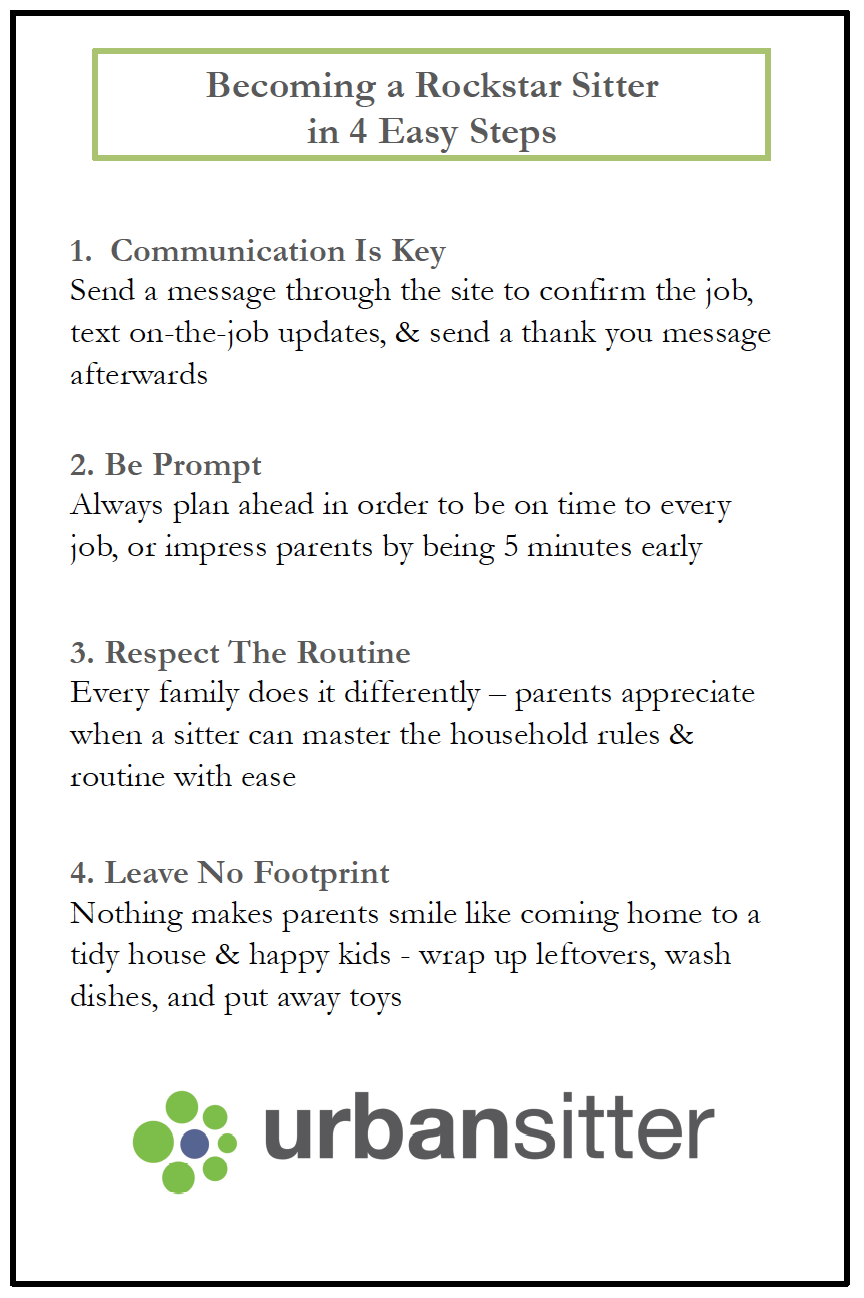
1. Be engaging. Have fun and be in the moment. Children can quickly gauge when you are not in a mood to hang out with them. Find a way to make it so that the kids enjoy your presence. Always listen and play in an effort to be engaging.  Never sit and ‘be boring’.

2. Don’t Afraid to Bargain. Kids try and get away with everything knowing you are not their parent. For example:

Child: I always drink soda for dinner.

Me: Really? I’ll have to ask your mom about that. How about some juice or water? If you eat your broccoli and drink your water, we can play Candy Land. Deal?

Child: Okay!

When all else fails, explain that you may have to tell their parent if they don’t start following the rules.

3. Mix up the routine. Teach a new game. Make a new craft. Fix a new snack. Tell a new story. You get the idea… incorporate something new into the child’s life. This serves as a distraction for those children who might be missing their parents, engages those who think they are not particularly excited about having a sitter, and makes sitter time fun.

4. Be consistent and clean up. Children need to build trust with you, but parents also need to know that they can count on you. So be consistent — don’t flake at the last minute, give a general sense of your availability and promptly respond to any sitting requests. Tidy up after yourself and the children, and if the mood elicits, leave the kitchen cleaner than when you found it.

5. ‘Read’ the parents. Be able to give a quick synopsis on how the time was spent. Different factors are important to each parent; parents of babies need to know about food and sleep schedule, while parents of older children are more concerned about behavior and level of fun.

6. Remember to have fun!  

Are you an experienced babysitter looking for jobs? Build a free profile at UrbanSitter and start getting jobs today!
Sitter’s Perspective: Why I babysit

UrbanSitter logoContributed by Erika, an UrbanSitter babysitter and author of blog, Sunshine & Sparkles.

Albeit a bit strange to some, I choose to babysit for ‘fun’. I see it as a hobby–I love playing with kids and see no harm in making a few extra dollars. Thanks to my dual immersion in San Francisco start-up culture and the babysitting world, I met the founder of and now use UrbanSitter, a child friendly San Francisco start-up.

UrbanSitter is a “linked in” version of babysitting, a way to see who both you and your friends know in the babysitting world. Its aim is to provide a network of sitters so that parents do not have to go to unnecessary lengths to find a trusted someone.

In a culture receptive to and alive with social media, this site has done very well for itself, just having received $1.75 million in funding. Word has spread like wildfire and the site has become extremely user friendly. It is slowly growing its user base which is subsequently increasing its credibility.

I only babysit on occasion, but have still been able to make good use of the site. I find it slightly exciting to be contacted by a random someone, to then meet them for a casual introduction and finally to babysit their children. I spent the past six months babysitting for a family who has since moved back to London–it can be said that we met by chance and with no expectation, but the relationship built and fun had became surprisingly worthwhile.